
As the bells of St. Peter’s Basilica echoed across a tense and divided world, a different kind of alarm was rising behind the Vatican walls — not one of warheads or armies, but of algorithms, artificial intelligence, and a future spiraling beyond human control.
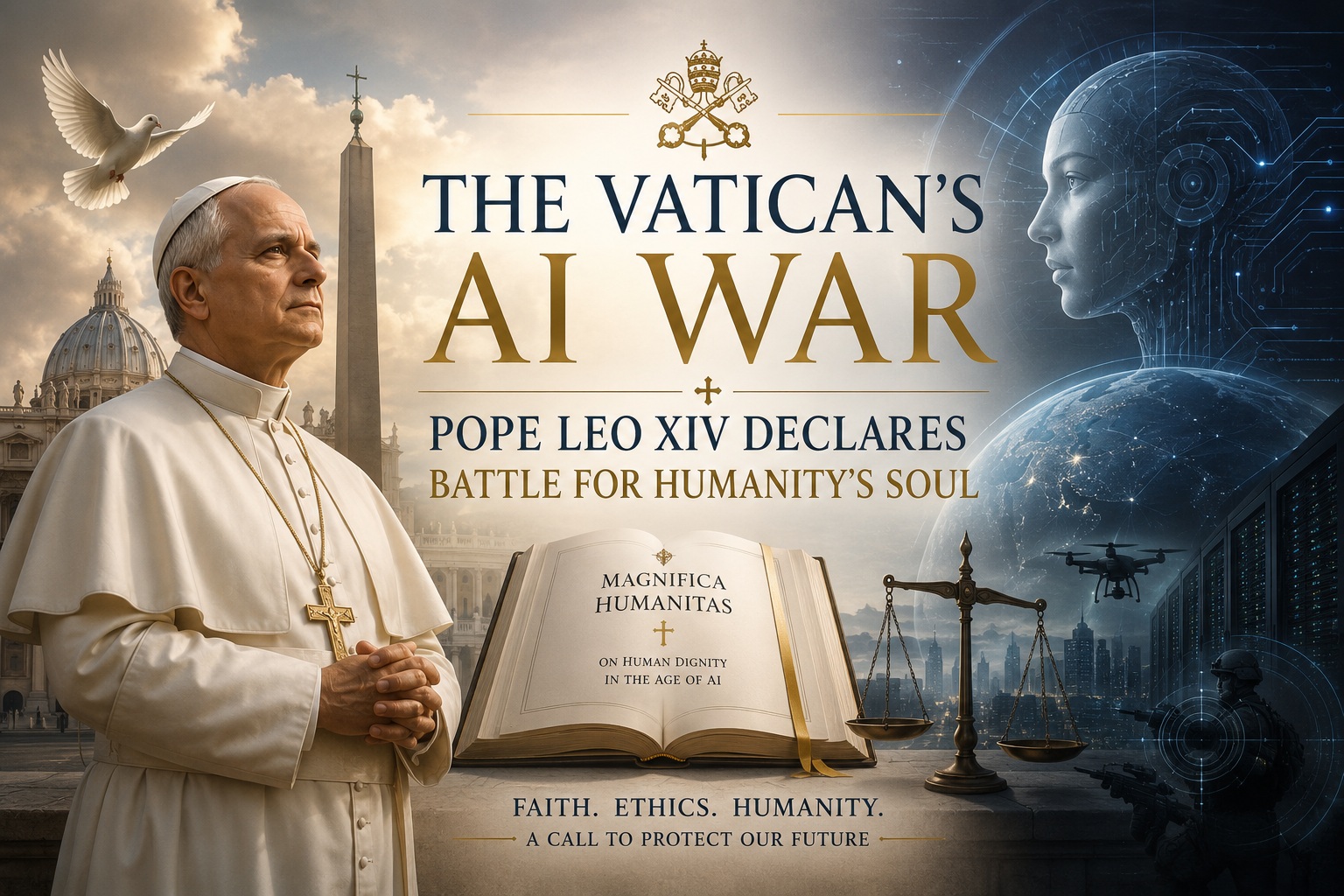
On May 25, the Vatican will unveil what insiders are already calling one of the most explosive papal documents of the modern era: Pope Leo XIV’s first encyclical, Magnifica Humanitas (“Magnificent Humanity”), a sweeping declaration on the fate of human dignity in the age of AI.
But this is no ordinary religious statement.
It is shaping into a global confrontation between the moral authority of the Catholic Church and the ruthless technological race now dominating world powers, Silicon Valley giants, and military strategists alike.
At the center of the storm stands Pope Leo XIV — the first American pope — a mathematically trained intellectual who believes artificial intelligence may become the defining existential crisis of the century. According to Vatican insiders, Leo sees the AI revolution as the modern equivalent of the Industrial Revolution that shook humanity 135 years ago, when Pope Leo XIII issued the historic Rerum Novarum, defending workers against unchecked capitalism.
Now history appears to be repeating itself — only this time, the machines are learning.
And the Vatican is preparing for battle.
The dramatic launch event inside the Vatican’s main auditorium will feature some of the Church’s most powerful figures alongside one of the world’s most influential AI minds: Christopher Olah, co-founder of Anthropic, the artificial intelligence company that has openly challenged unrestricted military use of AI systems.
His presence beside the pope is being viewed as deeply symbolic — and politically dangerous.
Anthropic has already clashed with the administration of Donald Trump after refusing to fully cooperate with U.S. military AI demands. The company was reportedly punished with sanctions and restrictions after resisting what it described as attempts to weaponize its technology without ethical safeguards.
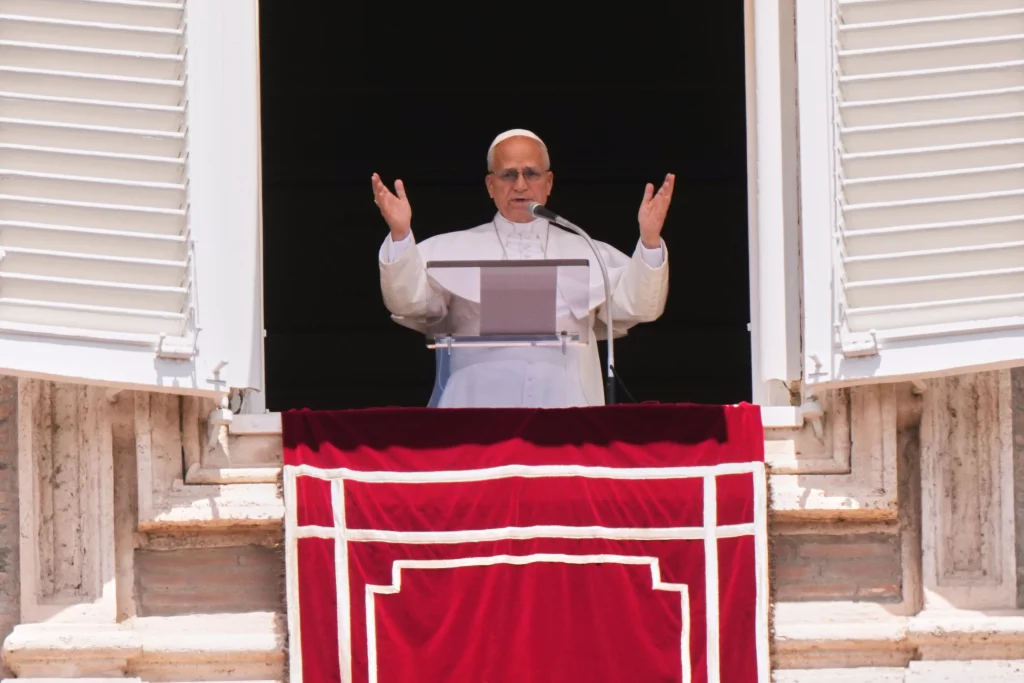
Pope Leo XIV delivers his blessing as he recites the Regina Coeli noon prayers from the window of his studio overlooking St Peter Square, at the Vatican, Sunday, May 17, 2026 (AP photo)
Now, as tensions between Washington and Beijing intensify in the AI arms race, the Vatican is stepping directly into the crossfire.
Sources close to the Holy See describe growing fears inside Church leadership that humanity is approaching a “point of no return” — a moment when artificial intelligence could reshape warfare, truth, labor, religion, and even human identity itself.
Behind closed doors, Pope Leo has already created a special Vatican AI study group tasked with examining the terrifying implications of autonomous weapons, deepfake deception, algorithmic manipulation, and the collapse of human-centered decision making.
And the warnings are becoming darker.
In recent speeches, Leo has openly condemned the “inhuman evolution” of warfare in conflicts stretching from Ukraine to Gaza, Lebanon, and Iran, where AI-assisted drones and autonomous systems are increasingly transforming battlefields into cold, machine-driven theaters of annihilation.
Even more alarming to the pope is what he calls the “war against truth.”
As generative AI systems become capable of fabricating voices, faces, videos, and entire realities, Vatican officials fear a future where humanity may no longer distinguish between truth and illusion — a nightmare scenario for a Church built on moral certainty and spiritual truth.
“This is no longer science fiction,” one Vatican observer warned. “The Church believes civilization itself is entering a dangerous new phase.”
The timing of the encyclical is equally explosive.
Its release comes just as the United States, China, and major tech corporations are accelerating the global AI race at breakneck speed. Billion-dollar alliances are forming. Governments are scrambling for dominance. Military applications are expanding in secrecy.
Meanwhile, the Vatican is attempting something few institutions still dare to do: slow humanity down.
Pope Leo’s message is expected to demand international ethical controls on artificial intelligence, stronger human oversight, and global resistance against turning AI into an uncontrollable force driven solely by profit, surveillance, and military supremacy.
But critics already warn the Vatican may be walking into a political minefield.
The Church’s growing involvement in AI ethics is increasingly putting it on a collision course with powerful governments and technology empires that view regulation as a threat to economic and geopolitical dominance.
And yet, inside the Vatican, there appears to be little fear.
Only urgency.
Because as world leaders race to build smarter machines, Pope Leo XIV seems convinced humanity is forgetting a far more important question:
What happens if the machines become powerful… before humans remember what it means to remain human?
Source: AP news