

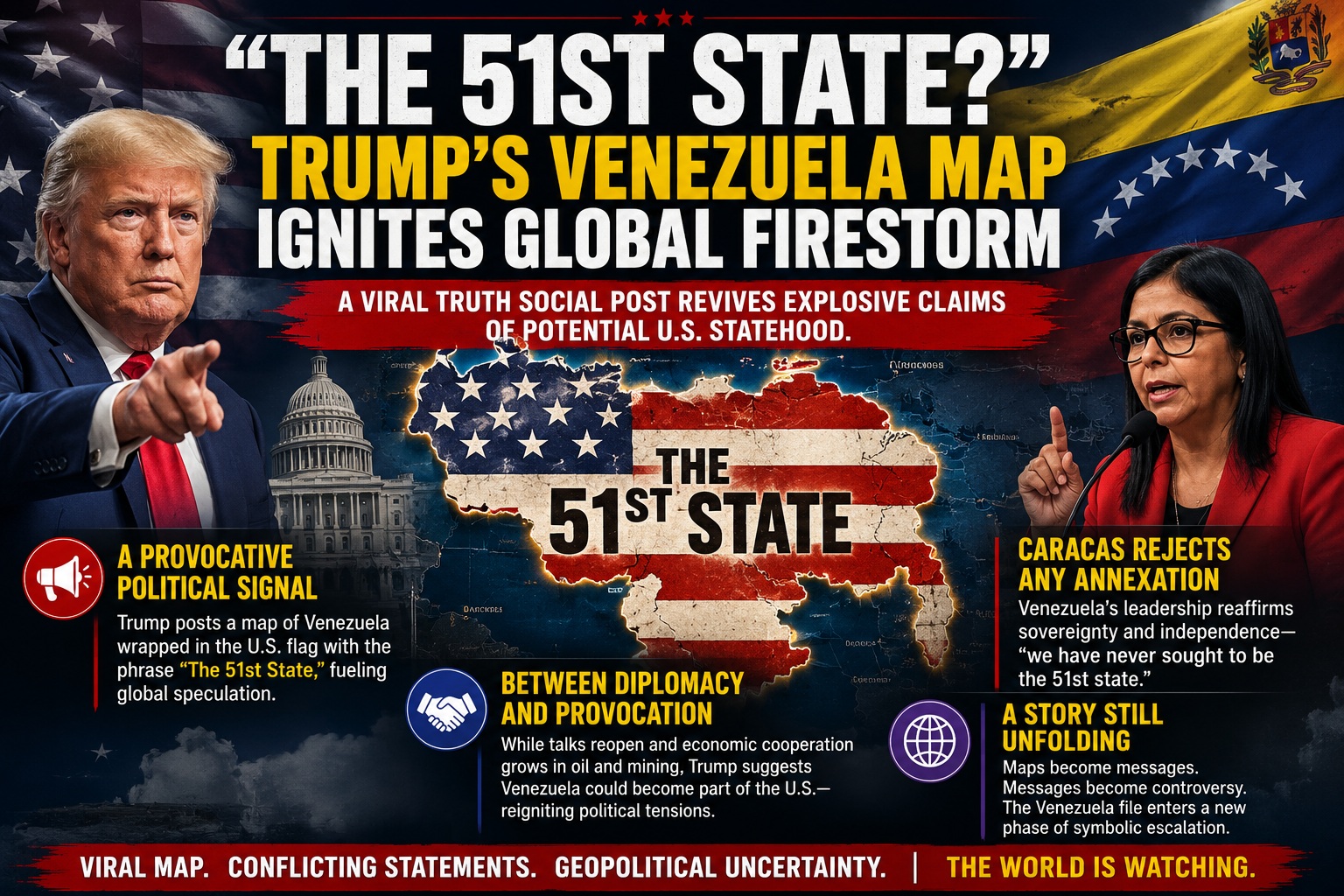
In a political scene growing increasingly tense and opaque, U.S. President Donald Trump has once again ignited controversy over Venezuela after posting an unusual map on his Truth Social platform depicting the Latin American nation wrapped in the American flag and labeled with a striking phrase: “The 51st State.”
The post, shared on Tuesday, was far more than a passing image. It appeared as a calculated political signal, released at a sensitive moment as Trump was on his way to China to attend a high-level summit with Chinese President Xi Jinping—against a backdrop of escalating global tensions and overlapping geopolitical crises.
The map itself carried a provocative symbolism that quickly transcended interpretation. It opened the door to speculation about Washington’s long-term intentions toward Caracas, particularly after earlier remarks by Trump in which he hinted at the possibility of integrating Venezuela into the United States—an unprecedented scenario that would fundamentally reshape the balance of power across the Western Hemisphere.
From within Venezuela, the response was immediate and unequivocal. Interim President Delcy Rodriguez, speaking from The Hague, firmly rejected any suggestion that her country would ever become the 51st U.S. state. She stressed that Venezuela “has never sought” such a path, adding with firm conviction that the nation’s identity is inseparable from its independence and the liberation heroes who shaped its history.
Yet even as she dismissed the idea outright, the political undertones between both sides have not disappeared. Rodriguez also emphasized that Venezuela is currently pursuing a renewed diplomatic approach toward Washington, following the reopening of communication channels and the revival of economic cooperation in key sectors such as oil and mining—areas where American companies are once again showing growing interest in re-entering Venezuela’s energy-rich market.
Behind this apparent economic thaw, however, lies a deeper and more unsettled layer of political tension. Venezuela has been navigating a complex transitional period following the January arrest of former President Nicolas Maduro in a U.S.-led special operation—an event that dramatically reshaped the country’s internal power structure and left lingering questions about its political future.
Adding further ambiguity to an already volatile landscape, Trump reiterated in an interview with Fox News that he is “seriously considering” the idea of making Venezuela part of the United States. His remarks revived earlier posts on Truth Social, in which he suggested that “good things are happening in Venezuela… is there a magical reason for it? The 51st state.”
Between a viral map, conflicting political statements, and firm denials from Caracas, the Venezuela file appears to have entered a new phase of symbolic escalation. Diplomacy is increasingly intertwined with insinuation, maps are becoming messages, and messages are evolving into open-ended scenarios—each more uncertain than the last, and all pointing toward a geopolitical storyline still unfolding in the shadows.