
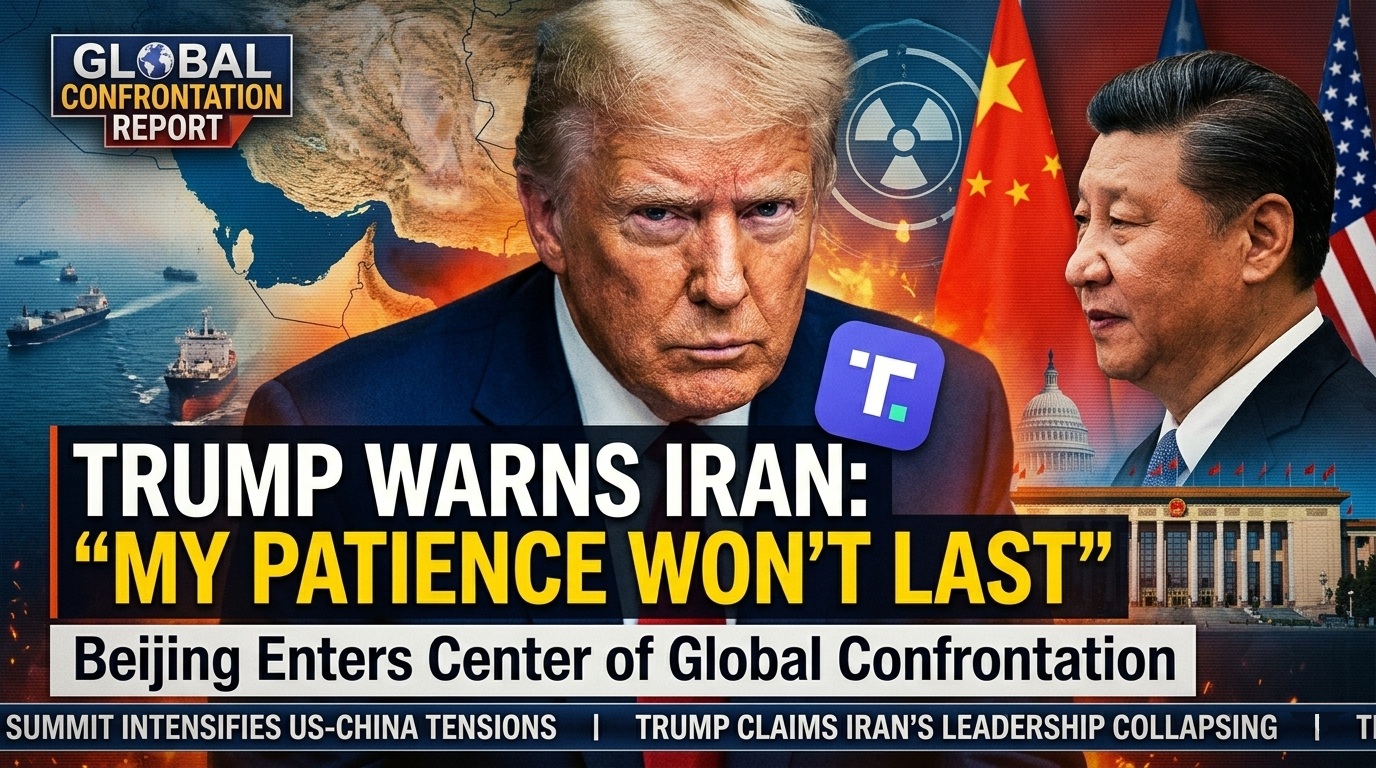
In a dramatic escalation that threatens to ignite a wider confrontation in the Middle East, U.S. President Donald Trump unleashed a series of fiery statements against Iran, declaring that “time is running out” and warning that he “will not remain patient much longer” with Tehran. His remarks came as political and military maneuvering intensified behind the scenes following his high-stakes summit with Chinese President Xi Jinping in Beijing.
Trump, appearing confident and combative throughout his speeches and social media posts, declared on his Truth Social platform that the “military destruction of Iran will continue,” claiming the United States had achieved a “crushing victory” over Tehran alongside what he described as unprecedented economic successes and record-breaking gains in American financial markets.
In a tense interview with Fox News, Trump escalated his rhetoric even further, insisting that Washington would “never allow Iran to obtain a nuclear weapon.” He argued that Iran’s leadership “would use the bomb against Israel, the Middle East, and possibly even the United States itself if they possessed it.”
The American president also revealed that U.S. military strikes and attacks targeting Iranian nuclear facilities had “crippled Iran’s nuclear program,” adding that Iran had been “militarily destroyed” while simultaneously being subjected to a suffocating blockade preventing ships and goods from entering the country.
Perhaps the most explosive element of Trump’s remarks was his claim that Iran’s leadership structure was collapsing. He stated that the first three levels of Iranian leadership had been “eliminated,” while the new leadership Washington is now dealing with is “fractured but more rational.” He then delivered a direct warning to Tehran: “They need to make a deal quickly… because my patience will not last.”
Behind the closed doors of the Beijing summit, Trump disclosed that he had urged Xi Jinping to pressure Iran, claiming the Chinese president promised not to provide Tehran with military equipment and expressed willingness to help facilitate a new agreement between Washington and Tehran.
In comments reflecting the growing international anxiety surrounding the crisis, Trump stated that Iranian nuclear sites are under constant surveillance through “nine cameras operating 24 hours a day,” warning that “any movement inside these facilities would trigger an immediate military response.”
While global attention remained fixed on Iran, the U.S.-China summit carried equally dangerous undertones, particularly amid rising tensions over Taiwan and the intensifying global race for dominance in artificial intelligence and energy.
Trump described his relationship with Xi as “very good,” emphasizing that Washington seeks “stronger relations with Beijing than ever before,” despite previously accusing China of exploiting the United States and stealing intellectual property for decades.
At the same time, Xi Jinping delivered what many viewed as a veiled warning, suggesting that any mishandling of the Taiwan issue could push the world’s two superpowers toward “direct conflict.”
Economically, Trump attempted to transform the summit into a platform for major business deals, announcing that China had agreed to purchase American oil and that Chinese vessels would “soon begin heading to U.S. ports.” He also revealed the possibility of China purchasing nearly 200 aircraft from Boeing.
Artificial intelligence also emerged as a central topic during the talks. U.S. Treasury Secretary Scott Bessent disclosed that Washington and Beijing are working on a “joint protocol” to regulate the AI race and prevent advanced technologies from falling into the hands of “dangerous non-state actors.”
Yet the most sensitive issue revolved around energy security and the Strait of Hormuz. Trump stressed that China “strongly wants the strait to remain open,” adding that Beijing is “frustrated by Iran’s attempts to impose fees or restrictions on shipping traffic.”
Meanwhile, U.S. Trade Representative Jamieson Greer confirmed that Chinese officials emphasized during the summit the importance of keeping the Strait of Hormuz open “without tolls or military control,” highlighting Beijing’s growing fears that any regional explosion could threaten one of the world’s most critical oil arteries.
As American escalation continues and pressure on Tehran intensifies, the region appears to be entering an exceptionally volatile phase—one in which military calculations intertwine with economic interests, while the Beijing summit increasingly looks like a pivotal turning point capable of reshaping the balance of power between Washington, Beijing, and Tehran all at once.