

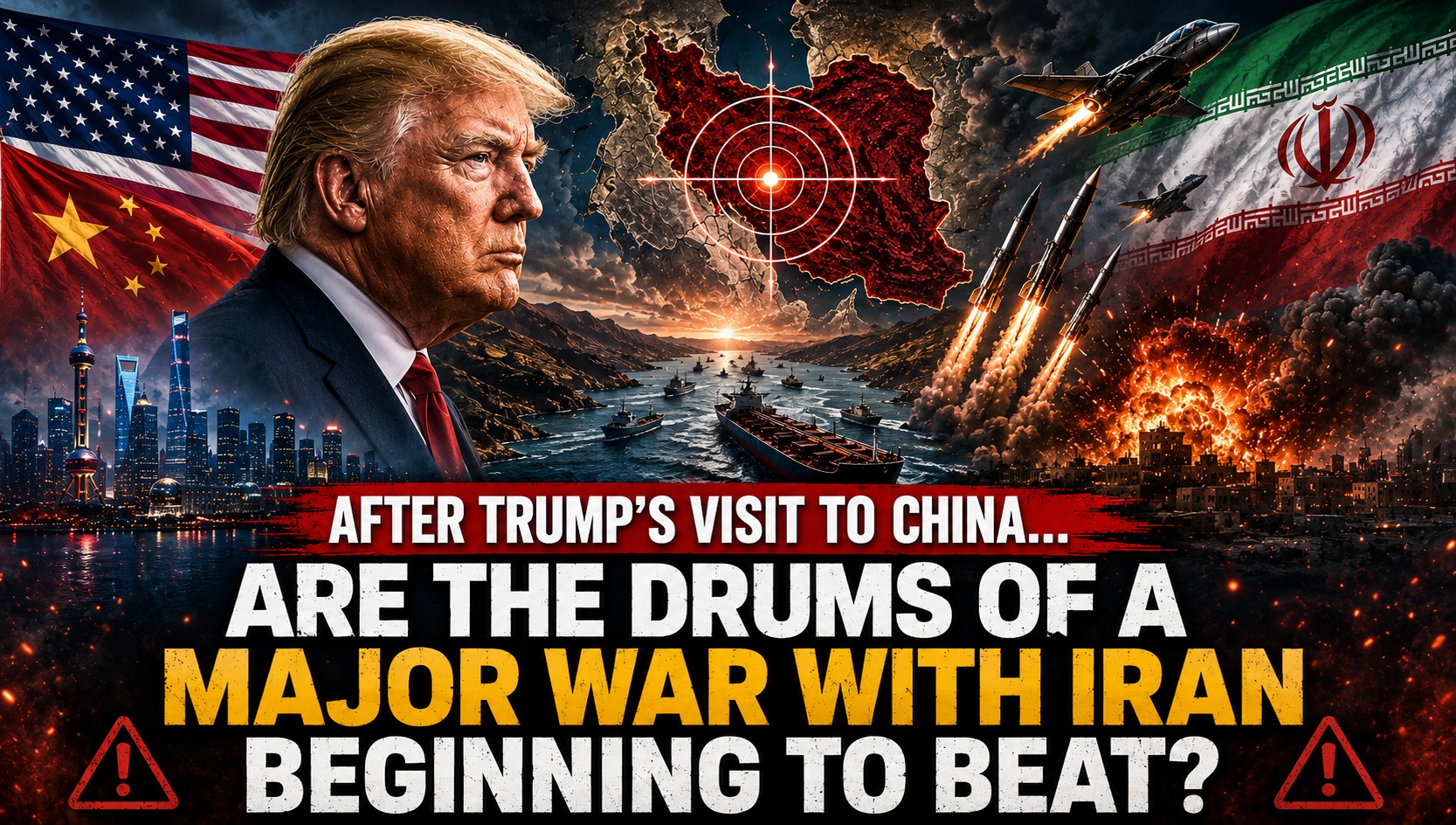
The visit of U.S. President Donald Trump to Beijing was far more than a routine political stop in the ongoing power struggle between Washington and China. It appeared instead as the opening chapter of a dangerous new international game — one in which the map of the next Middle East war may already be taking shape.
Behind closed doors, amid tense meetings and coded diplomatic messages, Iran’s name echoed louder than any other issue. As tensions rise once again in the Strait of Hormuz and discussions surrounding enriched uranium return to the spotlight, terrifying questions are resurfacing: Has the war truly ended… or is the region standing on the edge of an even greater explosion?
Beijing Steps into the Heart of the Confrontation
China, Tehran’s most powerful economically, suddenly found itself at the center of the storm. Washington understands that Beijing holds sensitive leverage over Iran, and the U.S. administration has repeatedly tried to push China into using its influence to impose a long-term de-escalation.
But China played the game with icy precision.
Publicly, Beijing called for dialogue and restraint. Behind the scenes, however, it continued purchasing Iranian oil while allegedly providing highly sensitive military and technical support, including equipment linked to missile and drone programs, as well as intelligence and aerial imagery that helped Tehran improve its military targeting capabilities.
Even so, China does not appear eager for a full-scale regional explosion. The closure of the Strait of Hormuz could become an economic nightmare for Beijing, which heavily depends on Gulf oil imports. Any new escalation could strike directly at China’s economy and shake global markets.
Washington Discovers Its Weaknesses
The recent war with Iran did not pass without serious consequences for the United States. The conflict drained part of America’s military capabilities and forced Washington to redirect weapons and ammunition away from Asia, opening the door for China to act more aggressively regarding Taiwan.
Behind the scenes, Chinese leaders increasingly view the United States as a declining power — but also a more dangerous one. They believe America’s weakening economic and diplomatic influence may push it to rely even more heavily on the one area where it still dominates: military force.
As Trump approached Beijing, Washington was betting on a highly strategic card: pressuring China to help fully reopen the Strait of Hormuz while cutting off any military support reaching Tehran.
But Iran suddenly flipped the table.
An Iranian Move That Disrupted Trump’s Calculations
Simultaneously with Trump’s arrival in Beijing, Tehran allowed a massive Chinese oil tanker — stranded for months — to pass through the Strait of Hormuz. Shortly afterward, the Iranian navy announced that dozens of Chinese vessels had crossed the strait with direct authorization from Iran’s armed forces.
Meanwhile, American and Israeli ships remained banned from passing.
The message was both clear and shocking: Iran can control one of the world’s most vital energy arteries… and capable of pulling China closer to its side at the most dangerous moment possible.
In doing so, Tehran effectively burned one of the key pressure cards Trump hoped to use during his China visit.
Could War Return Within Days?
At the conclusion of the trip, Trump issued fiery remarks, warning that the war with Iran “could resume,” while U.S. Secretary of State Marco Rubio insisted that Washington would offer Tehran no concessions.
The timing was no coincidence.
Reports revealed that the United States rejected Iranian proposals aimed at ending the conflict and demanded the transfer of hundreds of kilograms of enriched uranium before any agreement could be reached.
Tehran, on the other hand, proposed a two-stage plan beginning with a comprehensive ceasefire across all fronts — from Iran to Lebanon — before moving into nuclear negotiations.
But behind the statements, something much larger appears to be moving.
Three Terrifying Scenarios on the Table
According to political and military discussions circulating behind closed doors, Washington and Tel Aviv are considering three highly dangerous options regarding Iran’s nuclear file:
- Scenario One: Launching a special military operation deep inside Iran to seize uranium stockpiles — a mission described as resembling a combination of espionage thriller and military suicide inside heavily fortified underground facilities.
- Scenario Two: Forcing Iran to surrender its uranium through crushing economic pressure and suffocating sanctions while keeping the threat of war hanging over Tehran to push it toward a long-term “surrender deal.”
- Scenario Three: Carrying out a devastating strike using bunker-buster bombs capable of destroying deeply buried nuclear facilities in an attack that could ignite the entire Middle East.
Israel Moves… Even Without America
The most dangerous factor in the entire equation remains Israel.
If Tel Aviv believes Iran is approaching what it calls the “nuclear breakout point,” it is unlikely to stop planning covert operations, assassinations, and military strikes — even if it must act independently from Washington.
Inside Tehran, many believe the previous war was merely a “field test” designed to expose Iran’s military and security weaknesses ahead of a more precise and far bloodier confrontation.
The Region Enters a More Dangerous Era
All signs now suggest that the current ceasefire is nothing more than a fragile truce sitting atop a burning volcano.
Trust between Washington and Tehran is nearly nonexistent, military threats continue to escalate, and regional alliances are being reshaped at alarming speed.
Against this backdrop, the Middle East appears to be entering an entirely new phase — one where the next war may begin with a single missile… but may not end within Iran’s borders alone.
Source: An-Nahar