

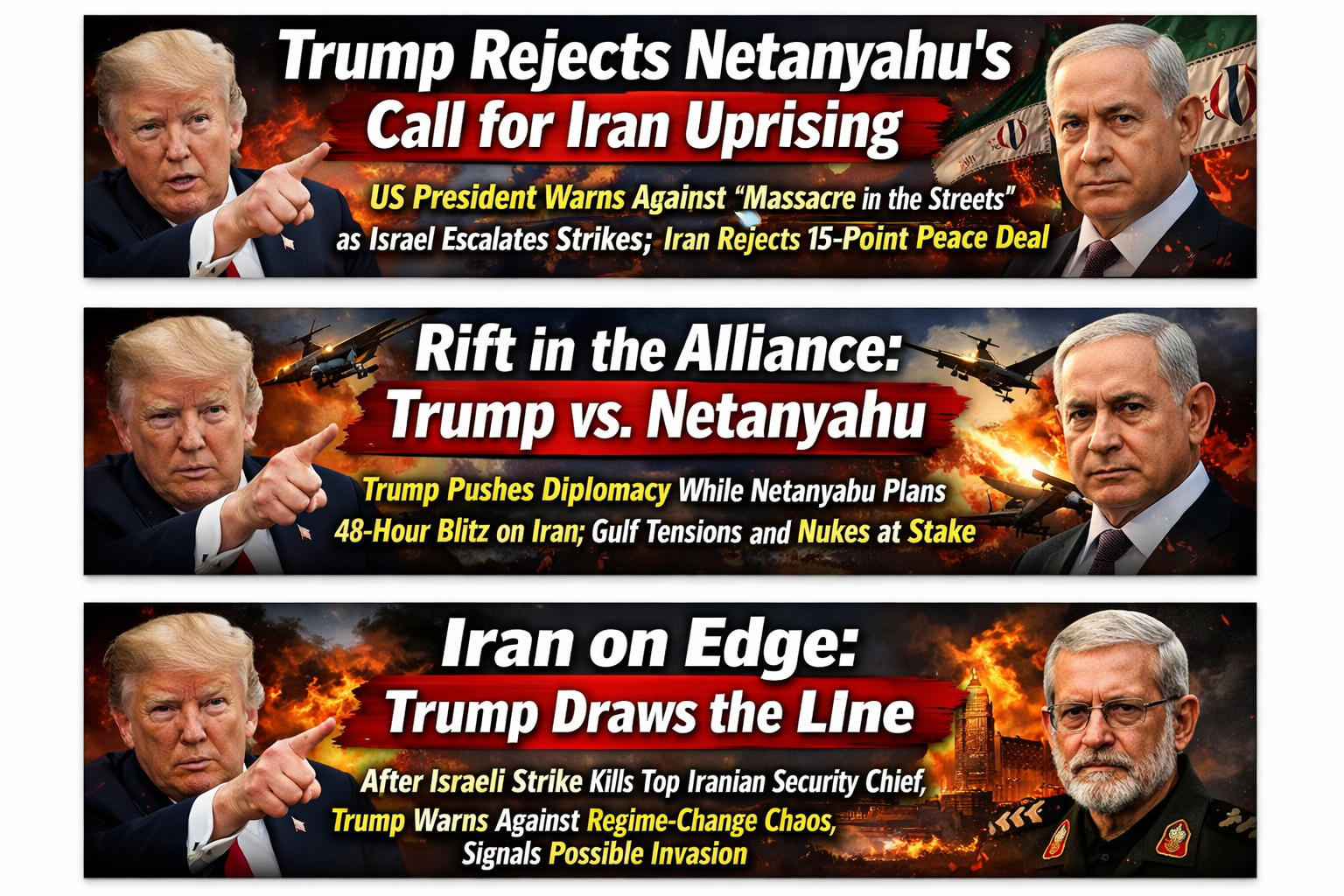
Donald Trump has sharply rebuffed Benjamin Netanyahu’s push for the U.S. to incite a violent street uprising aimed at toppling the Iranian regime.
“Why should we tell people to take to the streets when they’ll just get mowed down?” Trump reportedly told the Israeli prime minister during a call last week.
The conversation came hours after an Israeli strike killed Iran’s security chief, Ali Larijani, on Tuesday. According to a U.S. official and an Israeli source speaking to Axios, Netanyahu argued that the Iranian regime was in disarray and that the moment was ripe for a popular revolt.
Trump, mindful of past protests where thousands of Iranians were killed by paramilitary forces, warned that such a move could trigger a massacre. The two leaders agreed to observe whether Iranians would naturally demonstrate during the annual Festival of Fire, without U.S. encouragement.
Despite the agreement, Netanyahu publicly encouraged Iranians on TV: “Our aircraft are striking terrorist operatives… This is meant to allow the brave Iranian people to celebrate the Festival of Fire. So go out and celebrate… We are watching from above.”
The clash exposes a widening gap between Washington and Jerusalem on the question of regime change. While Trump initially called for a popular uprising at the war’s start, the U.S. has since quietly distanced itself from overtly supporting regime overthrow.
Netanyahu, meanwhile, has convened his generals to plan a possible 48-hour strike on Iran’s top targets, concerned that Trump’s push for a rapid peace deal might not sufficiently curb Tehran’s military power. On Tuesday, Netanyahu met Israeli commanders in a deep Tel Aviv bunker to review Trump’s 15-point peace plan, which officials said fell short of limiting Iran’s military capabilities. The atmosphere was described as “tense.”
Speaking to the National Republican Congressional Committee on Wednesday, Trump framed the campaign as a victory over Iran’s nuclear threat. “It’s short term. What we had to do is get rid of the cancer. We had to cut out the cancer. The cancer was Iran with a nuclear weapon. We’ve cut it out. Now we’re going to finish it off,” he said. Privately, he told allies he does not want the war to drag on and aims to stick to his original four- to six-week timeline.
Iran rejected the U.S. proposal on Wednesday, but Trump remains optimistic about a deal. Israeli media report that a ceasefire could come as soon as next Saturday. Netanyahu’s inner circle is focused on three objectives: destroying Iran’s ballistic missile stockpile, preventing nuclear weapon development, and creating conditions for civilians to challenge the Islamic regime.
Trump has not publicly referenced regime change since the early days of the war, and the White House does not list it among the official objectives, which include destroying Iran’s missiles, Navy, armed proxies, and nuclear capabilities.
Meanwhile, Pentagon leaders ordered roughly 2,000 paratroopers from the 82nd Airborne Division to join 4,500 Marines already en route, signaling readiness for a full-scale invasion if Iran continues to resist diplomacy. An aide told Axios, “Trump has a hand open for a deal, and the other is a fist, waiting to punch you in the face.”
Trump’s 15-point plan, modeled on his Gaza deal, calls for Iran to dismantle all nuclear and long-range missile capabilities, open the Strait of Hormuz, and abandon proxy groups. Iran rejected it outright, demanding U.S. base closures, reparations, and an end to Israeli strikes on Hezbollah. Tehran also seeks control over the strait—a vital passage for roughly a fifth of global oil—to levy transit fees, similar to Egypt’s Suez Canal.
U.S. officials described Iran’s demands as “unrealistic,” warning that a deal is now harder to achieve. Diplomacy has relied on intermediaries from Egypt, Turkey, and Pakistan, as direct U.S.-Iran contact remains limited.
Saudi Arabia has warned that ceding the Strait of Hormuz is unacceptable, urging Trump to maintain pressure. Crown Prince Mohammed bin Salman has repeatedly pressed for decisive action, including ground operations to seize Iran’s energy infrastructure.
Iran remains wary of Trump envoys Jared Kushner and Steve Witkoff, favoring Vice President JD Vance to lead U.S. negotiations, seeing him as more sympathetic after expressing doubts about Operation Epic Fury.
Trump faces mounting pressure to end the conflict as Iran’s grip on the Strait of Hormuz drives global oil prices higher. He announced a five-day halt to U.S. strikes on Iranian energy facilities while calling on Tehran to return to the negotiating table. Iranian parliament speaker Mohammed-Baqer Qalibaf has emerged as Tehran’s de facto leader and the preferred interlocutor for Trump officials, though he denies engaging in talks with Washington.