

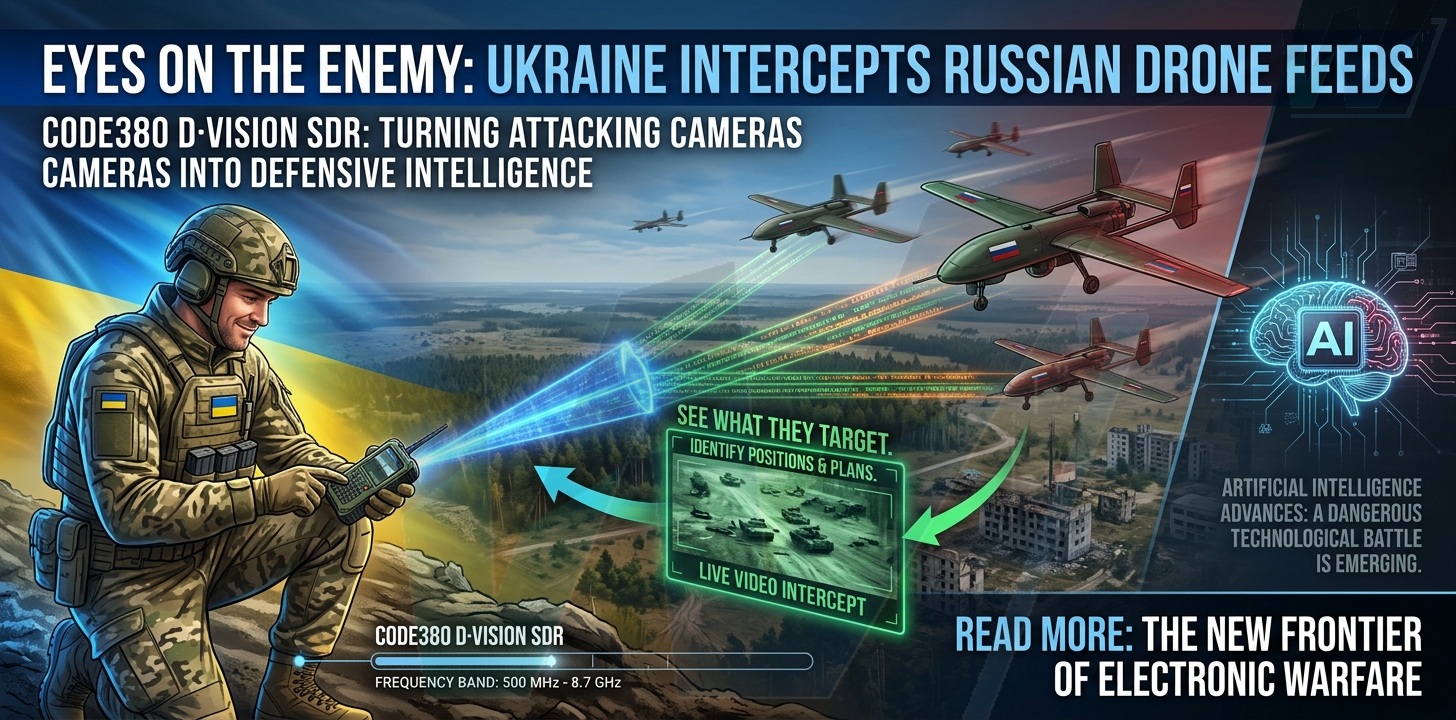
Ukraine Can See What Russian Drones See: Tiny Receiver Intercepts Live Camera Feeds
Russian Drone Cameras Under Surveillance? Ukraine’s New Technology Could Change the Battlefield
The CODE380 D·Vision SDR can intercept video transmissions from certain Russian drones, potentially allowing Ukrainian forces to see what an enemy camera is targeting. But as artificial intelligence advances, a more dangerous technological battle is emerging.
KYIV, Ukraine, what if defenders could see exactly what an attacking drone sees, before it reaches its target?
That is the capability a Ukrainian defense technology company is seeking to deliver with a device small enough to fit in the palm of a hand, yet potentially powerful enough to add a new layer of intelligence to battlefield surveillance.
Kyiv-based CODE380 has developed the D·Vision SDR, a compact receiver designed to capture live video transmissions from certain Russian drones and display their camera feeds on a screen. The technology could give Ukrainian forces a glimpse of what an incoming drone is observing, where it is heading and what its camera is focusing on.
Weighing approximately 280–290 grams, the device is part of a rapidly evolving electronic-warfare race in which radio signals emitted by enemy drones can become valuable sources of intelligence.
The concept is simple, but its battlefield implications could be significant: instead of merely detecting a drone in the sky, Ukrainian units may be able to see through its camera.
Turning Russian Drone Cameras into Intelligence Sources
Technology exploits a weakness in some drone communication systems: the transmission of video through unencrypted radio signals.
When a compatible signal is detected and received, the video feed may be accessible to another receiver within range. That can reveal images captured by the drone’s onboard camera rather than simply indicating that an aircraft is operating nearby.
The D·Vision SDR relies on Software-Defined Radio (SDR) technology, which uses software to process radio signals instead of depending entirely on fixed-function receiver hardware.
According to Defense News in a report published on November 2, the device can scan a broad frequency range from 500 MHz to 8.7 GHz. Its software-based architecture is also designed to accommodate changes in signal specifications.
The potential military advantage is clear: access to a drone’s video feed could help Ukrainian personnel understand what the aircraft is observing and assess whether it is approaching a sensitive location.
However, interception depends on the drone’s transmission technology, signal characteristics and operating conditions. The device is not a universal solution capable of accessing every drone camera.
Russian Molniya Drones Raise the Stakes
The development comes amid growing concern over the changing frequencies used by Russian unmanned aircraft.
In June, Serhii “Flash” Beskrestnov, a Ukrainian radio communications specialist and adviser to the president, warned that some Russian Molniya drones were using new video-transmission frequencies that many existing detection systems struggled to monitor effectively.
His warning exposed a growing vulnerability: equipment that cannot keep pace with changing drone frequencies risks leaving dangerous gaps in battlefield surveillance.
Technical reporting indicates that the D·Vision SDR covers frequency bands that include those associated with some Molniya drone transmissions. This could give it an advantage over certain conventional receivers.
Its compact size is another potential benefit. At roughly 280–290 grams, it is designed to be carried by personnel operating in the field, where mobility and lightweight equipment can be critical.
The Ukrainian market already includes competing systems, among them Vydun 7.5, SENSE-4 and Chuyka 3.0. D·Vision’s reported advantages include its low weight and broad advertised reception range.
Still, its actual effectiveness will depend on the specific drone, transmission method and conditions in which it is deployed.
From Radio Interception to AI-Powered Drones
The contest is no longer limited to detecting radio signals. A much more complex technological battle is unfolding over artificial intelligence and autonomous targeting.
A New York Times investigation published on August 24, 2026, reported that Ukrainian authorities had identified Nvidia computing modules in the wreckage of Russian drones. Officials said some systems were being used in connection with AI-assisted guidance.
The investigation discussed Nvidia Jetson Orin modules, which can support demanding computing tasks such as image processing, navigation and object recognition. It also examined claims that some drones could identify and engage targets with greater independence from human operators.
These developments raise a serious challenge for conventional drone-monitoring technology.
If a drone can process images and navigation data onboard and complete parts of its mission without continuously transmitting video, it may reveal far less information through the radio signals that receivers such as D·Vision are designed to exploit.
The shift from analogue video to more sophisticated digital transmission systems presents another obstacle. Fiber-optic-controlled drones create additional difficulties because their control and data links do not rely on conventional radio transmissions in the same way.
In other words, the next generation of drones may be designed not only to evade physical defenses, but also to conceal the electronic signals that expose their presence.
D·Vision is therefore not a final answer to the drone threat. It is another move in an ongoing technological contest between those developing new detection systems and those modifying drones to defeat them.
Ukraine’s War Becomes a Global Military Technology Laboratory
The war between Russia and Ukraine is increasingly being fought across more than conventional battlefields. It has become a testing ground for artificial intelligence, electronic warfare, advanced communications and digital surveillance.
Every improvement in drone technology forces the opposing side to develop new ways to detect, disrupt or neutralize it. The result is a cycle of innovation in which even small devices can have an outsized operational role.
CODE380’s D·Vision SDR reflects a broader trend towards lighter, more portable and software-updatable equipment that can bring additional surveillance capabilities to frontline units without relying exclusively on large and expensive systems.
But the next decisive advantage may not belong to the side with the fastest drone or the most powerful camera.
It may belong to the side that can hide its signals, process information faster and make decisions before its opponent even realizes it has been detected.
Above Ukraine, drones are no longer the only eyes watching the battlefield. Their cameras may now be watched, too.
The question is whether interception technology can keep pace with a new generation of aircraft capable of seeing, analyzing and attacking, with fewer signals left behind for the enemy to find.