

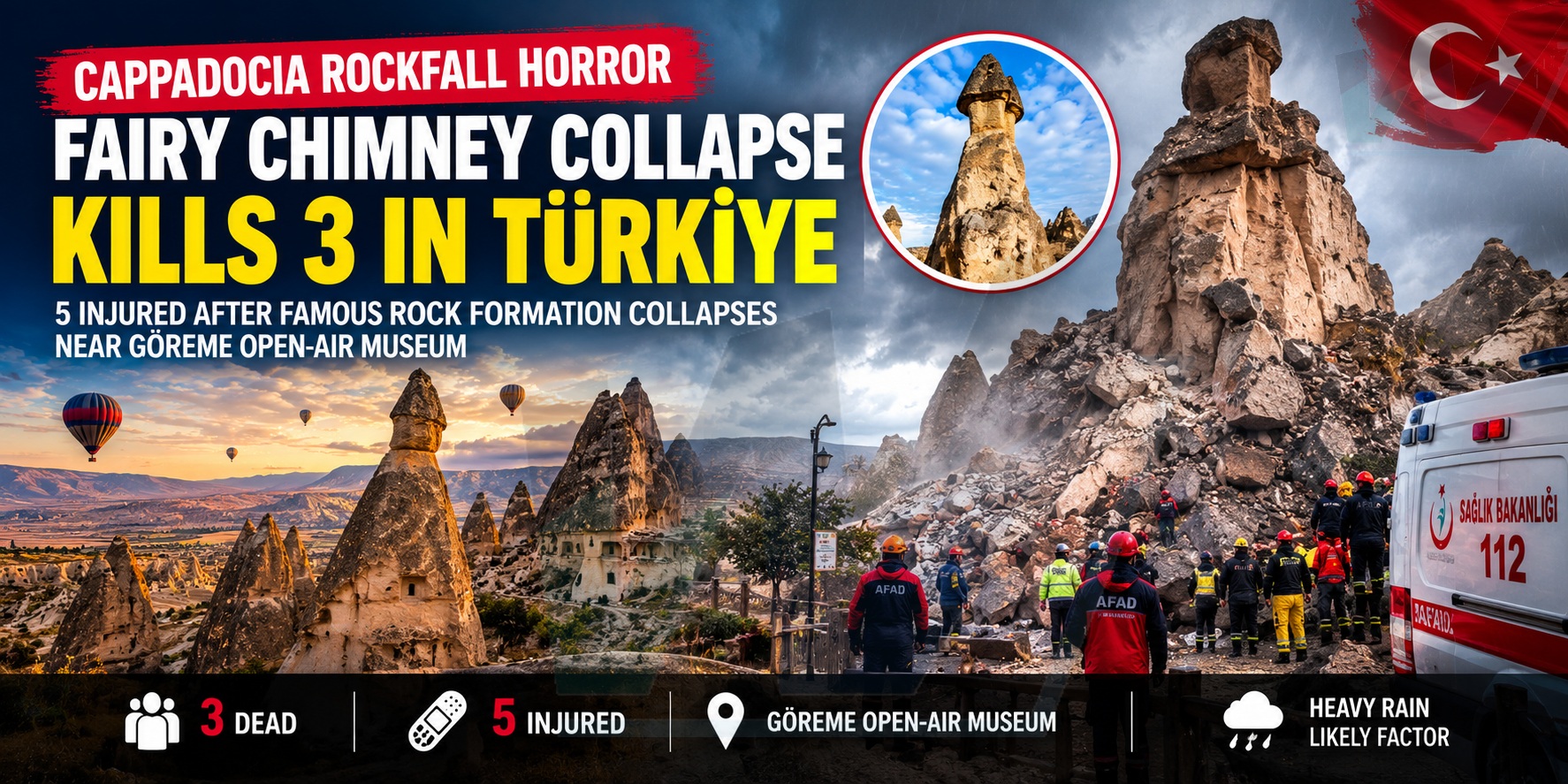
Cappadocia Fairy Chimney Collapse: At Least 3 Dead in Türkiye
At least three dead and five injured after a famous rock formation collapses near Göreme Open-Air Museum; heavy rain and the fragility of Cappadocia’s landscape come under scrutiny.
A landscape famous for looking almost otherworldly has become the scene of a deadly tragedy. A towering rock formation known as a “fairy chimney” collapsed in Cappadocia, central Türkiye, killing at least three people and injuring five, according to the latest reports from the Associated Press and Agence France-Presse.
The collapse occurred on Thursday, October 29, near the entrance to the Göreme Open-Air Museum, one of the region’s best-known tourist attractions. Emergency teams rushed to the scene as rescuers searched through fallen rock and debris for possible victims. Authorities subsequently launched an investigation into the disaster.
Heavy Rain, Falling Rock and a Race Against Time
The incident unfolded at approximately 3:15 p.m. local time, when a landslide sent pieces of the formation crashing down onto an area where people were present.
Nevşehir Governor Hüseyin Kök said recent heavy rainfall likely contributed to the collapse, although the precise sequence of events remains subject to investigation. Justice Minister Akın Gürlek confirmed that an investigation had been opened, while rescue teams worked to establish the full toll.
Initial reports varied as information emerged from the scene. Reuters first reported two fatalities and one injured person; subsequent AP and AFP reports raised the death toll to at least three, with five people injured. The evolving figures underline the uncertainty that can surround breaking disaster coverage.
The collapse occurred on Türkiye’s Republic Day, a national holiday that can draw additional visitors to popular destinations.
Why Cappadocia’s Famous Fairy Chimneys Are Vulnerable
Cappadocia’s extraordinary landscape was shaped by ancient volcanic activity and thousands of years of erosion. Its distinctive pillars, called fairy chimneys, are formed from relatively soft volcanic material, sometimes protected by harder caps of rock.
The forces that created this spectacular terrain continue to reshape it. Rainfall, weathering, fractures and the gradual weakening of rock can contribute to instability. Heavy rain may also saturate or erode surrounding material, potentially increasing the risk of landslides and rockfalls.
However, the precise cause of Thursday’s collapse has not yet been established by a completed investigation.
The danger is not entirely unprecedented. Turkish media have reported a separate fairy-chimney collapse in Cappadocia in 2024, when snowfall weakened a formation. That incident caused no reported casualties. The latest disaster has renewed attention on how vulnerable geological landmarks should be monitored and managed.
A UNESCO Landmark Under Pressure
Cappadocia is internationally renowned for its dramatic rock formations, cave dwellings, rock-cut churches and underground cities. The Göreme National Park and the Rock Sites of Cappadocia have been on UNESCO’s World Heritage List since 1985.
Millions of visitors are drawn to the region each year, including tourists seeking its famous hot-air-balloon views. But the same landscape that fuels Cappadocia’s global appeal is fragile—and protecting it requires balancing tourism, conservation and public safety.
AFP reporting has highlighted concerns about excessive visitor pressure and the deterioration of geological features. The tragedy raises difficult questions: Are risk assessments keeping pace with visitor numbers? Are vulnerable formations being inspected frequently enough? And how should authorities restrict access when weather conditions increase the danger?
Those questions require evidence-based answers, not assumptions about the cause of a single collapse. A thorough investigation will be essential to determine whether the incident was primarily the result of natural processes, site-management failures or a combination of factors.
What Happens Next?
The immediate priority is to account for anyone who may still be missing, support the injured and secure the affected area against further rockfalls. Investigators will need to examine the formation, the surrounding ground conditions and the role of recent rainfall.
Authorities may also face renewed pressure to review visitor routes, warning systems, inspections and temporary closures around unstable rock formations.
For travelers, the incident is a reminder that even iconic natural landmarks can pose risks, particularly after severe weather. Visitors should follow official instructions, respect closed areas and avoid approaching unstable cliffs or rock pillars.
Cappadocia’s fairy chimneys have endured for centuries, shaped by forces far older than modern tourism. But Thursday’s collapse has delivered a stark warning: preserving a natural wonder means protecting not only its beauty and heritage, but also the people who come to see it.