

Tiny T. rex Relative, Massive Price: Rare Dinosaur Fossil Sells for $47.3 Million
Who Bought the $47.3 Million Dinosaur? “Jodi” Sparks a Fossil Ownership Battle
A prehistoric predator has just delivered a modern-day auction sensation. A rare Nanotyrannus skeleton known as “Jodi” has sold for $47.3 million at Sotheby’s in New York, becoming the second-most-expensive dinosaur fossil ever auctioned and reigniting a fierce debate over who should own the world’s most scientifically valuable prehistoric discoveries.
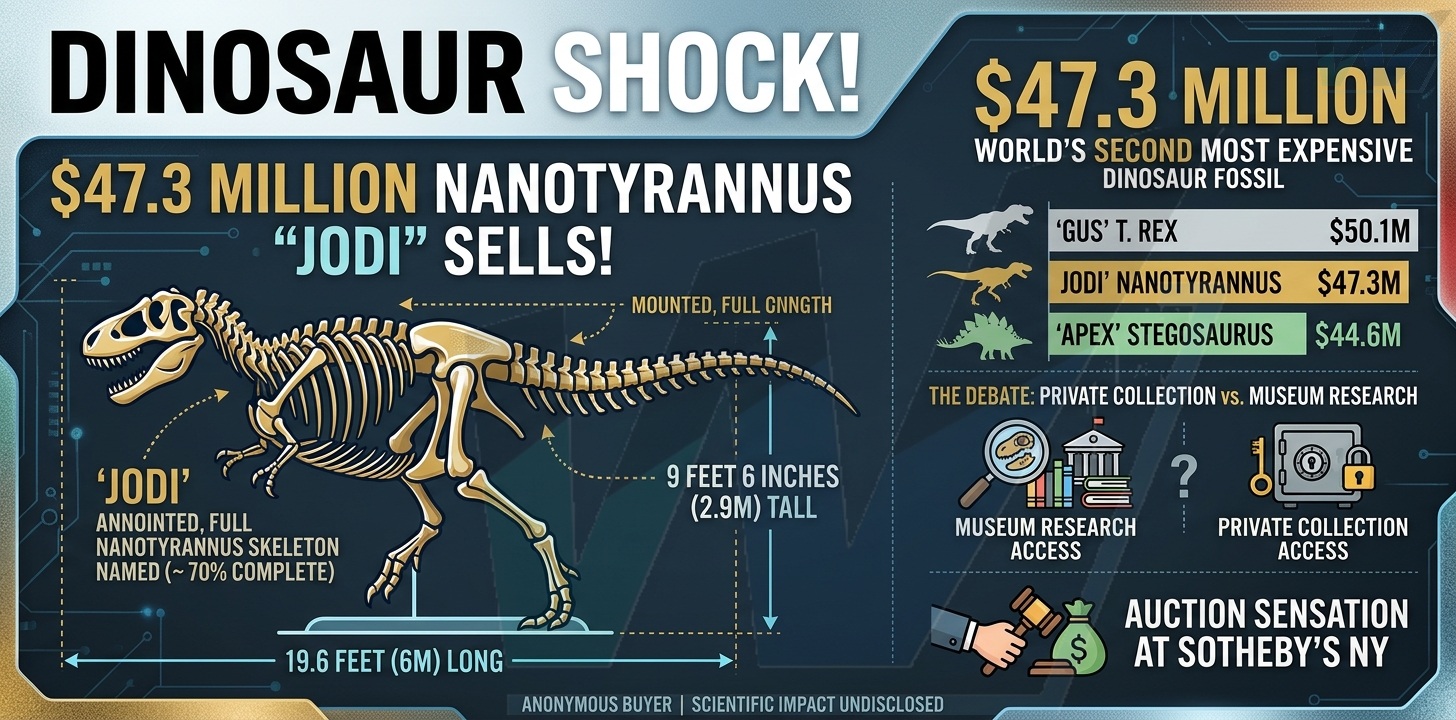
The final price, announced after a dramatic 12-minute bidding battle on October 27, soared far beyond Sotheby’s original estimate of $6 million to $9 million. Six bidders competed for the approximately 67-million-year-old specimen, while the identity of the winning buyer remained undisclosed. AP and Sotheby’s confirmed the landmark result.
A $47.3 million journey from Montana to Manhattan
Discovered in 2019 on rancher Jodi Pierson’s property in Montana’s Hell Creek Formation, the fossil was named in her honor. It measures approximately 19.6 feet from nose to tail and stands about 9 feet 6 inches tall on its display frame.
The mounted skeleton is estimated to be around 70% complete and includes approximately 191 fossil bone elements, making it an exceptionally rare specimen. Sotheby’s describes it as one of the few substantial Nanotyrannus skeletons known to science.
The sale also delivered a striking financial result: the final price exceeded five times the upper end of the auction house’s estimate.
Jodi now ranks behind “Gus,” a Tyrannosaurus rex skeleton that sold for $50.1 million at Sotheby’s in July 2026. It also surpassed the $44.6 million paid for the Stegosaurus “Apex” in 2024. The Guardian and Euronews place the sale among the most significant fossil auctions in history.
Not a young T. rex? The scientific debate behind the price
For decades, paleontologists debated whether Nanotyrannus was a distinct dinosaur genus or simply a juvenile Tyrannosaurus rex.
The smaller predator resembles its famous relative, but researchers have pointed to differences in its proportions, forelimbs, claws, teeth and other anatomical features. Research published in 2025 strengthened the case for Nanotyrannus as a distinct genus, adding fresh scientific significance to the auction.
However, the classification is not entirely beyond debate. Smithsonian Magazine notes that Jodi is identified as Nanotyrannus cf. lancensis, a designation that signals some uncertainty in the precise identification of the specimen.
The animal lived roughly 67 million years ago, near the end of the Cretaceous Period, sharing its ancient environment with T. rex. Smaller and more lightly built than its famous relative, Nanotyrannus has become one of paleontology’s most closely watched subjects.
The controversy: Should priceless fossils disappear into private collections?
Behind the headline-grabbing price lies a more difficult question.
Some paleontologists have criticized the sale, warning that rare fossils can become inaccessible if they are purchased by private collectors and placed in storage rather than displayed in museums or made available for research.
The concern is particularly acute in Jodi’s case because, so few substantial Nanotyrannus skeletons are known. Researchers argue that specimens of this rarity can provide important evidence about dinosaur evolution, anatomy and the relationship between different tyrannosaur species.
Supporters of private fossil sales counter that excavation, preparation and preservation require considerable time, expertise and money. Commercial sales can reward landowners and specialists who invest in recovering specimens that might otherwise remain buried.
The central issue is therefore not simply how much a fossil is worth, but whether its scientific and educational value can be preserved after the auction.
An anonymous buyer and an unanswered question
For now, the identity of Jodi’s new owner remains a mystery. It is also unclear whether the skeleton will be exhibited publicly, loaned to a museum or held in a private collection.
That uncertainty gives the sale significance beyond the art and luxury markets. The purchase has secured one of the rarest known dinosaur specimens, but the public may not know when, or whether, it will be able to see it again.
The prehistoric market is rewriting record books
Jodi’s sales confirm the growing financial power of the rare fossil market. Exceptional dinosaur skeletons now compete for attention alongside major works of art and other high-value collectibles, with scarcity, scientific importance and dramatic visual impact helping drive prices upward.
Yet the record books tell only part of the story. The scientific value of a fossil cannot be measured by its auction price alone.
A creature that vanished around 67 million years ago has captured the world’s attention once again. The question now is whether Jodi will become a celebrated public attraction, or an extraordinary scientific treasure hidden from view.