

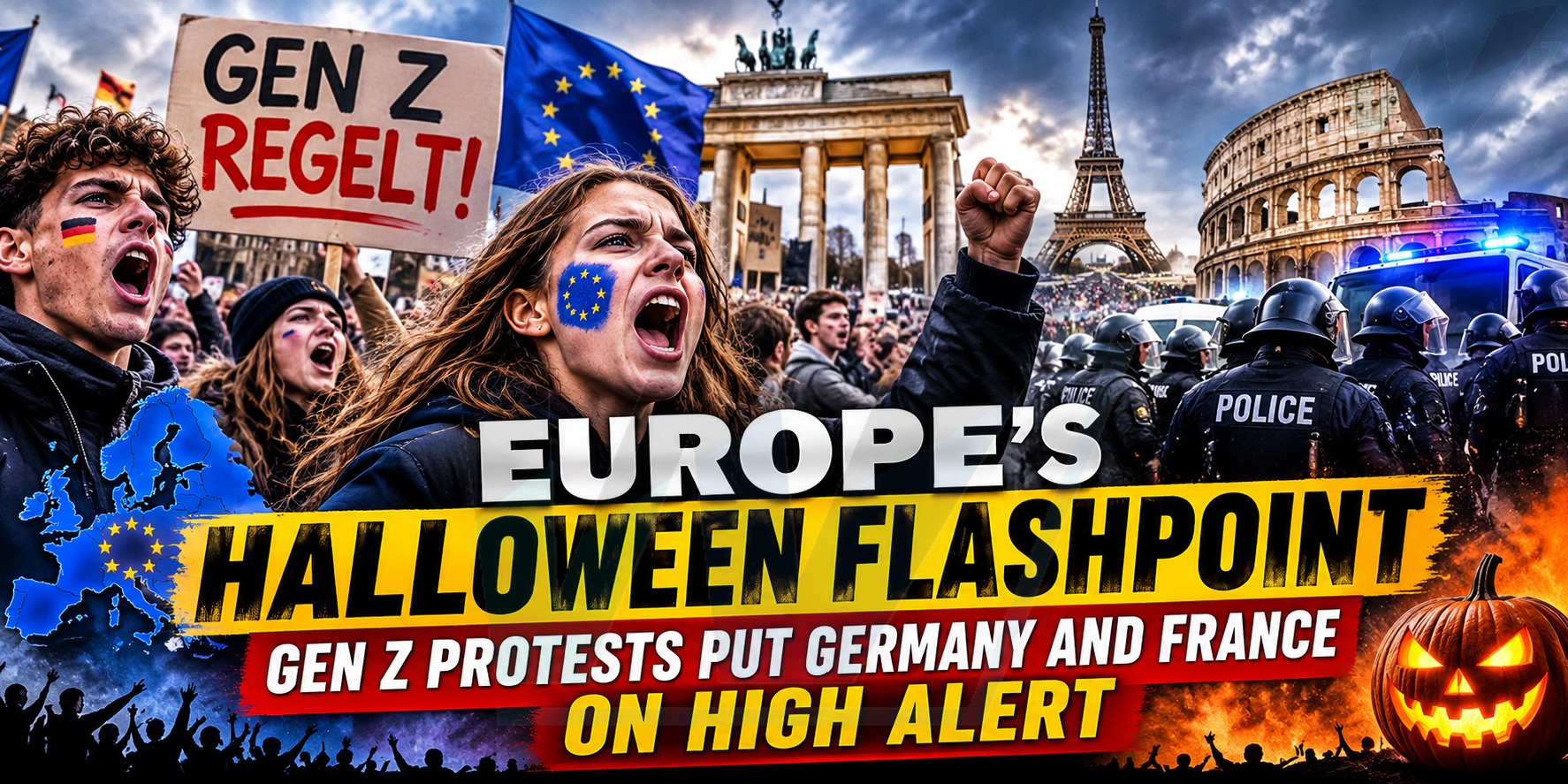
Europe on the Brink? Youth Protests Sweep Germany, France and Italy Amid Fears of New Riots
Gen Z Revolt Spreads Across Europe: Living Costs, Schools and Political Anger Fuel Mass Protests
More than 160,000 registrations for German demonstrations, 70,000 French security personnel deployed, and growing unrest across Europe turn Halloween into a major test of public order.
Europe is bracing for a volatile Halloween weekend as a powerful wave of youth-led protests sweeps across its major cities, exposing growing anger over soaring living costs, struggling schools and a generation increasingly convinced that politicians are ignoring its future.
Germany is preparing for demonstrations in 34 cities, with organisers reporting more than 160,000 online registrations. France, meanwhile, has deployed 70,000 police officers and gendarmes as authorities confront a third consecutive weekend of protests and fear another outbreak of street violence.
What began as student frustration is rapidly becoming a wider challenge to Europe’s political establishment.
Germany: Gen Z takes the streets
Under the slogan “Gen Z regelt!”, loosely translated as “Gen Z has got this!”, young demonstrators are preparing to mobilize across Germany, including Berlin, Frankfurt, Cologne and Munich.
Their demands go beyond cheaper living costs. They want better-funded schools and universities, affordable housing, stronger public services, meaningful climate action and a greater voice in political decisions.
Opposition to compulsory military service has also become a central rallying point.
The mobilization has triggered an extensive security response. Police are preparing for large gatherings, while some luxury retailers have boarded up their windows amid fears of vandalism and looting.
Yet organizers insist their demonstrations will remain peaceful. German police also expect most rallies to pass without major incidents, despite warnings that extremist groups could attempt to exploit the gatherings.
The movement itself faces questions over its organizational structure, with Germany’s national student umbrella organization distancing itself from the initiative.
France: 70,000 security personnel and a nation on edge
Across the border, France is preparing for another major confrontation.
Interior Minister Laurent Nuñez has ordered 70,000 police officers and gendarmes onto the streets, describing October 31 as a day carrying a very high risk of public disorder.
The decision follows two turbulent weekends.
On October 17, approximately 550,000 people demonstrated nationwide, with widespread looting and damage to hundreds of shops. The following weekend, around 410,000 marched. Although demonstrations were largely peaceful, police reported more than 1,300 arrests.
Authorities are now restricting demonstrations in sensitive city-centre locations, imposing additional security measures in affected Paris neighborhoods and monitoring calls for potentially violent gatherings after dark.
The coincidence with Halloween has intensified concerns. Costumes and face coverings could make it more difficult to identify individuals involved in vandalism or clashes.
For retailers, the fear is immediate: another night of smashed windows, damaged businesses and mounting financial losses.
Italy, Spain and beyond: Europe’s unrest spreads
The crisis is no longer confined to France and Germany.
Italy witnessed major demonstrations on Friday, October 30, as students, workers and trade unions mobilized in more than 40 cities over wages, education, living costs and public spending priorities. Clashes were reported in several locations.
In Spain, authorities raised security alerts in Barcelona following violent incidents and approximately 130 arrests during the previous weekend.
Protest calls have also circulated in Belgium, the Netherlands, Austria, Switzerland and Portugal.
Across the continent, the grievances increasingly overlap unaffordable housing, declining purchasing power, strained public services and fears that young people are inheriting a future with fewer opportunities.
A generation demanding answer
Behind the demonstrations lies a deeper political question: can Europe’s governments convince younger citizens that their future still matters?
For many protesters, the problem is not simply inflation or deteriorating schools. It is the feeling that decisions about education, employment, housing, climate policy and military obligations are being made without meaningful consultation with the generations most affected.
Social media has accelerated this mobilization, connecting students and young activists beyond traditional political organizations and national borders.
But the growing demonstrations also present a dangerous dividing line. Peaceful protest remains a fundamental democratic right; looting, intimidation and attacks on people or property threaten both public safety and the legitimacy of the movements themselves.
Halloween becomes Europe’s security test
As Germany watches its largest coordinated Gen Z mobilization and France prepares for another tense night, European authorities face a difficult balancing act: protecting public order without suppressing legitimate democratic expression.
The outcome could influence how governments across the continent respond to an increasingly vocal generation.
The central question is no longer whether young Europeans are angry.
It is whether their governments are prepared to listen before that anger deepens into a much wider political crisis.