
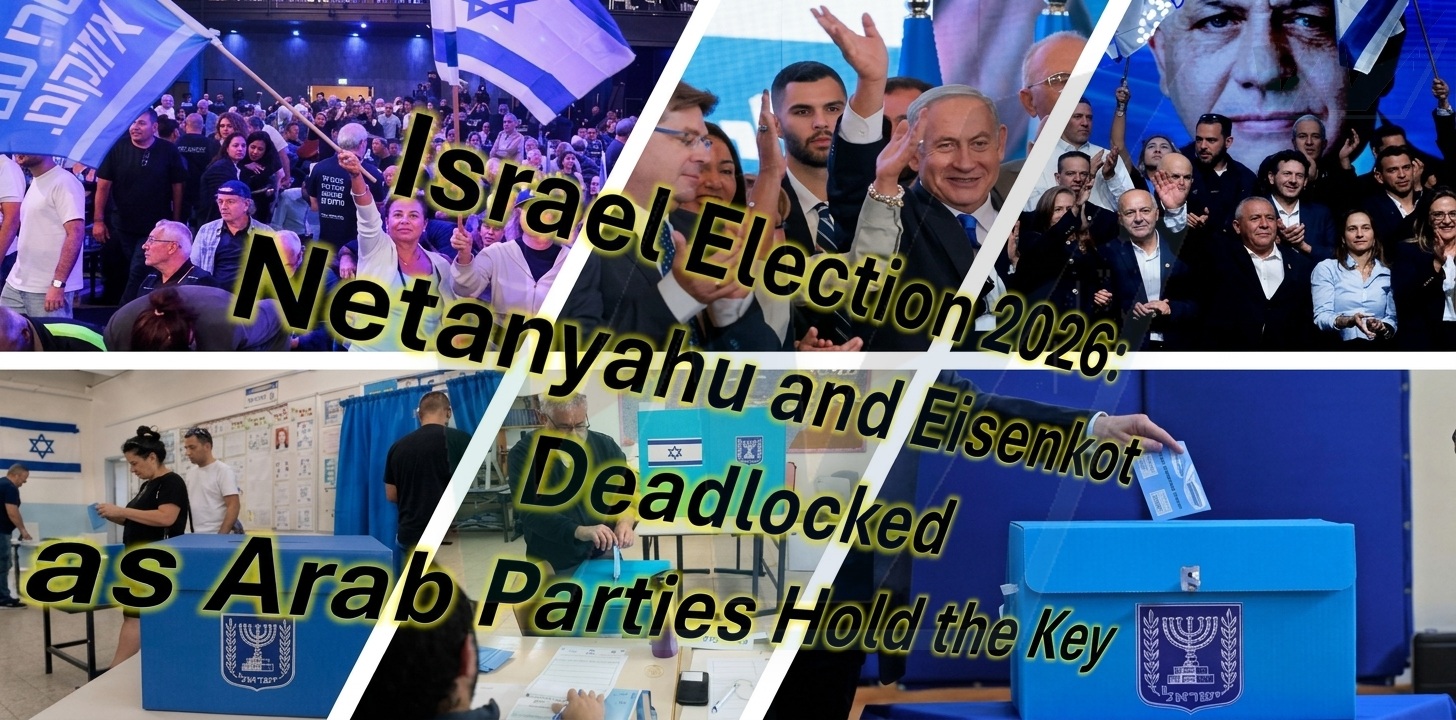
Israel Election 2026: Netanyahu and Eisenkot Deadlocked as Arab Parties Hold the Key.
JERUSALEM, Israel’s election has delivered a dramatic political cliffhanger, leaving Prime Minister Benjamin Netanyahu and his leading challenger, Gadi Eisenkot, competing to assemble a governing majority after exit polls pointed to a deadlocked parliament.
The October 27 vote was the country’s first general election since Hamas’s October 7, 2023, attack and the wars that followed. It became a referendum on Netanyahu’s leadership, national security, military policy and the future direction of the country.
Early exit polls initially gave Eisenkot’s opposition block a narrow advantage. Subsequent projections narrowed the gap, with major Israeli broadcasters putting the two camps at approximately 51 seats each in the 120-member Knesset. Other projections gave the opposition a slight lead.
Neither side appeared close to the 61 seats required for a parliamentary majority.
The result is a serious setback for Netanyahu, but not a confirmed defeat. His Likud party is projected to emerge as the largest individual party, giving the veteran prime minister a potential advantage as coalition negotiations begins.
The battle for 61 seats
The election’s most consequential outcome may be the increased strength of Israel’s Arab-led parties.
Exit polls projected these parties could collectively win approximately 17 to 19 seats, potentially making them decisive in determining which political camp can form a government.
Yet the path to majority remains complicated. Netanyahu has rejected relying on Arab parties to form his government, while key opposition figures have also expressed reservations about a formal coalition with them.
Eisenkot could explore alternative arrangements, including a minority government supported by outside parliamentary backing. Netanyahu, meanwhile, could attempt to attract parties or lawmakers from rival political groups.
The negotiations may take weeks. If no candidate can assemble a viable government, Israel could face another election, prolonging a period of political uncertainty.
Netanyahu fights to preserve his legacy
For Netanyahu, the vote represents one of the most consequential tests of his political career.
Israel’s longest-serving prime minister has built much of his public identity around security and military strength. But the October 7 attack, the subsequent war in Gaza and escalating regional conflicts have intensified scrutiny of his leadership.
Opponents have demanded accountability for the security failures preceding the Hamas-led assault and criticized the government’s handling of the war and its broader regional strategy.
Netanyahu has countered by emphasizing Israel’s military campaigns against Hamas and Iran and presenting himself as the leader best equipped to confront continuing threats.
US President Donald Trump publicly endorsed Netanyahu before the election, highlighting their cooperation on regional security. That endorsement added an international dimension to a contest already dominated by questions of war, diplomacy and Israel’s strategic future.
Eisenkot’s challenge: change without a decisive mandate
Eisenkot, a former chief of staff of the Israel Defense Forces and leader of the centrist Yashar party, campaigned on the need for political accountability and a new direction.
His message resonated with voters dissatisfied with Netanyahu’s government, particularly over the October 7 security failures, the prolonged conflicts and domestic political divisions.
Eisenkot has pledged to pursue national security while addressing issues including military service exemptions for ultra-Orthodox men and violence by extremist Israeli settlers against Palestinians in the occupied West Bank.
However, his political platform does not represent a complete break with Netanyahu’s security doctrine. Eisenkot has supported continued pressure on Iran and efforts to eliminate Hamas’s governing and military capabilities in Gaza.
The immediate challenge is therefore not simply defeating Netanyahu at the ballot box. Eisenkot must now persuade potential partners to support a government capable of surviving parliamentary votes.
Gaza, Iran and Lebanon remain central to the stakes
The election’s consequences extend well beyond Israel’s domestic politics.
The war in Gaza, the confrontation with Iran, continuing tensions involving Hezbollah in Lebanon and instability in Syria have all shaped the security debate.
Netanyahu has argued that Israel must maintain a forceful posture against its adversaries. Eisenkot has also advocated strong military measures, although the two camps differ over leadership, accountability and aspects of strategy.
For Palestinians, the election offers no immediate guarantee of a major policy shift. Both leading camps have resisted a straightforward return to pre-war conditions in Gaza, and neither has presented a clear commitment to establishing a Palestinian state under current circumstances.
The outcome could influence the tone of Israel’s relations with Washington, its regional partners and European governments, but a change in leadership alone would not automatically transform Israeli policy.
A high-turnout vote exposes Israel’s divisions
Turnout was reported at approximately 77.7%, the highest level since 1999, according to reporting by AFP and French-language outlets carrying its coverage.
The strong participation underscored the intensity of the contest and the determination of voters on opposing sides to influence Israel’s future.
Arab citizens of Israel also turned out in significant numbers, strengthening the electoral position of parties representing a substantial minority of the population.
The campaign exposed enduring divisions over the war, relations between religious and secular communities, military service, judicial reform and the treatment of Palestinians.
These issues will not disappear when the final votes are counted. They are likely to shape the coalition negotiations and the political compromises required to establish a new administration.
What happens next?
Israel’s president, Isaac Herzog, will consult party representatives once the official results are finalised and determine which candidate is best placed to form a government.
The task will require negotiations across a fragmented parliament. A candidate must build a coalition capable of commanding majority support, rather than simply leading the largest individual party.
Until the new government takes office, Netanyahu remains caretaker prime minister.
For now, both camps have reasons to claim momentum, but neither can declare victory. Netanyahu retains a path to political survival; Eisenkot has an opportunity to turn public dissatisfaction into a governing majority.