

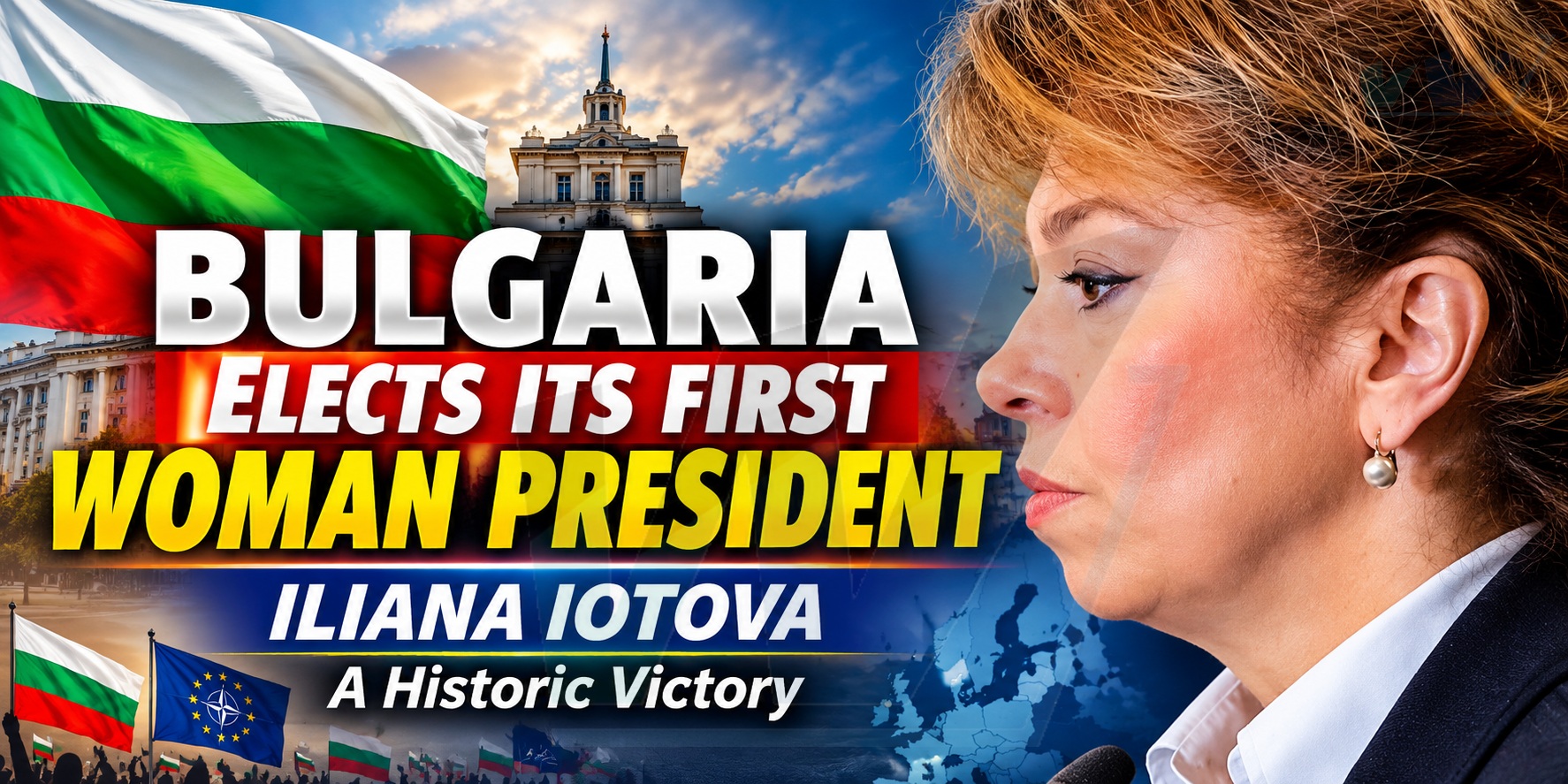
Bulgaria’s First Elected Woman President Delivers a Major Geopolitical Blow to Europe’s Political Balance
Iliana Iotova Wins Bulgaria’s Presidency: What Her Victory Means for Russia, Ukraine and NATO
Bulgaria’s Political Earthquake: Iotova Victory Strengthens Radev and Raises Questions for Ukraine
SOFIA — Bulgaria has entered a new political chapter. Iliana Iotova has secured a decisive victory in the November 1 presidential runoff, becoming the first woman directly elected to the country’s highest office in its democratic history, and delivering a significant political boost to Prime Minister Rumen Radev.
But behind the historic breakthrough lies a much bigger geopolitical question: Will Bulgaria become a stronger voice for negotiations with Moscow at a time when Europe remains divided over Ukraine and regional security?
Preliminary results published by the Bulgarian National Radio, based on 99.56% of processed election protocols, put Iotova and her running mate Kiril Valchev at 57.68%, against 39.35% for opposition challenger Andrey Gyurov and his running mate Georgi Kandev. Gyurov has conceded defeat, while final certification remains pending.
The outcome gives Iotova a substantial mandate and strengthens the political camp led by Radev, whose government has advocated negotiations with Russia and opposed additional military assistance to Ukraine.
A historic victory with geopolitical consequences
At 62, Iotova had already made history once. She assumed the presidency in January 2026 after Radev resigned to enter parliamentary politics, becoming the first woman to occupy Bulgaria’s presidency.
Sunday’s election takes that milestone further: she has now secured the position through a direct popular vote.
Her victory came against Gyurov, a former caretaker prime minister backed by pro-Western opposition parties. The campaign exposed a deep national divide over Bulgaria’s relationship with Moscow, its commitments to Kyiv and its place within the European security architecture.
Iotova presented herself as a candidate for peace, national sovereignty and diplomatic engagement. Her message resonated with voters concerned about the possibility of further escalation in the Russia-Ukraine war.
Moscow, Kyiv and the battle over Europe’s eastern flank
The election’s most consequential implications extend far beyond Sofia.
Iotova has repeatedly argued that the war in Ukraine cannot be resolved through weapons deliveries alone. She supports renewed diplomatic engagement with Moscow and opposes additional military assistance that, in her assessment, could prolong the conflict.
Her rival offered a sharply different vision.
Gyurov maintained that Russia must end its aggression before meaningful negotiations can proceed. During his earlier caretaker premiership, he supported closer security cooperation with Ukraine, including a bilateral security agreement.
The contrasting positions transformed the presidential contest into a referendum on Bulgaria’s foreign-policy direction.
For Kyiv, Iotova’s victory raises questions about the future political climate surrounding Bulgarian support for Ukraine. For Moscow, her calls for diplomatic engagement could offer an opportunity to reopen political channels with an EU and NATO member that has historically maintained close cultural, economic and political ties with Russia.
Nevertheless, Bulgaria remains a member of both Western institutions, and the election does not automatically translate into a change in its international commitments.
Black Sea tensions add urgency
The election unfolded against an increasingly dangerous security backdrop.
Drone attacks on merchant vessels near Bulgaria’s Black Sea coast have intensified concerns about the expanding regional consequences of the war in Ukraine. Reuters reported that approximately two dozen seafarers were feared dead or missing in connection with the incidents.
The attacks have raised urgent questions about maritime safety, commercial shipping routes and the possibility of a wider confrontation.
Although Bulgarian authorities have not established direct Russian responsibility, the incidents have placed additional pressure on Sofia to balance diplomacy with national and allied security requirements.
Iotova’s approach will therefore face an immediate test: whether Bulgaria can advocate negotiations while protecting its Black Sea interests and maintaining confidence among its NATO and EU partners.
A victory for Radev’s political camp
The election also represents an important political success for Prime Minister Rumen Radev.
Iotova is a longtime political ally, and their shared positions on Ukraine, Russia and European diplomacy give the government a potentially stronger voice in shaping Bulgaria’s international direction.
The result could also influence discussions within the European Union over sanctions, military support for Kyiv, energy security and the future of relations with Moscow.
Yet the Bulgarian presidency is not equivalent to executive control of government. Although the office has substantial constitutional and political influence, including the ability to veto legislation and appoint ambassadors, foreign and domestic policy remain subject to the wider constitutional system.
The silent warning: A divided electorate
Despite the scale of Iotova’s victory, voter participation remains an important concern.
Preliminary estimates placed runoff turnout at approximately 27–29%, following a first round in which participation was around 23%.
The figures show a troubling contradiction: a decisive electoral outcome accompanied by limited public engagement.
For Iotova, the challenge will be to turn an electoral victory into a broader national consensus, particularly among citizens who fear political instability, corruption, economic uncertainty and Bulgaria’s growing exposure to regional tensions.
Europe’s next diplomatic test
Iotova’s victory sends a message that European governments cannot ignore.
Bulgaria is strategically positioned at the intersection of the Black Sea, the Balkans, the European Union and NATO. Its political direction matters not only to Sofia, but also to Kyiv, Moscow, Brussels and Washington.
The new president must now navigate competing expectations: maintaining Bulgaria’s European and Atlantic commitments, addressing security concerns in the Black Sea, and pursuing the diplomatic engagement with Russia that helped define her campaign.
Her historic election may have settled the presidential contest. It has not settled Bulgaria’s geopolitical dilemma.