
The heavy iron gates of Zhongnanhai didn’t just open last week; they parted like the curtain of a high-stakes theater where the world’s two most powerful men stepped into the spotlight.
Outside, hundreds of flag-waving children and goose-stepping soldiers put on a masterclass in authoritarian pageantry. Inside the secluded Chinese Communist Party compound, however, the air was thick with tension. US President Donald Trump and Chinese President Xi Jinping sat face-to-face for two days of intense, closed-door talks.
When the dust settled and Air Force One wheels left the Beijing tarmac, the global media immediately began hunting for a victor. But as the smoke clears from this diplomatic battlefield, a fascinating divide has emerged among the world’s leading newsrooms.
So, who really won the Battle of Beijing?
The Spin: Trump’s “Fantastic” Fortune
If you listen to the American President, the trip was nothing short of an absolute triumph. Boarding Air Force One, Trump boasted to reporters of “fantastic trade deals” and claimed he had solved deep-seated problems “that other people wouldn’t have been able to solve.”
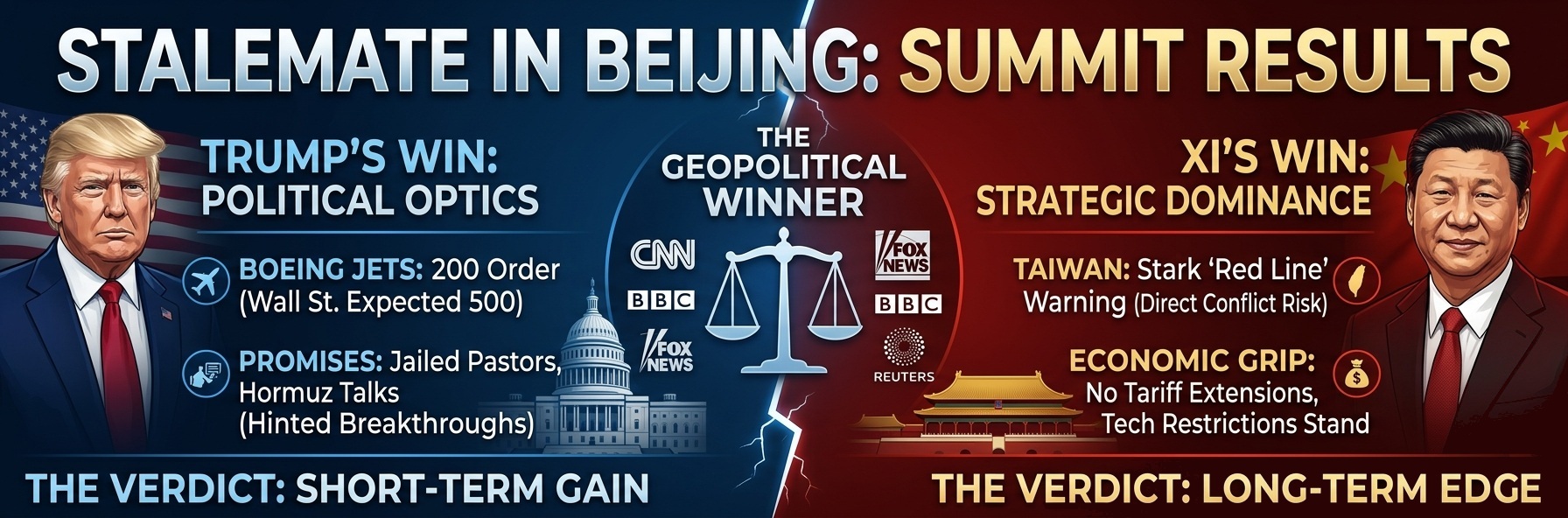
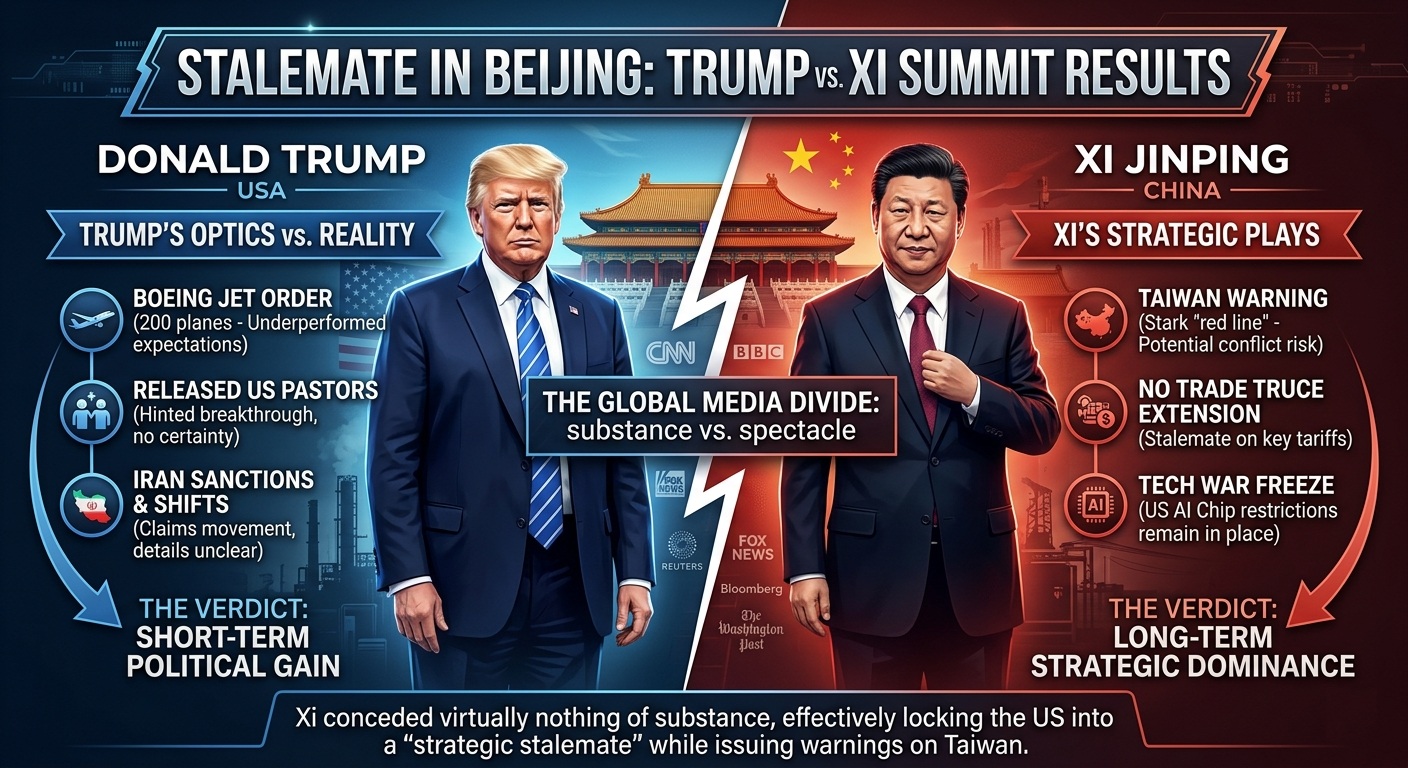
To bolster his narrative, Trump touted a headline-grabbing order from China for 200 Boeing commercial jets equipped with General Electric engines. He dropped hints to Fox News that Xi was “seriously considering” releasing jailed American pastors and suggested that a personal breakthrough had been made to eventually reopen the critical, conflict-choked Strait of Hormuz. For a president battered at home by high inflation, soaring gas prices, and political headwinds, it was the exact transactional optics he craved.
Reality Check: Pageantry Over Policy
But behind the glitz and the promises, global consensus painted a far more bruising picture for the White House.
Major financial and investigative outlets—including Reuters, The Wall Street Journal, Bloomberg, and The New York Times—were quick to pull back the curtain. They pointed out that underneath the performative flair, the summit was starved of substance.
- The Markets React: Wall Street wasn’t buying hype. Investors had anticipated an order of closer to 500 Boeing jets; when the reality of 200 thin-on-details planes hit, Boeing shares plummeted over 4%, dragging Chinese stocks down with them.
- The Tariff Stalemate: A crucial trade truce is set to expire later this year. According to reports from Bloomberg TV, U.S. Trade Representative Jamieson Greer could not even secure an extension on that basic benchmark.
- The Tech Cold War: Even a last-minute, high-octane arrival in Beijing by Nvidia CEO Jensen Huang failed to move the needle. The tight U.S. restrictions on advanced AI chips remained frozen solid.
Xi’s Soft-Spoken Ambush
While Trump looked for quick business wins to flash to voters back home, Xi Jinping was playing 3D chess. Armed with a sense of geographic and political permanence, the Chinese leader used the summit to execute a quiet, calculated ambush.
According to analyses by The Washington Post, The Guardian, and BBC, the sheer grandiosity of the welcome served a dual purpose: it flattered Trump’s affinity for strongman aesthetics while subtly projecting China as an absolute geopolitical peer to the United States.
More alarming, however, was what happened when the doors closed. On China’s absolute red line—Taiwan—Xi dropped the diplomatic pleasantries. He delivered a stark, chilling warning, telling Trump that mishandling the island could push the two superpowers into a “dangerous place” of direct conflict.
Rather than standard American pushback, Trump opted for what The Guardian noted as unusual restraint, later telling reporters on his plane, “On Taiwan, he feels very strongly… I made no commitment either way.” Analysts speaking to CNN and NBC News noted that by appearing to plead for favors on trade and Iran oil sanctions, Trump inadvertently handed Beijing the upper hand, allowing Chinese officials to play hardball.
The Verdict: Who is the Winner?
In the theater of geopolitical warfare, victory is defined by your objectives.
If the metric of success is the short-term political theater, Donald Trump secured a temporary shield. He got his photo-ops, his Boeing announcement, and a dramatic narrative of structural stability to showcase on American cable news.
But if the metric is long-term strategic dominance, the undisputed winner of the Beijing Summit is Xi Jinping.
As regional experts summarized across Axios and The Associated Press, China effectively locked the U.S. into a “strategic stalemate.” Xi conceded virtually nothing of substance on Russia, Iran, or trade, successfully readied defenses against future American tariff shocks, and issued a direct, unreciprocated warning on Taiwan.
Trump flew into Beijing looking for a breakthrough; he flew out trapped in a beautifully choreographed cage of “strategic stability.” The world’s two giants have hit a tense, volatile equilibrium—and the clock toward their next inevitable collision is already ticking.