
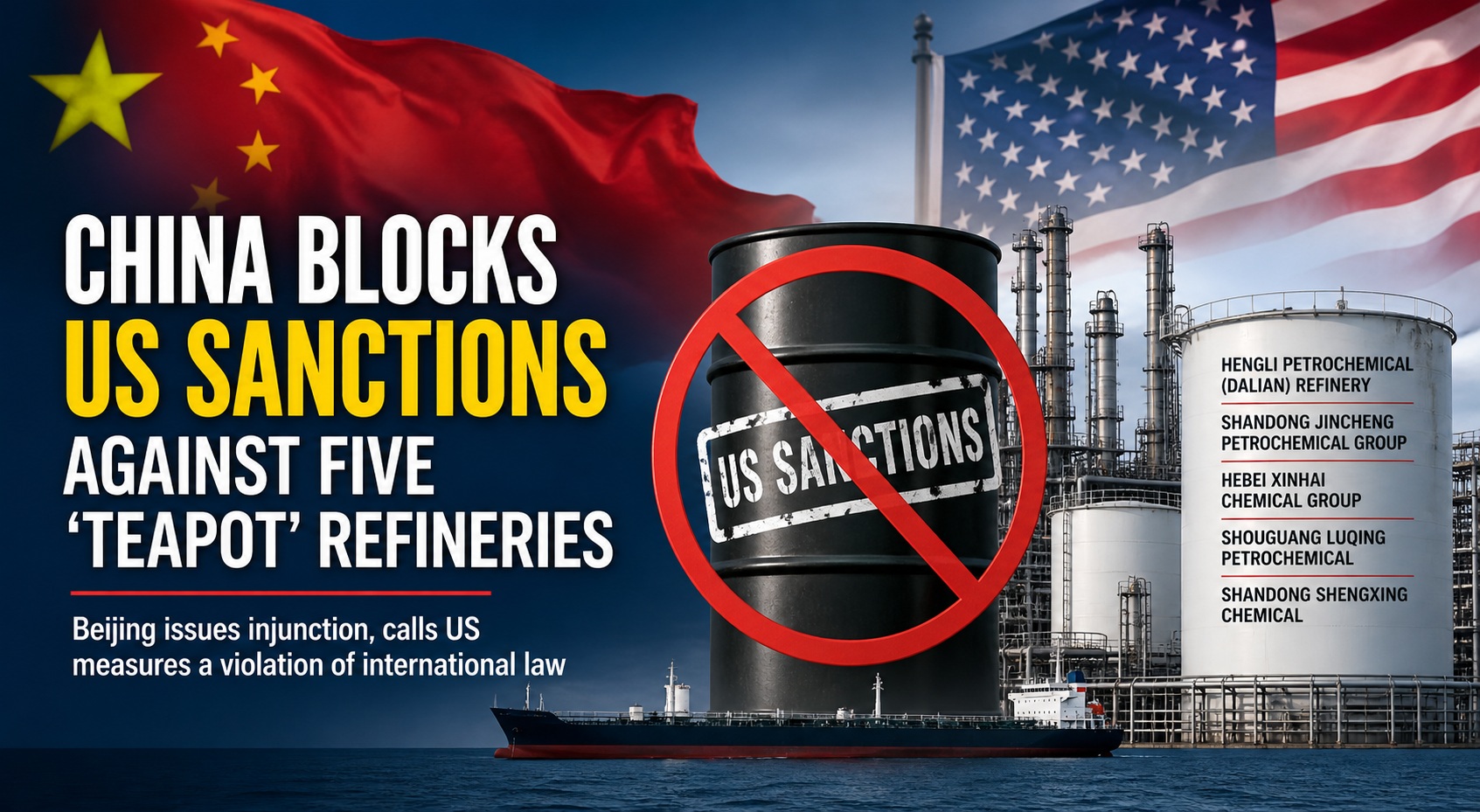
China has formally moved to counter U.S. sanctions targeting five of its oil refineries, intensifying tensions between the world’s two largest economies over energy trade and the enforcement of unilateral sanctions.
In a statement issued by the Ministry of Commerce, Beijing announced a legal injunction prohibiting the recognition or enforcement of U.S. measures imposed on Chinese firms accused of importing Iranian crude. The decision directly challenges Washington’s latest sanctions, which aim to curb Tehran’s oil revenues by targeting key buyers in China’s independent refining sector.
The U.S. Department of the Treasury had imposed restrictions on the refineries—most recently in late April—barring them from access to the American financial system and threatening penalties for any entities conducting business with them. Among those named are Hengli Petrochemical (Dalian) Refinery and four privately operated “teapot” refineries: Shandong Jincheng Petrochemical Group, Hebei Xinhai Chemical Group, Shouguang Luqing Petrochemical, and Shandong Shengxing Chemical.
Beijing sharply criticized the sanctions, arguing they constitute an overreach of U.S. authority. The Commerce Ministry stated that the measures “violate international law and the basic norms of international relations,” and emphasized that China consistently opposes unilateral sanctions lacking United Nations authorization.
Under the newly issued “prohibition order,” Chinese entities are explicitly instructed not to comply with the U.S. restrictions. Officials framed the move as necessary to safeguard national sovereignty, economic security, and development interests, signaling a more assertive stance against extraterritorial enforcement by Washington.
The dispute underscores the strategic role of China’s independent, or “teapot,” refineries in global energy markets. Typically, smaller and privately operated, these facilities account for roughly a quarter of China’s refining capacity and have become central to its energy security strategy by purchasing discounted crude from sanctioned producers such as Iran, Russia, and Venezuela.
U.S. officials have accused at least one of the targeted companies, Hengli Petrochemical, of generating substantial revenue for Iran through large-scale oil purchases—claims that form part of a broader American effort to restrict Tehran’s financial resources.
Despite mounting pressure, China remains the dominant buyer of Iranian oil, with estimates indicating it accounted for more than 80 percent of Iran’s crude exports in 2025. This trade has persisted through a combination of discounted pricing, alternative payment mechanisms, and complex supply chains designed to bypass sanctions.
For China’s refiners, however, the environment is becoming increasingly challenging. Beyond geopolitical risks, many “teapot” operators are grappling with weak domestic demand, tight profit margins, and logistical complications stemming from sanctions—such as difficulties in sourcing crude and marketing refined products under standard origin labels.
Beijing’s latest move marks a significant escalation, transforming what had largely been a pattern of indirect circumvention into an explicit legal rejection of U.S. sanctions authority. It also raises broader questions about the effectiveness of unilateral sanctions in a global economy where major powers are increasingly willing to contest their reach.
Source: Reuters