
Europe Under Aviation Alert: Anonymous Bomb Threats Trigger Emergency Landings Across 13 Countries
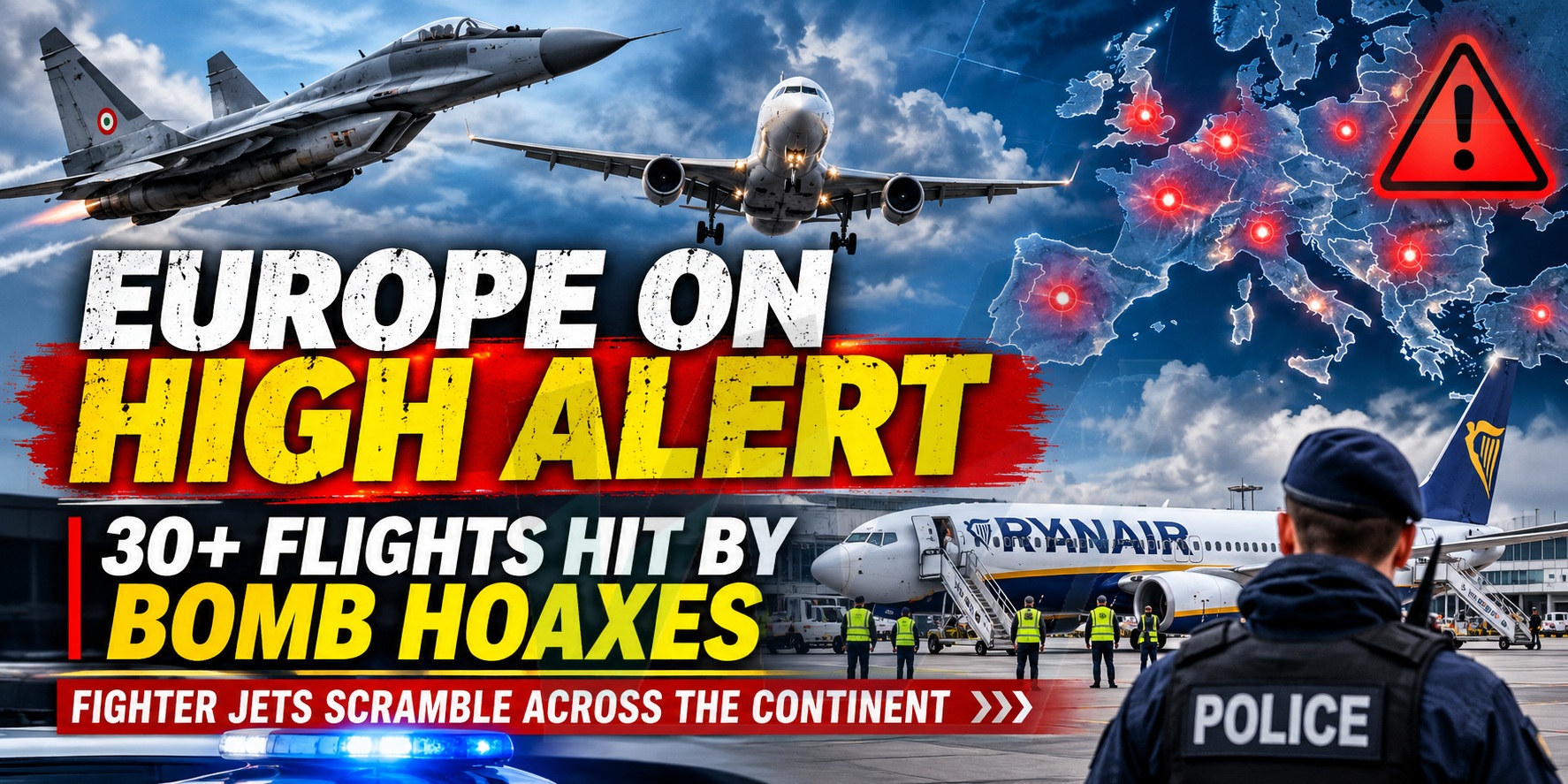
MiG-29 Fighters Scramble as Bomb Hoaxes Spread Across Bulgaria and Europe
From Rome and Sofia to Paris and Warsaw, a wave of suspicious bomb threats has triggered emergency landings, military escorts and airport security operations. Investigators are examining possible links to Russian extremist circles, but responsibility remains unconfirmed.
Europe’s skies have become the scene of an alarming security scare. A growing wave of bomb threats targeting commercial aircraft has forced emergency diversions, military interceptions and extensive security inspections across the continent, leaving airlines and authorities scrambling to contain the disruption.
From France and Italy to Bulgaria, Poland, Austria and the Czech Republic, passenger aircraft have been placed under emergency procedures after threatening messages claimed explosives were on board.
The scale is growing. At least 35 flights have reportedly been disrupted during the week, according to The Guardian, while AFP reported approximately 20 commercial flights affected on Thursday alone.
So far, the most reassuring finding is also the most important: searches have uncovered no explosives, and no passenger casualties have been reported.
But the mystery surrounding the threats is deepening.
Fighter jets scramble as aircraft are diverted
Thursday, November 5, brought a dramatic escalation.
In France, an Aer Lingus Airbus A320 travelling from Dublin to Rome was diverted to the Évreux military airbase after a bomb alert.
The aircraft carried 151 passengers and six crew members. French authorities confirmed that everyone was safe as bomb-disposal specialists began inspecting the plane.
French fighter jets were scrambled to intercept and escort the aircraft.
In Italy, a Finnair flight from Helsinki to Rome received a similar threat and was escorted by Italian Air Force aircraft to Fiumicino Airport. The plane landed safely, with the airline subsequently reporting that nothing unusual had been found.
A Wizz Air flight travelling from Milan to Warsaw was diverted to Vienna, where security inspections were conducted.
Bulgaria deploys MiG-29 fighters
Bulgaria became one of the principal flashpoints in the unfolding crisis.
Three Ryanair flights heading to Sofia from Copenhagen, Madrid and London received bomb threats.
The Bulgarian Air Force responded by scrambling three MiG-29 fighter jets from Graf Ignatievo Air Base.
Two passenger aircraft landed at Sofia’s Vasil Levski Airport, while the third was diverted to Plovdiv.
Emergency services were deployed; passengers were evacuated and security teams searched for the aircraft. No explosives were found.
The Bulgarian Ministry of Defense confirmed that the fighter-jet operation was conducted under NATO’s air-policing arrangements.
The incidents followed earlier scares involving flights bound for Sofia, including a Wizz Air aircraft diverted from London Luton to Budapest.
A disturbing Russian connection emerges
Perhaps the most troubling development concerns the threatening messages themselves.
According to AFP, emails targeting flights to Sofia and Rome contained misogynistic language and claimed to originate from individuals identifying themselves as fighters of the Russian extremist movement known as Male State.
The messages threatened explosions aboard specific aircraft and invoked an extremist anti-feminist ideology.
The movement was designated extremist by Russian courts in 2021. However, investigators have not established that its members sent the threats.
Reuters reported that the group’s founder denied involvement.
Nor has any verified evidence established that the Russian government or intelligence services directed the campaign.
The allegations nevertheless raise questions about whether extremist networks, copycat actors or other unidentified groups are exploiting Europe’s security vulnerabilities.
A continent-wide pattern raises hybrid warfare concerns
The latest incidents did not emerge in isolation.
On November 3, several aircraft operated by Ryanair, LOT Polish Airlines, SAS and Wizz Air received threats. Flights were diverted or searched in connection with incidents involving Warsaw, Murcia, Sofia and other European destinations.
One airport near Warsaw suspended operations while security teams inspected aircraft.
Earlier, a Wizz Air flight travelling from London’s Luton Airport to Sofia was diverted to Budapest and escorted by Hungarian Gripen fighter jets.
The latest wave has involved airlines including Aer Lingus, Finnair, Ryanair, Wizz Air, LOT Polish Airlines and others.
The geographical spread is equally striking, with reports involving France, Italy, Bulgaria, Poland, Austria, Spain, Romania, Denmark, the Czech Republic and other European destinations.
European officials have warned against drawing premature conclusions about whether all the incidents are connected.
Nevertheless, the repeated targeting of civilian aviation has renewed concerns about hybrid threats designed to create confusion, undermine public confidence and disrupt essential infrastructure without necessarily causing physical destruction.
The real cost of a bomb hoax
Even when no explosive exists, a bomb threat can trigger a costly chain reaction.
Aircraft must be diverted, passengers evacuated, luggage and cargo inspected, airport operations adjusted and security personnel mobilized.
Airlines face delays, missing connections, additional fuel consumption, crew scheduling problems and expensive operational disruptions.
For passengers, the consequences are immediate: uncertainty, missed appointments, cancelled connections and the fear of being caught in an emergency thousands of meters above ground.
Europe’s aviation system is designed to treat every credible threat seriously. That response protects lives, but it also creates opportunities for malicious actors to disrupt air travel through relatively inexpensive anonymous messages.
Who is behind the threats?
That remains the central unanswered question.
Investigators are examining the threatening communications, their wording, possible connections between the senders and the timing of the incidents.
The appearance of the Male State name provides an investigative lead, not proof of responsibility.
European authorities must now determine whether the incidents represent a coordinated operation, an extremist campaign, copycat threats or several unrelated acts of criminal disruption.
For now, the aircraft have landed, passengers have been brought to safety, and no explosives have been discovered.
But the security challenge remains airborne.