

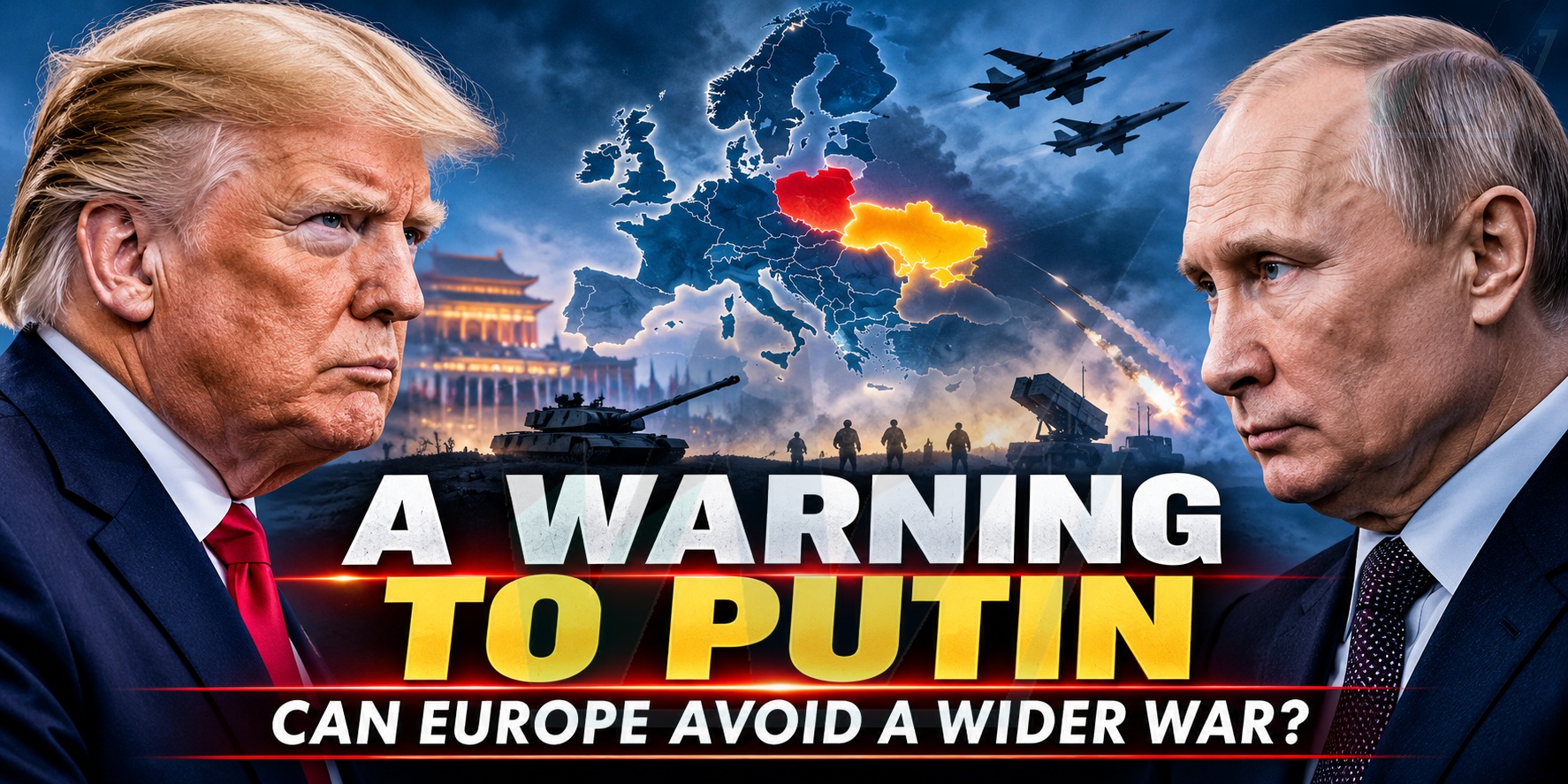
A friendship, a warning, and a continent holding its breath
Trump Warns Putin to Stop Military Aggression Across Europe as Ukraine Peace Talks Face Deadlock
One week ago, Donald Trump welcomed Vladimir Putin in China with a warm handshake and a description that immediately raised eyebrows across European capitals: “He’s, my friend.”
Now, the American president says he wants that same Russian leader to pull back all military aggression against territories throughout Europe.
The shift is striking. And its timing is anything but ordinary.
On November 26, Trump revealed that he had raised the issue directly with Putin during their November 19 discussions in Shenzhen, China. His stated objective was to accelerate a negotiated settlement between Russia and Ukraine, a war that continues to devastate lives, infrastructure and Europe’s security architecture.
“I really believe this is a strong possibility,” Trump said, describing the conflict as a complete bloodbath.
But there is a critical detail: Trump did not clearly define which European territories he meant, nor did he publicly outline a mechanism to ensure that Moscow would comply.
That ambiguity matters enormously when NATO’s eastern flank is increasingly anxious about Russian military activity.
-
Poland becomes the warning Europe cannot ignore
The diplomatic conversation is unfolding against a troubling security backdrop.
On November 23, Poland requested an extraordinary meeting of the North Atlantic Council after Russian CH-101 cruise missiles violated Polish airspace and struck areas near Nowy Lipowiec, Rudnik nad Sanem and Mołodycz, according to the Polish government’s NATO account.
The incident placed a NATO member’s territory directly at the center of an increasingly dangerous confrontation.
Poland called for stronger protection of NATO’s eastern flank. NATO’s Supreme Allied Commander Europe deployed an AWACS surveillance aircraft to Poland and said additional defensive resources would be considered.
This is not a minor geographical detail.
Poland is a member of NATO. An attack or serious military incident involving its territory carries implications far beyond the Polish border because of the alliance’s collective-defense commitments.
That does not mean every airspace violation automatically triggers Article 5. It does mean that repeated incidents, miscalculations or deliberate provocations could bring NATO and Russia closer to a confrontation neither side officially claims to want.
For European governments, the question is no longer simply how to support Ukraine. It is how to prevent the war from spilling into their own territory.
-
Trump and NATO: A message Moscow cannot easily dismiss
Trump’s remarks followed his November 25 meeting with NATO Secretary-General Mark Rutte at Mar-a-Lago in Florida.
Their joint statement stressed that Russia and Ukraine must avoid actions that intentionally or unintentionally expand the war and called for a peaceful resolution as quickly as possible.
The sequence is significant:
- November 19: Trump meets Putin in China and publicly calls him a friend.
- November 25: Trump meets NATO’s Mark Rutte in Florida.
- November 26: Trump publicly says he urged Putin to end military aggression across Europe.
The message appears to combine two approaches: maintaining direct communication with Moscow while reassuring NATO allies that Washington does not want the conflict spreading beyond Ukraine.
Yet the language also exposes a strategic tension.
Trump has previously criticized Kyiv for striking targets deep inside Russia. In this latest statement, however, he did not make an equivalent public demand that Ukraine exercise similar restraint.
For Moscow, that difference may become part of the diplomatic argument. For Kyiv and European capitals, it raises a different question: will Washington apply pressure equally to both sides, or will the pursuit of a rapid agreement place greater demands on Ukraine?
-
The real obstacle: Territory, sovereignty and Putin’s demands
Behind the diplomatic language lies the hardest question of all: territory.
Jared Kushner, Trump’s son-in-law and one of the administration’s envoys involved in the Ukraine negotiations, acknowledged in an interview with Germany’s MD Meets Podcast that territorial questions in eastern Ukraine remain a major obstacle.
He described the negotiations as being at a “deadlock” over territory claimed by Moscow.
Kushner also characterized Putin as a “grandmaster of politics” and argued that the Russian leader had demonstrated restraint by not using nuclear weapons.
These remarks have drawn attention because they reveal the thinking of people involved in the American diplomatic effort.
But there is an essential distinction: a willingness to negotiate is not the same as an agreement, and a description of Putin’s intentions is not independent proof that Moscow is prepared to abandon its territorial demands.
For Ukraine, this is not simply a discussion about drawing lines on a map.
It concerns sovereignty, the future of occupied communities, the security of millions of people and whether military conquest can be converted into internationally accepted political gains.
Any settlement that ignores these questions risks producing an agreement on paper without producing lasting peace on the ground.
-
The nuclear shadow: One mistake could change everything
The danger extends far beyond the current battlefield.
Kushner warned that a relatively small miscalculation could cause the conflict to escalate dramatically.
That concern is not theoretical.
The war has already brought repeated warnings about nuclear risks, attacks on critical infrastructure, military incidents near NATO territory and growing pressure on European defense systems.
A missile crossing a border, a drone strike mistakenly attributed to the wrong actor, or a misinterpreted military maneuver could trigger a chain of decisions with consequences far beyond the original incident.
This is why NATO’s language about preventing intentional or accidental expansion of the war matters.
The objective is not merely to avoid a deliberate attack on an alliance member. It is also to prevent an unintended escalation in an environment where military forces are operating under extraordinary pressure.
The cost of miscalculation is potentially enormous.
-
Ukraine is still fighting, and the battlefield is not waiting for diplomacy
While leaders discuss peace in diplomatic rooms, the war continues on the ground.
An Associated Press report on November 27 said Ukrainian President Volodymyr Zelenskyy had warned of a potentially major Russian attack targeting energy infrastructure, logistics and critical services.
The warning followed overnight attacks involving ballistic missiles and 113 drones. Ukrainian authorities reported damage across multiple locations and ongoing repair work in six regions.
As winter approaches, the threat to electricity, heating, transport and essential services becomes particularly serious.
The consequences reach ordinary families first: homes without power, hospitals under pressure, damaged infrastructure and communities forced to endure another period of uncertainty.
Meanwhile, Ukraine continues to seek additional air-defense capabilities, including Patriot interceptors.
This is the reality that any diplomatic initiative must confront. A peace process cannot be measured only by meetings, declarations or optimistic statements. Its real test is whether the attacks stop and civilians become safer.
-
China, Putin and Trump’s diplomatic gamble
The November 19 meeting in Shenzhen also highlights China’s increasingly important place in the diplomatic equation.
Trump’s engagement with both Putin and Chinese President Xi Jinping offers Washington an opportunity to use direct leadership-level diplomacy rather than relying exclusively on conventional channels.
But Beijing’s influence should not be confused with control over Moscow.
China has its own strategic interests, economic priorities and relationship with Russia. Its participation in high-level discussions does not guarantee that Putin will accept a settlement that requires major concessions.
The summit produced no immediate breakthrough on ending the war, despite broader discussions about reducing nuclear risks and international cooperation, according to Anadolu Agency’s account.
The question is whether China’s diplomatic weight can help create conditions for negotiations or whether the meeting will remain another symbolic encounter among powerful leaders.
-
The G20 question: Will Putin come to Trump’s table?
Trump also raised the possibility of Putin attending the G20 summit scheduled for December 14–15 in Florida.
He said the Russian president would be welcome if he wanted to attend, while acknowledging that he was uncertain whether Putin would accept.
The Kremlin, according to Reuters reporting, had not decided.
Such an appearance would carry enormous political symbolism. It could signal renewed high-level engagement between Washington and Moscow, but it would also raise questions about Russia’s international standing while the war continues.
For European leaders and Ukraine, the symbolism would matter almost as much as the discussions themselves.
Would Putin arrive as a negotiating partner ready to make concessions, or as a leader seeking diplomatic legitimacy without changing Russia’s conduct?
That distinction could define the political meaning of the summit.
THE BIGGER PICTURE: WHAT IS TRUMP REALLY TRYING TO ACHIEVE?
Three possible objectives stand out:
First — Prevent a wider European war. By addressing military aggression beyond Ukraine, Trump is signaling that Washington wants to avoid further incidents involving NATO territory.
Second — Create leverage for a Ukraine settlement. Direct communication with Putin may help identify areas where negotiations are possible, but the territorial question remains unresolved.
Third — Reposition American leadership. Trump wants to demonstrate that he can speak directly to Moscow while maintaining America’s central role in NATO and European security.
These objectives are not necessarily incompatible. The challenge is turning them into a coherent policy with enforceable commitments.
WHAT HAPPENS NEXT?
The coming weeks will offer several important tests:
- Moscow’s response: Will Putin publicly address Trump’s demand, and will Russian military activity change?
- Kyiv’s position: Will Ukraine accept the terms being discussed, particularly on territory and security guarantees?
- NATO’s readiness: Will European allies strengthen their eastern defenses in response to further incidents?
- Washington’s consistency: Will the United States maintain pressure on Russia while supporting Ukraine’s ability to defend itself?
- The December G20 summit: Will Putin attend, and could the meeting produce a meaningful diplomatic development?
These are the questions that will determine whether Trump’s latest words become a turning point or another episode in a long diplomatic cycle.
THE FINAL QUESTION: CAN PEACE BE NEGOTIATED WITHOUT REWARDING AGGRESSION?
There is a difference between ending a war and resolving the conditions that made it possible.
A ceasefire may stop the immediate killing. A negotiated agreement may create breathing room. But lasting peace requires more: credible security guarantees, respect for sovereignty, enforceable commitments and a political framework that prevents the conflict from simply returning under a different name.
Trump is betting that personal diplomacy and direct pressure can bring Putin closer to an agreement.
Europe is watching because the consequences of failure would not remain confined to Ukraine.
And Ukraine is watching because the terms of any settlement will shape its future for generations.
One week after the handshake in China, Washington’s message has changed. Whether Moscow changes its actions is the question that matters most.