

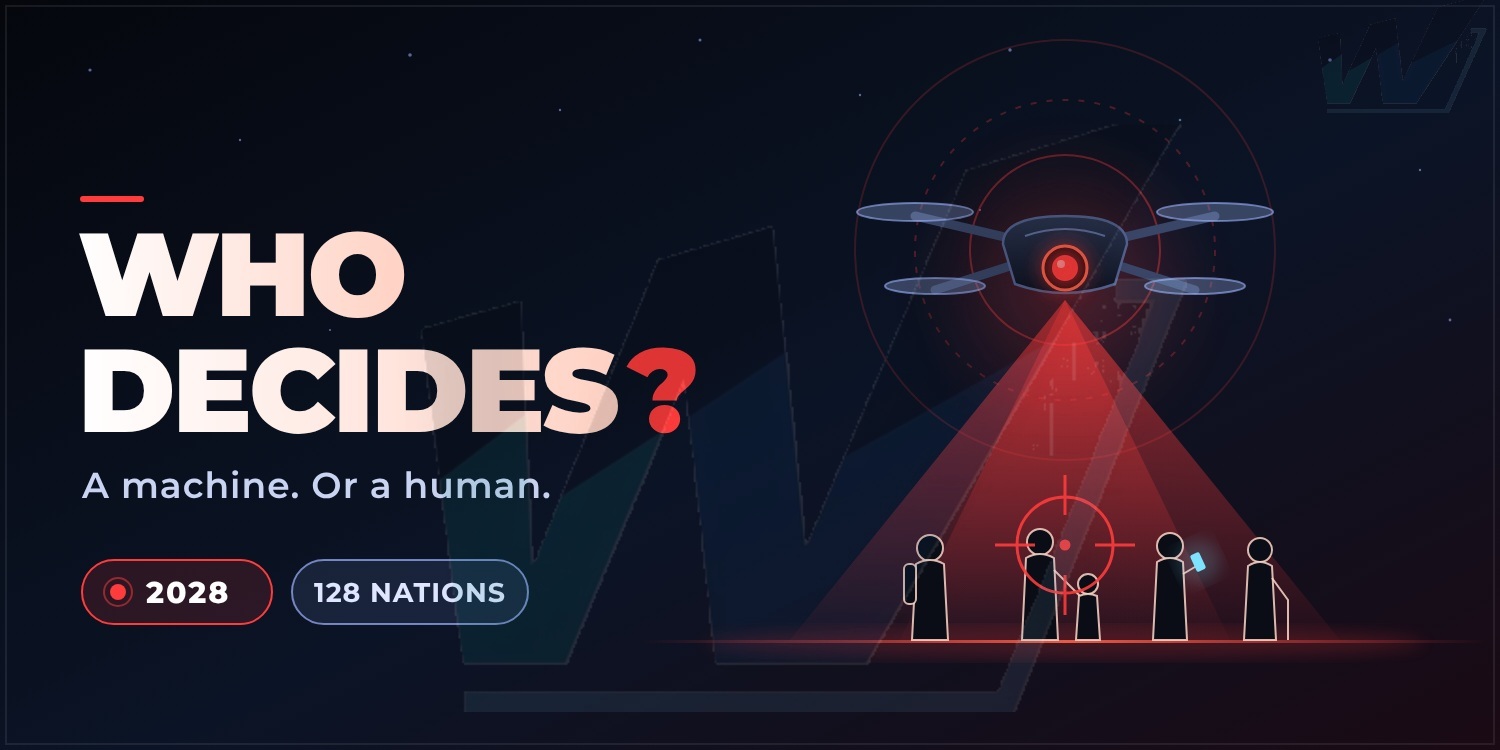
Killer Robots: 128 Nations Agree Talks Until 2028
After a night of overtime in Geneva, governments chose the word “elaborate” over “negotiate”. No ban. No binding treaty. And AI weapons aren’t waiting.
Scene It is 4:30 a.m. in Geneva. Five days of United Nations talks have already spilled into overtime. Some sessions were called off over procedural fights; delegates have been haggling over single words through the night. Then the final text is read out.
Revelation The word at the center of it isn’t “ban” It isn’t even “negotiate”. The 128 countries in the Convention on Certain Conventional Weapons agreed to “elaborate” a possible accord on lethal autonomous weapons by 2028, because some states refused to accept the word “negotiate” at all.
Consequence In plain English: for at least the next two years, there is still no new, legally binding rulebook written for weapons that can find a target and strike it without a human making the final call. The technology, meanwhile, keeps moving.
Question So who decides when a machine pulls the trigger, and who answers when it gets it wrong?
What was agreed
- The deal: countries will “elaborate” an instrument on autonomous weapons, with a group of government experts reporting back in 2028.
- What’s missing: a mandate to negotiate a legally binding ban or treaty. The text, per reporting, doesn’t commit to binding rules.
- The scope: Swiss diplomat Julien Thoeni, who chaired the conference, said the work should sort out which weapons can be banned under international humanitarian law and which can be allowed but regulated.
- The mood: Thoeni called it proof that “multilateral diplomacy can still deliver concrete results.” Campaigners called it “watered down.”
Why it took a night and still fell short
Think of the UN conference as a group chat where every single member can veto every decision. That is how this convention works: decisions need the agreement of all members. Nearly 100 nations pushed for swift, legally binding rules. The United States, Russia and Israel opposed that push, and diplomats said Russian objections over procedure got some formal sessions cancelled. The US reportedly proposed five more years of talks on voluntary guidelines instead. EU diplomats cited by Politico said the UK, South Korea, Japan, Türkiye and Israel also resisted binding regulation, while France floated a “hybrid” text mixing binding and non-binding parts.
A diplomat from a supporting country summed it up for Al Jazeera: disappointing, but it could have been much worse.
“Sci-fi” stopped being the right word
Vincent Boulanin, who directs the AI governance programme at the Stockholm International Peace Research Institute (SIPRI), told FRANCE 24 that something long seen as futuristic is now showing up in real cases, with weapons used in autonomous mode to finish an attack. Campaign groups say armies have already tested or used such systems in Ukraine and Gaza; governments that use drones and robots in war say humans keep the final say. NPR reports that AI-assisted weapons have been used in both conflicts, but that those systems are still controlled remotely by people. That gap, “assisted” versus “autonomous”, is exactly what the world is arguing about.
The risk, without the jargon
- Wrong target. Experts warn machines can miss context a human would catch. The Red Cross worries that autonomous systems may not reliably tell fighters from wounded or surrendering soldiers, as the Geneva Conventions require.
- Cheap and spreading. The cheaper the tech gets, the likelier it reaches armed groups or repressive police forces, human rights groups warn.
- Nobody to blame. If an algorithm kills the wrong person, who is accountable, the coder, the commander, the company?
What happens now
UN Secretary-General António Guterres had wanted a binding treaty by 2026, calling machines that take lives without human control a “moral red line.” That deadline is gone. Rain Liivoja of the Asia-Pacific Institute for Law and Security warned there may still be no treaty by the end of 2028. History offers one escape hatch: when talks on landmines stalled, frustrated countries moved outside the UN and created the Ottawa Convention. Stop Killer Robots, a coalition of roughly 300 groups, says delay “puts civilians and humanity at risk.”
Why this is your story too
Whether you scroll at 17 or 70, the same question lands: should a life-or-death call ever be handed to software? The answer won’t be written in a lab. It will be written in Geneva, in 2027 and 2028, and, increasingly, by how loudly ordinary people care.
The bottom line
This wasn’t a failure, and it wasn’t a breakthrough. It was a door left ajar. Whether it swings open into a real treaty, or quietly shuts, depends on who shows up between now and 2028.