

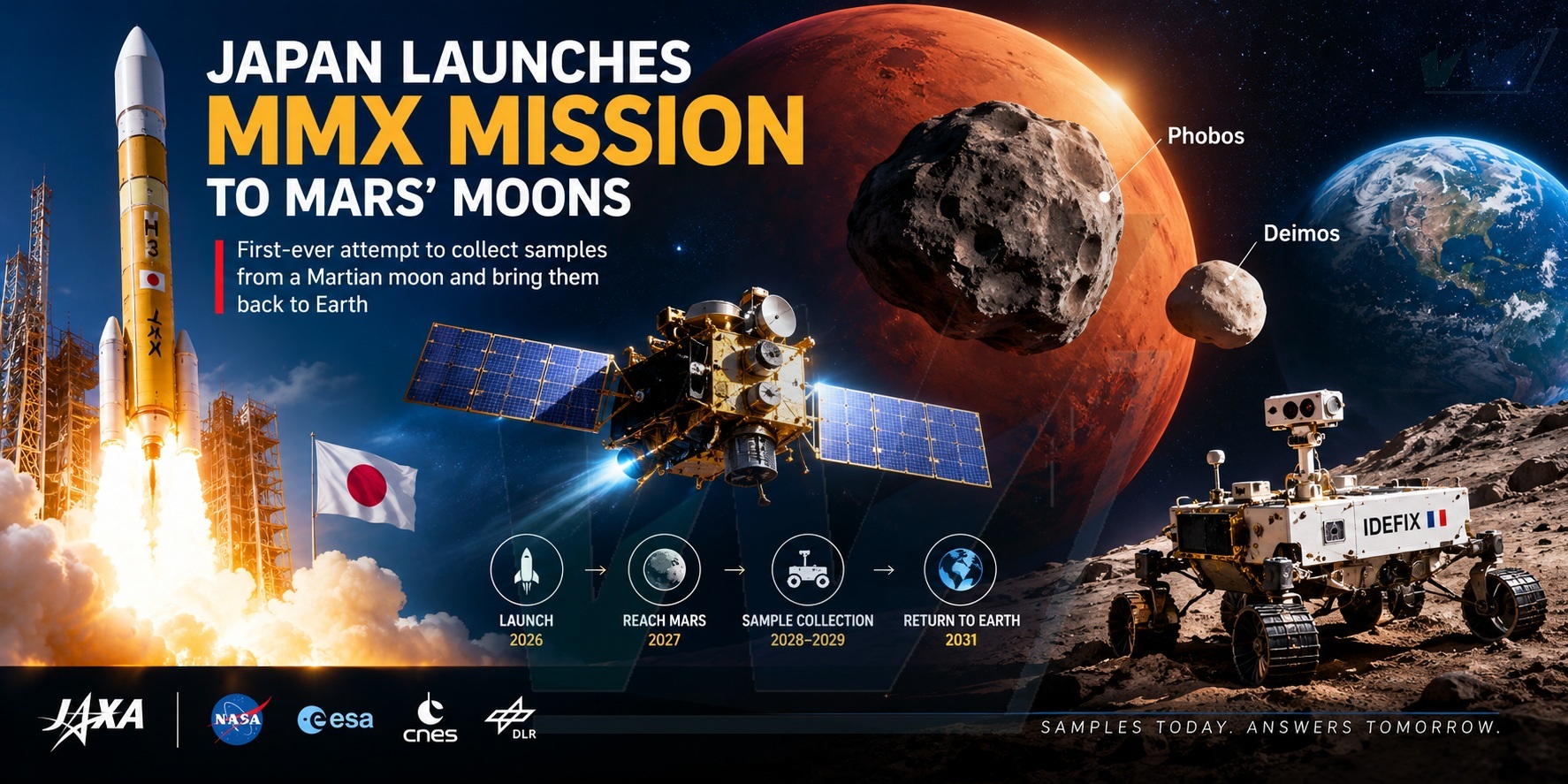
Japan Launches MMX Mission to Mars’ Moons, Targets 2031 Sample Return
Japan’s Boldest Mars Mission Is Underway, And It Could Rewrite the History of Two Mysterious Moons
Japan’s $578 Million Space Mission Targets Mars’ Mysterious Moons, Collects First-Ever Samples and Sets Sights on Earth Return in 2031
TANEGASHIMA, JAPAN, October 20, 2026
Japan has launched one of its most ambitious deep-space missions, sending a spacecraft toward Mars to investigate its enigmatic moons, Phobos and Deimos, and attempt something never achieved before: bringing samples from a Martian moon back to Earth.
The Martian Moons eXploration mission, known as MMX, lifted off aboard Japan’s H3 rocket from the Tanegashima Space Center early Tuesday local time. The Japan Aerospace Exploration Agency (JAXA) confirmed a successful launch sequence, with the spacecraft separating from the rocket as planned, according to Reuters and The Associated Press.
The five-year mission, valued at approximately $578 million, aims to return at least 10 grams of dust, soil and rock from Phobos in 2031. Its findings could help scientists determine how Mars’ two moons formed, reconstruct the Red Planet’s early history and investigate how the ingredients necessary for life may have spread through the Solar System.
A tiny moon, a monumental scientific prize
Phobos is an irregular, potato-shaped world measuring roughly 22 kilometers across. It circles Mars approximately 6,000 kilometers above the planet’s surface, completing three orbits in about one Earth Day.
Despite decades of robotic exploration of Mars, neither Phobos nor Deimos has been visited by a spacecraft that successfully landed and conducted surface operations. No samples have ever been returned from either moon.
That is the challenge facing MMX.
The spacecraft is expected to reach the Martian system in August 2027 before conducting detailed observations of both moons. It will study Phobos’ surface, composition, structure and gravitational environment, searching for a safe location to collect material.
The mission’s scientific prize is not simply a handful of extraterrestrial dust. Scientists hope the samples will preserve evidence of the processes that shaped the Martian system billions of years ago.
Idefix: The rover preparing to explore an alien landscape
One of MMX’s most delicate operations will involve deploying Idefix, a small French-German rover developed through international cooperation.
Named after the little white dog in the Asterix comics, Idefix will investigate Phobos’ rugged terrain and help engineers assess potential sampling sites.
The rover is designed to survive the moon’s extremely weak gravity, where ordinary assumptions about landing and movement no longer apply. Its deployment will require careful control, and its slow movements will help it navigate a surface that remains poorly understood.
The reconnaissance mission is critical. Powdery ground, unstable material or rocks could complicate the larger spacecraft’s landing and sampling operations.
After the rover’s surface work, the main MMX spacecraft is expected to descend to Phobos and collect material during a brief landing operation. The mission plan calls for gathering at least 10 grams of samples, with the collection phase targeted for 2028–2029 in initial mission reporting and the broader return journey scheduled afterward.
The spacecraft will then continue observations of Deimos before beginning its journey home. The returned capsule is expected to land in Australia in 2031.
Did Mars create its own moons, or capture wandering asteroids?
Behind the mission lies a fundamental question: How did Phobos and Deimos form?
Scientists are investigating two leading possibilities.
One theory proposes that the moons are captured asteroids, objects that formed elsewhere and were subsequently trapped by Mars’ gravity.
Another suggests they formed from debris thrown into space after a major collision between Mars and a large impactor. In this scenario, the material gradually accumulated to create the moons.
Samples from Phobos could help distinguish between these competing explanations.
Researchers also expect the material to contain clues about the interaction between the moon and Mars. If Martian debris was transported to Phobos by ancient impacts, the samples could offer an indirect window into geological processes on the Red Planet itself.
The mission will not, by itself, establish whether life ever existed on Mars. However, by examining the chemistry and history of material from the Martian environment, scientists hope to improve their understanding of planetary evolution and the conditions that may support habitability.
Japan, NASA and Europe join forces
MMX is led by JAXA, with contributions from NASA, the French space agency CNES, the German Aerospace Center (DLR) and the European Space Agency (ESA).
NASA is contributing scientific equipment, including the MEGANE instrument, developed with the Johns Hopkins University Applied Physics Laboratory and Lawrence Livermore National Laboratory. It will measure gamma rays and neutrons emitted from Phobos to help determine the moon’s elemental composition.
The international partnership combines Japan’s experience in asteroid sample-return missions with American and European expertise in planetary science, instrumentation and rover technology.
Japan has previously returned samples from asteroids through its Hayabusa and Hayabusa2 missions. MMX builds on that experience while confronting a more complicated challenge: operating in the gravitational environment of Mars and returning material from one of its moons.
According to figures reported by AP, Japan is contributing approximately $350 million, with NASA providing $87 million, France about $68 million, Germany around $56 million and ESA approximately $17 million.
A new space race is taking shape
Japan is not alone in pursuing samples from the Martian system.
China has plans for a Mars sample-return mission targeting a launch in 2028, with a potential return in 2031. NASA, meanwhile, continues to confront the technical and financial challenges of retrieving samples already collected by its Perseverance rover on Mars.
These efforts represent different approaches to the same scientific ambition: bringing pristine extraterrestrial material into laboratories on Earth, where researchers can study it using instruments too large or complex to send into space.
The race is not simply about national prestige. Returned samples can be examined repeatedly as analytical technologies improve, potentially revealing information that current spacecraft instruments cannot detect.
For Japan, MMX also marks the first interplanetary mission for its H3 rocket, a major step for the country’s launch program following the vehicle’s inaugural failure in 2023.
The five-year test begins
The successful launch is only the opening chapter. MMX must travel to Mars, navigate the planet’s gravitational environment, survey an unfamiliar moon, deploy its rover, collect samples and safely return its precious cargo to Earth.
Every stage presents a distinct engineering challenge, and the final scientific payoff depends on the spacecraft completing the journey.
If successful, the mission will deliver the first samples ever returned from the moon of Mars, opening a new chapter in planetary exploration.
The dust and rocks collected from Phobos could help scientists reconstruct the history of Mars’ moons, understand the early Solar System and refine theories about how habitable environments emerge.
For now, the spacecraft is on its way. The answers remain millions of kilometers ahead, and their arrival on Earth is not expected until 2031.