

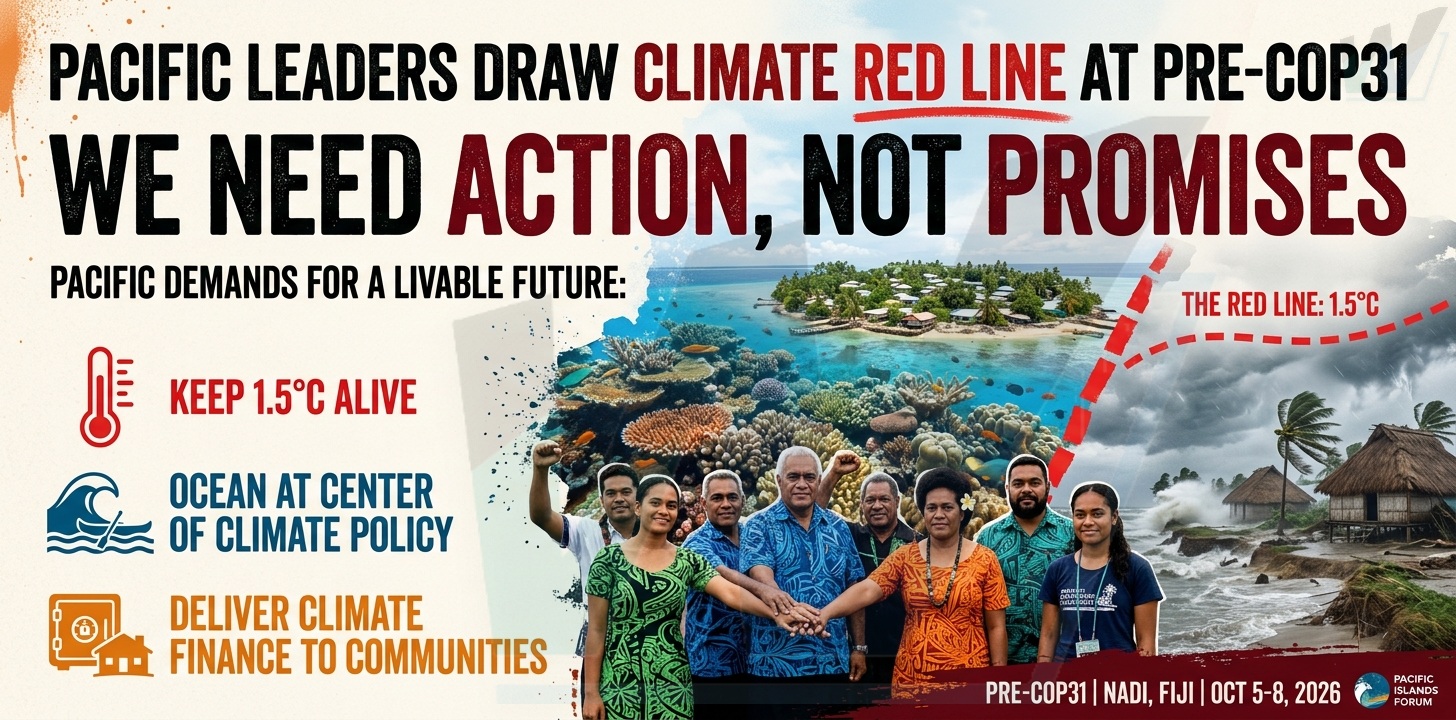
“We Need Action, Not Promises”: Pacific Leaders Draw a Climate Red Line in Fiji
1.5°C, climate finance and the future of the oceans move to the center of the global climate fight as Pacific nations demand action, not promises
NADI, Fiji, October 5, 2026
The Pacific is putting the world on notice.
As the United Nations’ official Pre-COP31 climate talks opened in Nadi, Fiji, Pacific leaders and climate advocates pressed governments to turn years of climate promises into concrete action—warning that for vulnerable island nations, the climate crisis is no longer a distant forecast but a daily fight for land, livelihoods and survival.
The four-day meeting, running October 5–8, brings together representatives from more than 50 countries ahead of the COP31 summit in Antalya, Türkiye, in November. Fiji, Tuvalu and Australia are using the gathering to put Pacific priorities at the center of the negotiations.
The message from the Pacific is blunt: Keep 1.5°C within reach, unlock climate finance, protect the oceans and give frontline communities a decisive voice.
And behind the diplomatic language is a harder reality—some Pacific communities are already being forced to abandon homes because of rising seas, coastal erosion and extreme weather.
The 1.5°C fight moves to the Pacific
Fiji has identified four central pillars for Pre-COP31: keeping the 1.5°C temperature goal within reach, improving access to climate finance, elevating the ocean-climate connection and strengthening Pacific leadership.
The 1.5°C threshold remains the defining target of the Paris climate framework. For Pacific Island states, however, it is more than a negotiating benchmark.
It is a line between adaptation and catastrophe.
Pacific civil-society groups have now drawn five red lines ahead of the talks: rejecting false climate solutions, demanding a phase-out of fossil fuels, opposing extraction without consent, strengthening protection of the Pacific environment and recognizing cultural loss and grief that cannot simply be priced in dollars.
The urgency is amplified by the region’s vulnerability. Pacific island countries contribute only a tiny share of global greenhouse-gas emissions while facing some of the most severe consequences of a warming planet.
The ocean is no longer a side issue
Fiji is also demanding that the ocean become a central pillar of global climate policy.
Fiji’s Minister for Climate Change and Environment, Lynda Tabuya, has called for the ocean-climate relationship to be integrated directly into climate negotiations, with greater investment in clean shipping, renewable energy, sustainable fisheries and ocean conservation.
That demand reflects the Pacific’s unique reality: the ocean is simultaneously its economic lifeline, food source, transport corridor and first line of defense against climate change.
Coral reefs are degrading. Coastlines are eroding. Fisheries face growing pressure. Rising seas threaten communities whose identities and histories are inseparable from their islands.
The region is therefore pushing an increasingly simple proposition:
There can be no serious climate strategy for the Pacific without an ocean strategy.
Climate money: from promises to communities
Finance is the other major battleground.
Pacific governments want climate funding to reach vulnerable communities faster and with fewer barriers. The agenda includes strengthening resilience, expanding access to private finance and improving mechanisms capable of funding locally led adaptation.
The issue is not merely how much money is pledged.
It is whether that money actually reaches the villages, coastlines and families confronting climate impacts.
Fiji’s Pre-COP program is consequently putting practical investment alongside diplomatic negotiations, including sessions on Pacific resilience finance, resilient coastlines, blue and green natural capital, and pathways for keeping 1.5°C within reach.
Five years in a tent: the human face of the crisis
The stakes are visible far beyond conference rooms.
In Fiji, families from Nabavatu have spent years living in temporary accommodation after their village was declared unsafe following cyclones that damaged the land beneath it.
One resident described heavy rain filling parts of the family’s tent as they wait for permanent homes. The story has become a stark illustration of what climate adaptation means when global negotiations collide with everyday life.
In Tuvalu, meanwhile, leaders are preparing to showcase adaptation projects and the reality of life in one of the world’s most climate-vulnerable nations. The Pre-COP Leaders’ event is taking decision-makers directly to the frontline, including climate-affected locations and resilience projects.
That physical exposure is deliberate.
Pacific governments want visiting leaders to see the consequences before they return to negotiating rooms thousands of miles away.
A powerful summit, but a thin guest list
There is, however, an uncomfortable contradiction hanging over the meeting.
Reuters reported before the opening that the number of international leaders attending was lower than Pacific governments had hoped. The limited turnout has raised concerns that the world’s most powerful countries may still be failing to treat the Pacific’s climate emergency with the urgency island nations believe it deserves.
The Guardian likewise reported criticism of Australia and Türkiye—the countries responsible for steering COP31—over their continued reliance on coal, gas and other fossil fuels while preparing to lead the international climate negotiations.
Australia’s position is particularly sensitive.
Canberra is positioning itself as a Pacific climate partner while remaining one of the world’s major fossil-fuel exporters. Activists argue that the credibility of COP31 will ultimately depend on whether its hosts are prepared to confront fossil-fuel expansion rather than simply negotiate around it.
For Pacific governments, the contradiction is difficult to ignore.
They are being asked to adapt to a crisis they did little to create while some of the world’s biggest economies continue to profit from the fuels driving global warming.
Youth and Indigenous voices enter the negotiations
The Pacific is also attempting to change who gets heard.
A recent Australia-Pacific Youth Climate Dialogue in Nadi produced recommendations that Fiji says will be carried into the Pre-COP discussions. Youth representatives are demanding that their concerns not disappear once the formal negotiations begin.
Indigenous knowledge is also being elevated, particularly in discussions about ocean management, adaptation and community resilience.
That could prove significant.
For Pacific communities, climate policy is not simply about emissions models and financial mechanisms. It is about ancestral land, cultural identity, traditional knowledge and the possibility that entire communities may eventually have to move.
Health joins the climate agenda
The talks are also expanding beyond environmental policy.
The World Health Organization said Monday that it is joining Pacific leaders and partners in Fiji to push health priorities into climate action. Health is one of COP31’s 10 priority themes, with a dedicated Health Day planned for November 9 at the Antalya summit.
That reflects a broader shift in climate diplomacy: extreme heat, disasters, food insecurity, displacement and damage to health systems are increasingly being treated as direct consequences of climate change rather than separate policy problems.
The real test comes in Antalya
Pre-COP31 is designed to build political momentum before the main negotiations.
But the Pacific’s central challenge is not a lack of declarations.
It is implementation.
The UN climate process will move from Fiji and Tuvalu to Antalya, Türkiye, from November 9–20, where governments will confront the harder task of translating the Pacific’s demands into negotiated outcomes.
For the islands on the frontline, the clock is already running.
They want 1.5°C protected, climate finance delivered, oceans placed at the heart of climate policy and fossil-fuel dependence confronted.
The Pacific has brought climate negotiations to its doorstep.
Now it is demanding that the world listen, and, more importantly, act.