
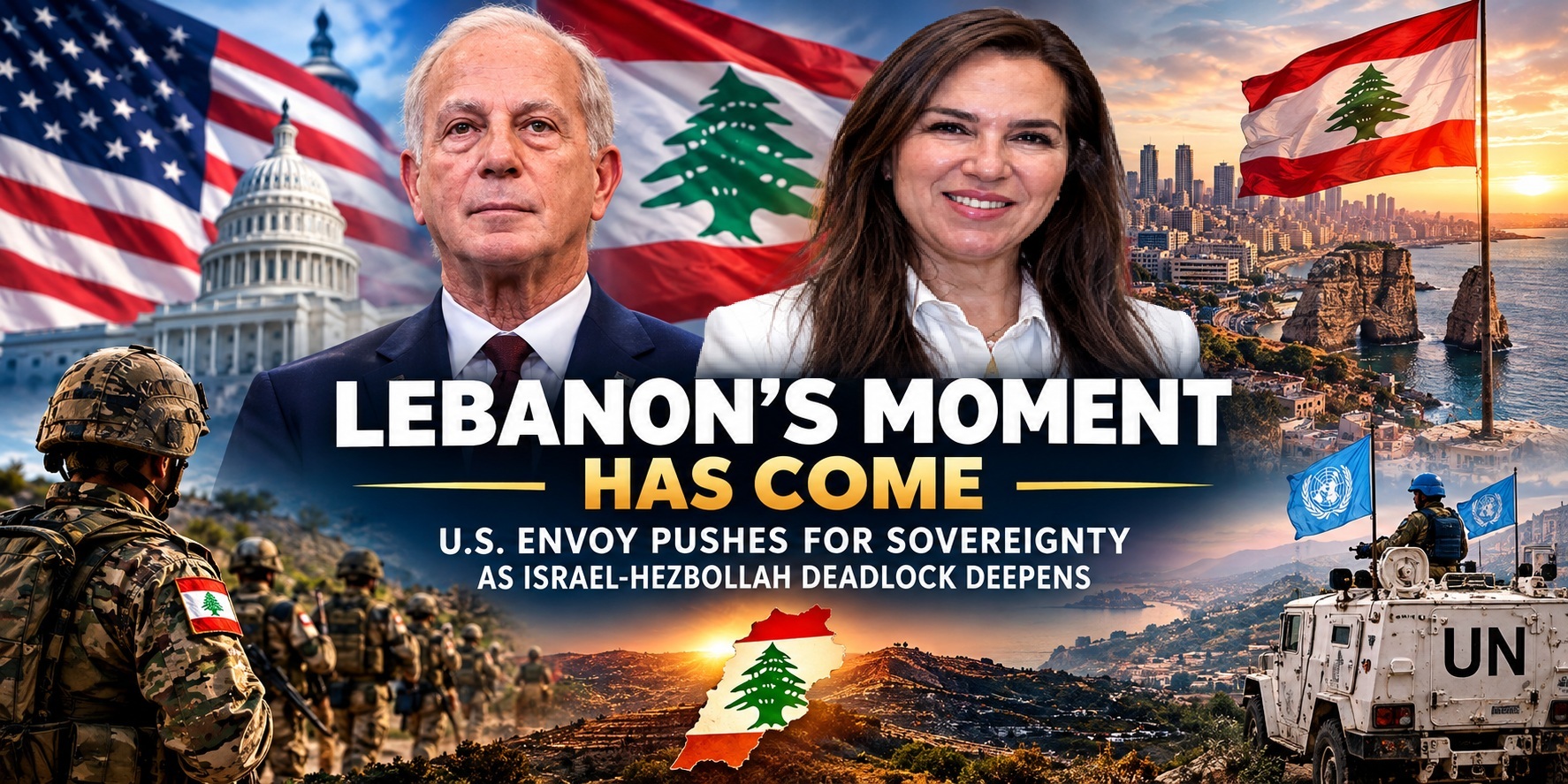
Lebanon’s Moment Has Come: U.S. Envoy Pushes for Sovereignty as Israel-Hezbollah Deadlock Deepens
U.S. envoy Michel Issa says Lebanon has a rare opening to reclaim sovereignty as Washington pushes Beirut, Israel and Hezbollah toward a new security reality
September 26, 2026 / Beirut/Washington
Lebanon’s moment has come. The question now is whether the country can turn diplomatic momentum into state power.
A striking message emerged this week from Washington: Lebanon may finally have an opportunity to decide its own future, but that opportunity will not remain open indefinitely.
U.S. Ambassador to Lebanon Michel Issa and Lebanon’s Ambassador to the United States Nada Hamadeh Moawad delivered parallel messages at the American Task Force on Lebanon’s annual dinner in Washington on September 24, placing sovereignty, state authority and the future of Lebanon’s security architecture at the center of the moment. ATFL’s 2026 gathering was explicitly framed around Lebanon’s future after the war and the need to strengthen the U.S.-Lebanon relationship.
Issa’s message was blunt: Lebanon cannot be sovereign only on paper while decisions over war and peace remain outside state institutions.
He argued that no political party or armed organization should be able to make decisions of war and peace independently of the Lebanese state, while the Lebanese Armed Forces and legitimate state institutions should ultimately be responsible for security throughout the country.
The issue goes directly to the heart of Lebanon’s confrontation with Hezbollah — and to the fragile U.S.-brokered framework linking Hezbollah’s disarmament to an Israeli withdrawal from southern Lebanon.
A diplomatic window, with a clock running
The United States, Lebanon and Israel have spent months attempting to convert the battlefield into a diplomatic process.
In June, Beirut and Jerusalem signed a U.S.-brokered framework intended to establish a phased path toward Israeli withdrawal from southern Lebanon, greater Lebanese army control and the dismantling of Hezbollah’s military infrastructure. Axios described the agreement as the most significant Israel-Lebanon diplomatic breakthrough in four decades, while warning that implementation remained highly uncertain as long as Hezbollah retained its weapons and political influence.
The framework has since collided with reality.
The strategically important Ali al-Taher ridge became a major test. The United States wanted the Lebanese army to assume control of the area, but Hezbollah rejected the proposal. Israeli forces subsequently claimed operational control of the ridge, while Lebanese officials argued that Israel was obstructing the army’s deployment.
The result has been a dangerous contradiction: diplomacy is advancing at the political level while military facts on the ground continue to change.
Rome is delayed, the pressure is not
The next formal Israel-Lebanon negotiating round was expected in Rome, but it has now been postponed.
Reuters reported that the talks are expected to take place in October. CNN likewise reported that the Rome meeting was delayed and that the United States expects the next formal round to take place during October.
Issa said on September 25 that no new date had been finalized and that the delay could run into Israel’s October election period. He also stressed that developments on the ground in southern Lebanon may matter more than the calendar of diplomatic meetings.
That distinction is critical.
The negotiations are not happening in a vacuum. Israeli forces remain in parts of southern Lebanon, Hezbollah retains weapons, Lebanese soldiers are expanding their presence, displaced residents are waiting to return, and the international security architecture itself is approaching a major transition.
Beirut’s answer: sovereignty, and withdrawal
Lebanon’s position is not identical to Israel’s or Washington’s.
Prime Minister Nawaf Salam, addressing the United Nations General Assembly on September 25, called for the consolidation of the ceasefire and an Israeli withdrawal, while Lebanon continues to argue for the restoration of full state authority over its territory.
President Joseph Aoun has simultaneously pressed the Lebanese army to strengthen its presence in the south while criticizing Israel over attacks and, more indirectly, Hezbollah over resistance to surrendering its arsenal to the state. L’Orient Today reported that Aoun has emphasized the army’s role as the institution capable of restoring state authority in the south.
The Lebanese army has already been taking concrete steps.
Its recent operations include the establishment of new observation positions and security deployments. On September 18, the army said an Israeli force approached a newly established Lebanese observation post near Deir Mimas, triggering a heightened alert before Israeli troops withdrew following contacts through the military coordination mechanism.
The army has also continued nationwide security operations and weapons seizures, underscoring the government’s broader effort to reinforce state authority.
The Hezbollah question remains the locked door
This is where the diplomatic equation becomes most difficult.
Washington and Israel have tied the long-term security arrangement to the removal of Hezbollah’s military capability. Hezbollah, however, has resisted surrendering its weapons, particularly north of the Litani River.
Issa has repeatedly argued that Hezbollah’s disarmament would open the way to an Israeli withdrawal and a broader security settlement. On September 25, he again said that if Hezbollah surrendered its weapons, Israel would withdraw and the continued presence of UNIFIL would eventually become unnecessary.
Yet the sequence remains disputed.
Israel says its security requires Hezbollah’s disarmament. Lebanon says its sovereignty requires an Israeli withdrawal. Hezbollah maintains its own position on weapons and resistance.
The diplomatic challenge is therefore not simply reaching an agreement.
It is deciding what happens first, and who guarantees the next step.
A new role for the Lebanese state
For Moawad, the significance of the moment is measured not only in military terms but in political responsibility.
She described Lebanon as having endured decades in which outside powers and conflicts repeatedly shaped its fate, while insisting that the country must now take responsibility for its own choices.
Her message was that sovereignty cannot simply be declared; it has to be built, protected and exercised.
That argument mirrors the direction of Lebanon’s current diplomatic strategy: negotiate directly, strengthen state institutions, reinforce the army and seek an arrangement that places Lebanon’s national decisions formally in the hands of its government.
The United States has publicly backed that direction. ATFL itself has repeatedly called for stronger Lebanese state institutions, support for the Lebanese Armed Forces and a diplomatic process centered on sovereignty and territorial integrity.
And then there is UNIFIL
Another clock is ticking.
The U.N. Security Council has set December 31, 2026, as the end of UNIFIL’s mandate, followed by an orderly drawdown and withdrawal. The stated objective is ultimately for the Lebanese government to become the sole provider of security in southern Lebanon.
As of September 24, UNIFIL still had 7,565 peacekeepers from 46 countries deployed in Lebanon.
That makes the coming months unusually consequential.
If the Lebanese army expands its authority while Israeli forces withdraw, the state could gain a significantly greater security role.
If the transition fails, the vacuum could become another source of instability.
A country standing between war and a new political map
The language coming from Washington is therefore more ambitious than a call for another ceasefire.
It is about changing who has the authority to decide Lebanon’s security future.
For Issa, that means a Lebanon capable of exercising sovereignty throughout its territory and preventing non-state actors from independently determining war and peace.
For Moawad, it means a Lebanon that accepts the responsibility accompanying political freedom.
For Beirut, it also means insisting that sovereignty includes the recovery of occupied territory and an end to attacks.
For Israel, security remains inseparable from the removal of Hezbollah’s military threat.
And for Washington, the challenge is to keep these competing demands inside one diplomatic framework before the opportunity disappears.
The next Rome meeting may be delayed.
The battlefield is not.
Lebanon’s “moment” has arrived in the middle of an unfinished war, a stalled disarmament process, an Israeli military presence in the south and a rapidly approaching UNIFIL deadline.
The central question is no longer whether Lebanon can speak about sovereignty.