

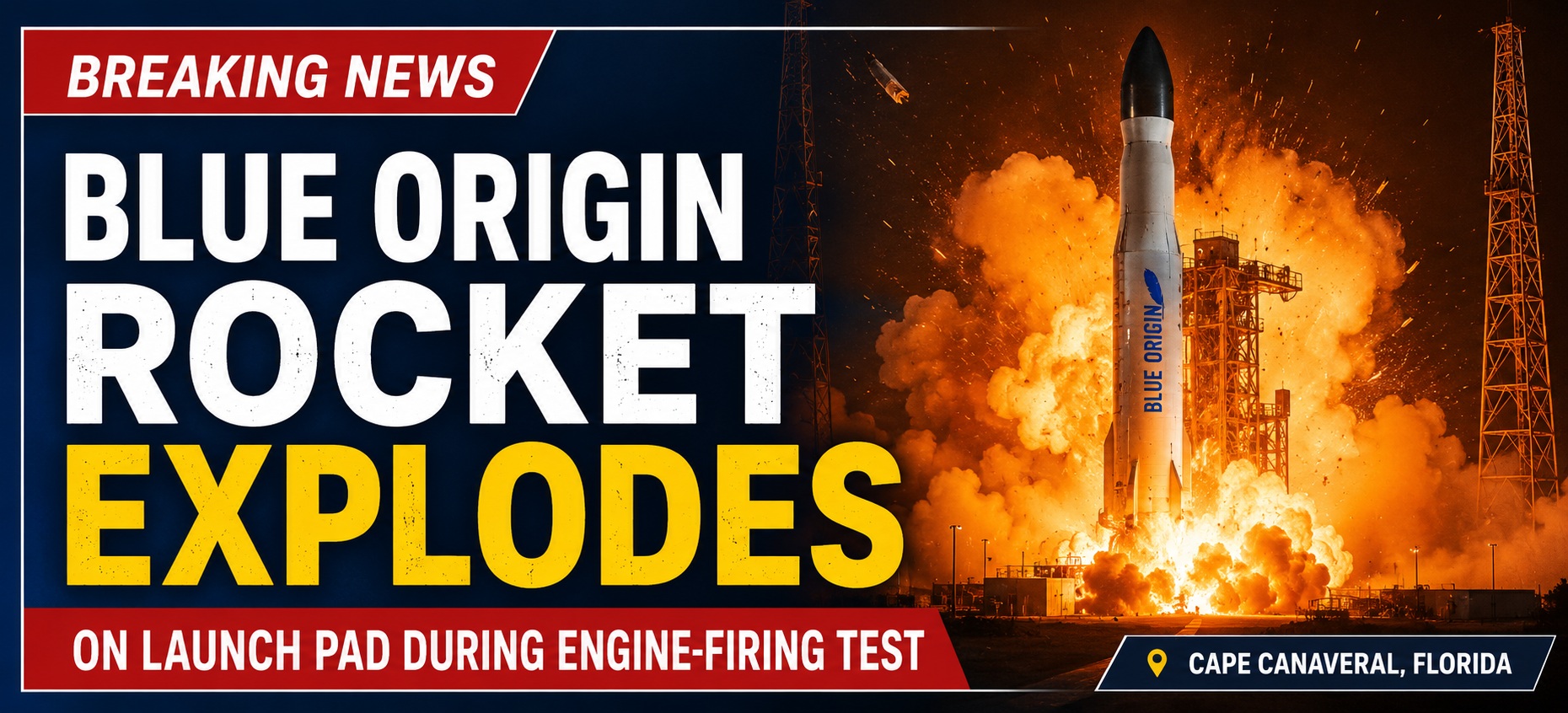
The countdown had barely reached its final phase when the night sky above Cape Canaveral erupted into a scene straight out of a disaster film.
At exactly the moment Blue Origin engineers were pushing the company’s colossal New Glenn rocket through a critical engine-firing test Thursday night, the massive launch vehicle suddenly exploded on the pad — unleashing a violent orange fireball that lit up Florida’s coastline and rattled homes miles away.
Residents in Cape Canaveral and Cocoa Beach felt windows shake and walls tremble around 9 p.m. social media exploded almost instantly with frantic videos and photos showing a blazing inferno swallowing Launch Complex 36.
For a few terrifying moments, the sky itself appeared to burn.
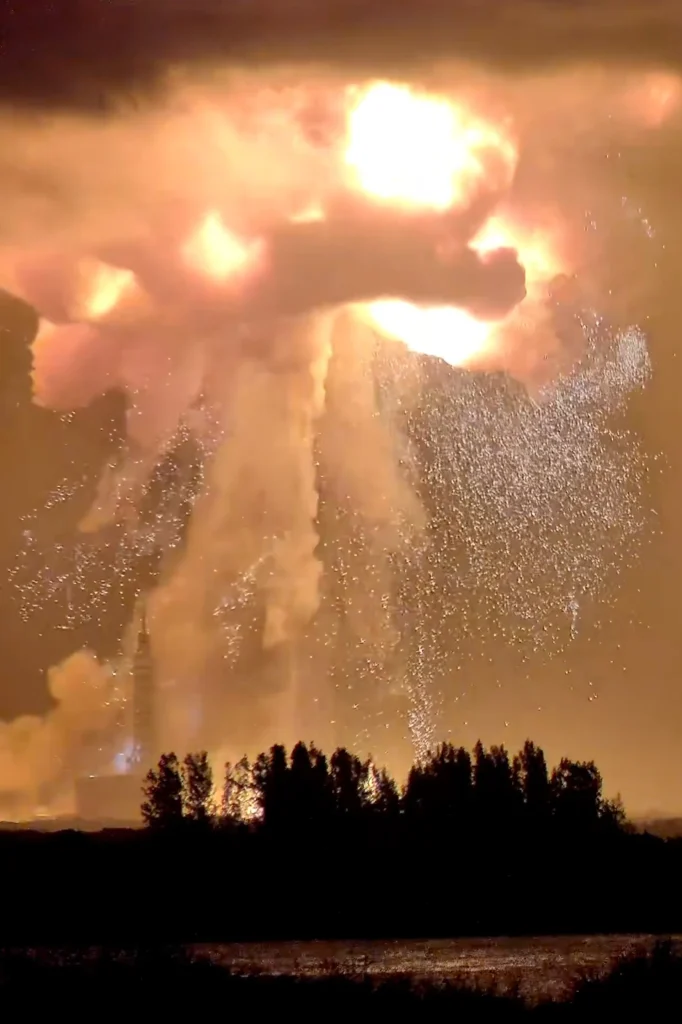
A Blue Origin New Glenn rocket explodes during an engine-firing test on Thursday, May 28, 2026, in Cape Canaveral, Fla. (@JConcilus via AP)
The rocket — owned by billionaire Jeff Bezos’ space company Blue Origin — was preparing for a highly anticipated satellite mission scheduled for next week. Instead, the company now faces another brutal setback in its race against rivals like SpaceX.
Miraculously, no injuries were reported.
“It’s too early to know the root cause but we’re already working to find it,” said Jeff Bezos in a message posted on X. “Very rough day, but we’ll rebuild whatever needs rebuilding and get back to flying. It’s worth it.”
But behind the calm words lies a mounting crisis for Blue Origin’s ambitious lunar program.
The towering 321-foot New Glenn rocket — named after legendary astronaut John Glenn — was supposed to become America’s next heavy-lift powerhouse, carrying satellites, lunar landers, and eventually supporting missions tied to NASA’s Artemis moon program.
Instead, the rocket now carries a growing reputation for instability.
Only months earlier, another New Glenn mission ended in embarrassment after an engine malfunction left a satellite stranded in the wrong orbit. Thursday’s explosion marks yet another devastating blow to a program already under immense pressure.
The timing could hardly be worse.
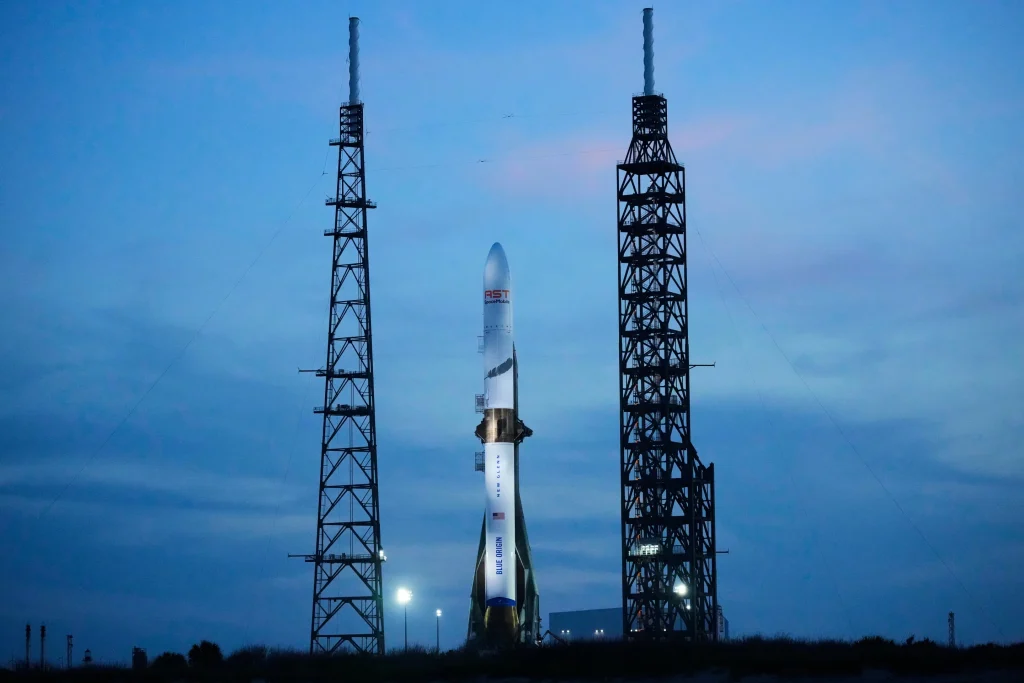
A Blue Origin New Glenn rocket stands ready for launch at the Cape Canaveral Space Force station in Cape Canaveral, Fla., April 18, 2026. (AP Photo)
Just days ago, NASA awarded Blue Origin a contract worth hundreds of millions of dollars to launch future lunar vehicles as part of the Artemis initiative — humanity’s planned return to the Moon.
Now questions are swirling across the aerospace world:
Can Blue Origin recover fast enough?
Will Artemis timelines survive another delay?
And how many failures can the company endure before confidence collapses?
“Spaceflight is unforgiving,” NASA Administrator Jared Isaacman warned after the blast, acknowledging the brutal difficulty of developing new heavy-lift rockets.
As emergency crews surrounded the smoking launch pad late into the night, officials insisted there was no toxic threat to nearby communities. Yet the psychological shock had already spread across Florida’s Space Coast.
Meanwhile, competitors continue marching forward.
A rocket from United Launch Alliance was still scheduled to launch Friday night from another pad nearby, carrying the very same type of Amazon internet satellites New Glenn was originally meant to deliver.
Even longtime rival Elon Musk — no stranger to catastrophic rocket explosions himself — publicly offered support.
“Sorry to see this, I hope you recover quickly,” Musk posted online.
But sympathy will not erase the image now burned into the public imagination:
a giant moon rocket engulfed in flames before ever leaving Earth.
For Blue Origin, the road to the Moon suddenly looks far more dangerous than anyone imagined.
Source: AP news