

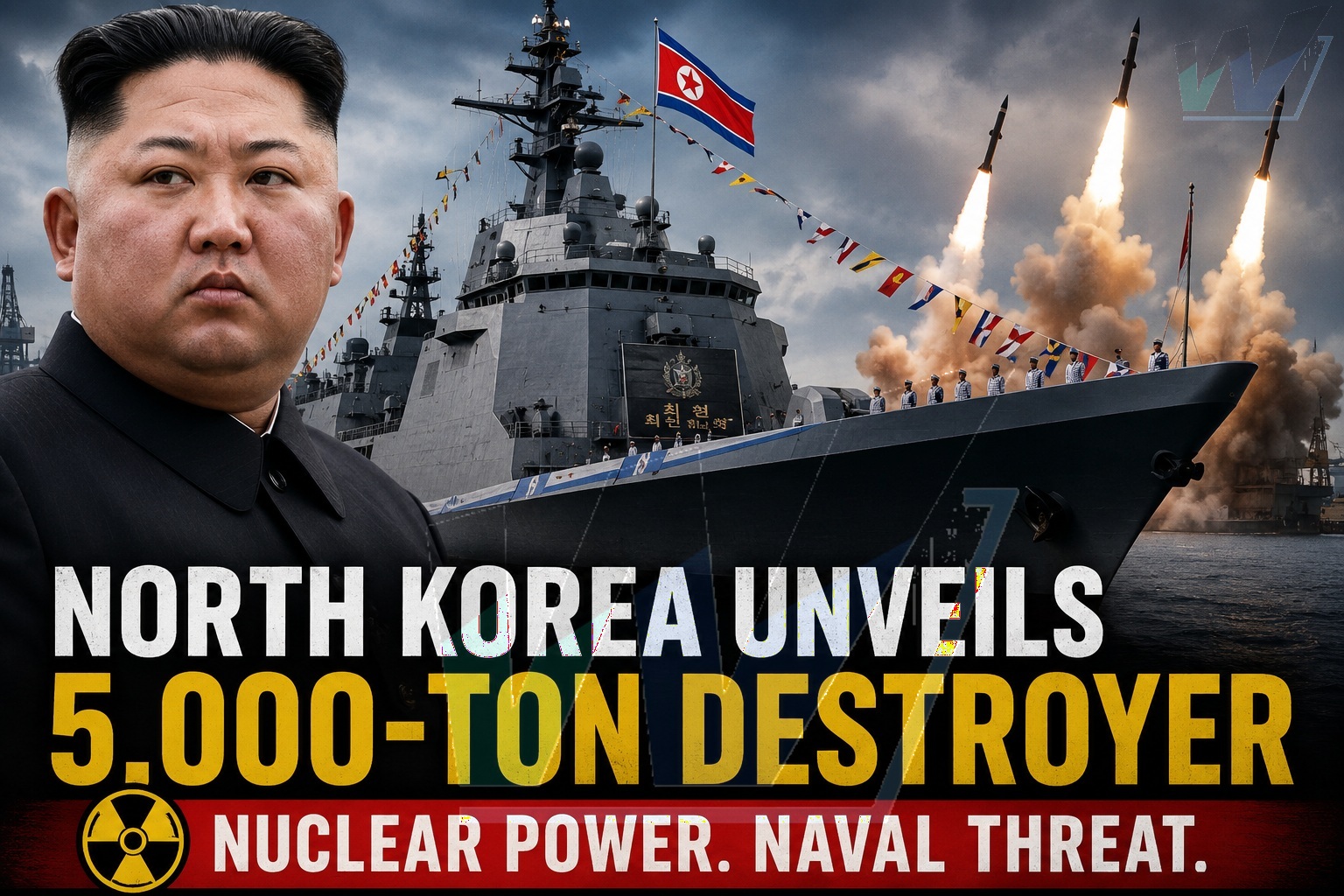
Kim Jong Un Unveils Destroyer as North Korea Pushes into a New Era of Naval Power
PYONGYANG / SEOUL / WASHINGTON —
The sea was calm.
The message was not.
Under gray skies at the western port of Nampo, sirens echoed across the harbor as a colossal warship emerged, dark, angular, and unmistakably built for intimidation. Standing before military commanders and party elites, North Korean leader Kim Jong Un declared the commissioning of the Choe Hyon, a 5,000-ton destroyer he says marks a historic turning point in Pyongyang’s military doctrine.
But this was no ordinary launch.
According to North Korea’s state media, the vessel represents something far more dangerous: the arrival of a nuclear-capable navy.
“This is no longer a fleet confined to coastal defense,” Kim reportedly said. “Our navy is becoming a strategic force equipped with nuclear weapons.”
The statement sent immediate shockwaves through Asia’s defense circles.
For decades, North Korea’s military strength has centered on missiles launched from land, intercontinental ballistic missiles, tactical nuclear systems, and increasingly sophisticated cruise weapons. Now, Kim appears determined to take that threat offshore.
A Floating Missile Platform
The Choe Hyon is believed to carry an alarming arsenal.
North Korean media claims the destroyer is equipped with:
- Anti-aircraft missile systems
- Anti-ship strike weapons
- Cruise missiles
- Ballistic missiles capable of carrying nuclear payloads
If those claims prove accurate, the destroyer will give Pyongyang a new strategic advantage: mobility.
Unlike land launchers, warships can maneuver, disperse, and complicate enemy targeting.
Military analysts say that everything changes.
A mobile naval missile platform dramatically increases uncertainty for adversaries like South Korea, Japan, and the United States, especially if armed with nuclear-capable cruise missiles designed for surprise strikes.
Russia’s Shadow Over the Shipyard
One question dominates intelligence assessments:
How did North Korea build this so quickly?
South Korean analysts suspect assistance from Russia, citing rapidly deepening military ties between Moscow and Pyongyang.
The timing fuels speculation.
Since the strengthening of Russia–North Korea military cooperation, Pyongyang has accelerated weapons development at a pace many experts find difficult to explain through domestic capability alone.
No hard public proof has emerged.
But suspicion remains.
And it is growing.
From Embarrassment to Escalation
The launch also carries irony.
Just last year, North Korea suffered an embarrassing setback when a sister destroyer, the Kang Kon, partially capsized during launch at Chongjin port.
Kim was reportedly furious.
State media described the incident as a near-criminal failure and blamed negligence.
Yet only months later, the vessel was repaired and relaunched.
Now Kim says Kang Kon will soon enter active service as well.
That means the Choe Hyon may only be the beginning.
The 10,000-Ton Threat
If regional powers were hoping this destroyer was symbolic, Kim ended that illusion quickly.
He announced plans to build two destroyers of this class every year for the next five years.
Even more alarming: Pyongyang is already planning a 10,000-ton strategic destroyer, nearly double the size of the Choe Hyon.
That suggests North Korea is thinking far beyond coastal deterrence.
It may be preparing for blue-water naval operations, missions far from home waters.
Such capability would represent the most dramatic expansion of North Korean naval ambition in modern history.
The Maritime Flashpoint
The destroyer’s deployment carries particular significance in one dangerous region:
The Yellow Sea.
Kim has repeatedly rejected the Northern Limit Line, the disputed maritime boundary drawn after the Korean War between North and South Korea.
That line has already seen deadly naval clashes.
Now imagine that flashpoint with nuclear-capable warships.
One miscalculation.
One radar lock.
One missile launch.
The consequences could be catastrophic.
Message to Washington
The timing is impossible to ignore.
Since nuclear diplomacy with Donald Trump collapsed in 2019, Kim has abandoned restraint and accelerated weapons expansion.
Yet Pyongyang continues sending a consistent signal:
Talks with Washington remain possible, but only if the United States abandons demands for denuclearization.
That condition remains unacceptable to successive U.S. administrations.
Which leaves the Korean Peninsula trapped in a dangerous stalemate.
Negotiation is frozen.
Military modernization is not.
A New Strategic Reality
For years, the world feared North Korea’s missiles.
Now, the world must watch its waters.
The Choe Hyon is more than a warship.
It is a declaration.
A signal that North Korea no longer wants merely to survive behind fortified borders.
It wants reach.
It wants deterrence.
It wants power that sails.
And as steel cuts through the waters off the Korean coast, one reality becomes impossible to ignore:
Pyongyang’s nuclear ambitions are no longer confined to land.
They are moving to sea.
And the Pacific is watching.