

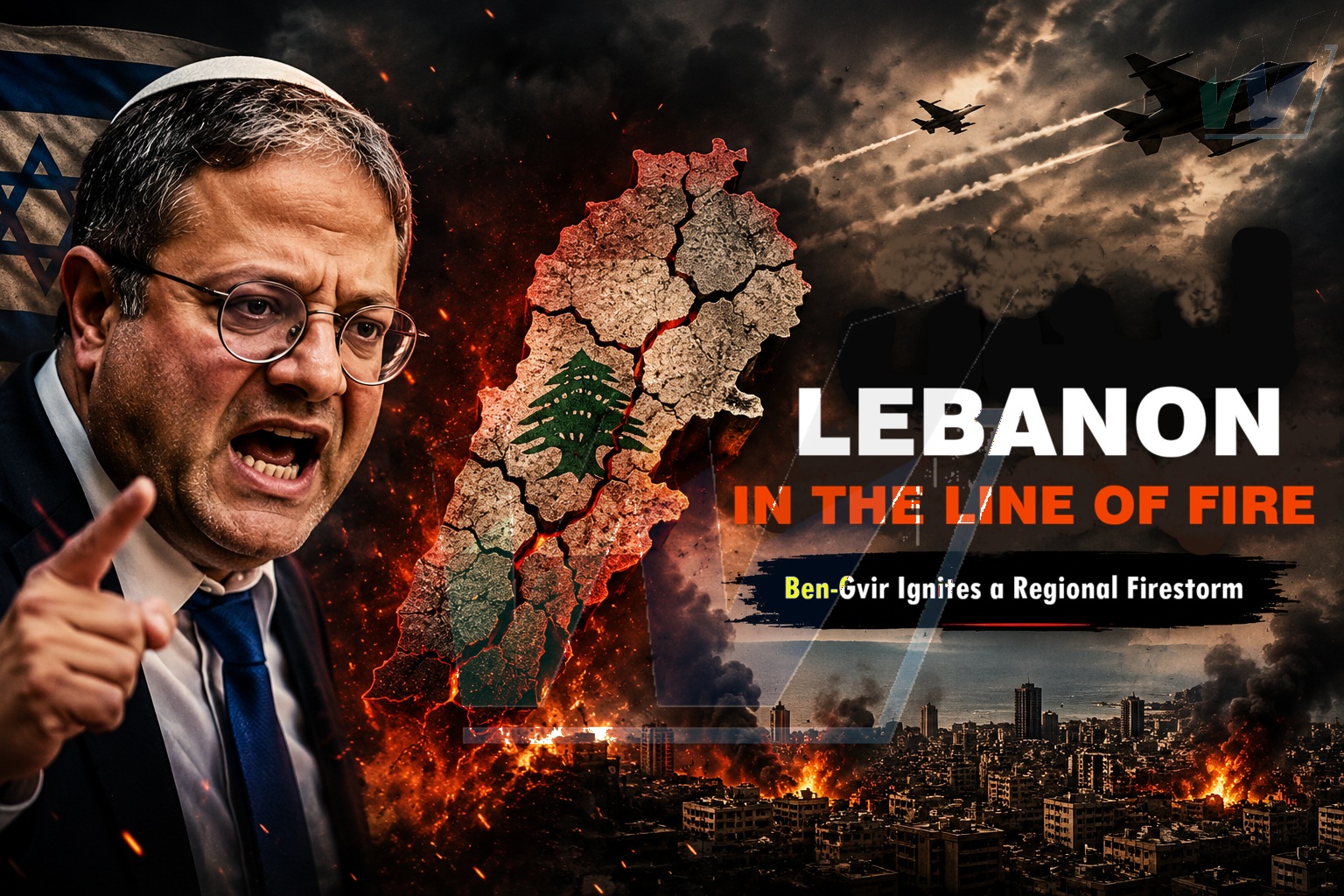
Ben-Gvir Ignites a Regional Firestorm: “Lebanon Must Become Israel’s Playground”
Beirut | Jerusalem | Washington —
At a moment when the Middle East appears to be standing on the edge of another major explosion, Israeli National Security Minister Itamar Ben-Gvir delivered incendiary remarks that sent shockwaves across political and media circles, with many describing them as among the most extreme public calls since the outbreak of hostilities on the Lebanese front.
His words were not perceived as routine political rhetoric.
They sounded like a declaration of intent for an open war.
Ben-Gvir openly called for Lebanon to become a “playground” for the Israeli military, dismissing American and international pressure aimed at containing military operations and preventing further escalation in southern Lebanon. In a speech marked by an unusually aggressive tone, he insisted that Israel must accept “no American restrictions” on its military campaign.
He went further.
Even if U.S. President Donald Trump were to tell Prime Minister Benjamin Netanyahu to leave Lebanon, Ben-Gvir said Israel’s response should be simple:
“Mr. President, no.”
Yet even this was not the most alarming part.
“A Thousand Lebanese Mothers Must Cry”
In remarks that triggered widespread outrage both inside and outside the region, Ben-Gvir escalated his rhetoric dramatically.
He declared:
“For every tear shed by an Israeli mother, a thousand Lebanese mothers should cry.”
The statement stunned observers.
But he pushed further still, calling for all Lebanese territory to become a direct target of military operations, with no exceptions. He rejected any “humanitarian” or “moral” restrictions on warfare, arguing that Israel’s security must remain the absolute priority—regardless of the cost to Lebanese civilians.
His rhetoric, reinforced by the chilling phrase “All of Lebanon must burn,” sparked immediate condemnation. Analysts warned that such language signals collective punishment and deliberately erases the distinction between the Lebanese state, civilians, and armed groups.
From Targeting Hezbollah to Targeting Lebanon
The most dangerous aspect of Ben-Gvir’s message may not be the escalation itself, but the doctrine behind it.
He dismissed the distinction between Hezbollah and the Lebanese state as artificial and unacceptable.
In his view, Lebanon as a whole must be treated as a legitimate battlefield.
This marks a dangerous strategic shift—one analysts describe as moving from localized deterrence to total punitive warfare.
Under such a doctrine, civilian infrastructure, economic networks, and social systems become pressure points designed to force strategic surrender.
It is no longer merely about weakening Hezbollah.
It becomes about reshaping Lebanon through overwhelming military force.
These remarks also come amid mounting pressure inside Israel’s governing coalition to reject ceasefire efforts or negotiated de-escalation. Ben-Gvir has consistently positioned himself among the strongest opponents of restraint, openly attacking American diplomatic efforts to contain the Lebanese front.
A Direct Challenge to Washington
The message was not intended for Beirut alone.
It was aimed at Washington as well.
Ben-Gvir’s remarks amount to a rare public challenge to the United States at a time when Washington is working aggressively to prevent regional war.
Western and Israeli media have increasingly reported growing friction between the White House and Israeli decision-makers over the future of military operations in Lebanon.
While Washington seeks to avoid a wider conflict, Israel’s hardline nationalist camp insists the time has come to rewrite the rules of engagement entirely.
Political Theater… or Prelude to Something Bigger?
Some Israeli political figures dismissed Ben-Gvir’s remarks as familiar populist provocation.
But the real concern lies elsewhere.
Are these merely inflammatory political statements meant to energize his base?
Or do they reflect a broader strategic mindset gaining ground inside Israel’s power structure?
That question now haunts regional capitals.
History has repeatedly shown that in the Middle East, extreme rhetoric voiced inside government circles can rapidly evolve into military orders.
Lebanon Faces Its Most Dangerous Hour
Today, Lebanon once again stands beneath the shadow of a grim scenario.
Between escalating Israeli threats, ongoing border clashes, and fears of diplomatic collapse, the question troubling the region grows more urgent:
Is this merely political noise?
Or is the Middle East moving toward a major new war?
In this region, wars often begin with words.
But the words spoken this time feel different.
They resemble a spark thrown into a field of gunpowder.
The question is no longer whether the fire will ignite,
but how far the flames will spread.