

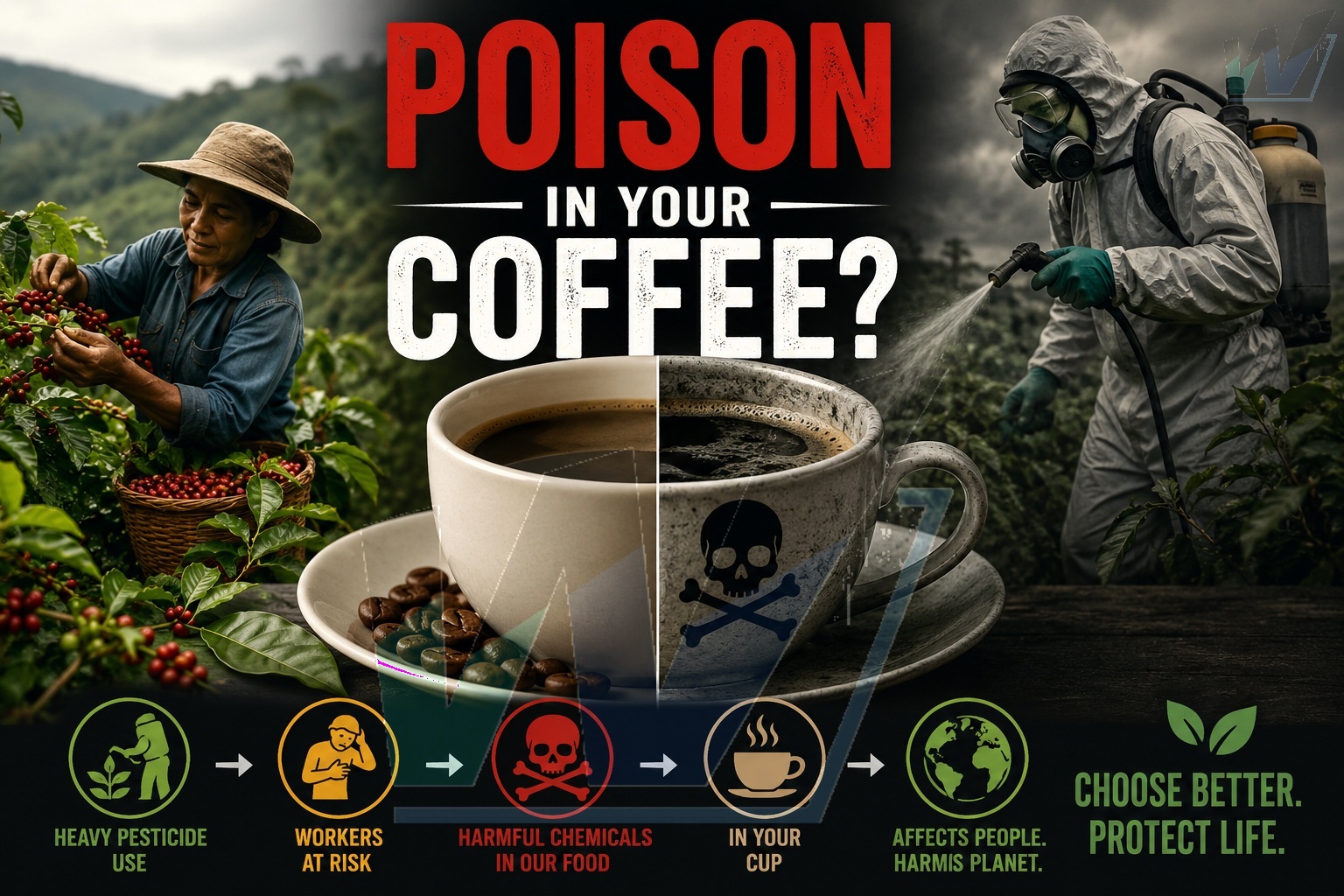
The Bitter Truth Behind the World’s Favorite Drink
GENEVA / BRUSSELS / SÃO PAULO –
For billions, it begins the same way.
A kettle whistles. Beans grind. Steam rises.
Morning starts with comfort, warm, dark, familiar.
But behind that daily ritual, a disturbing warning is spreading across the global coffee industry.
A new report is sounding the alarm with a title impossible to ignore: “Poison in Your Coffee.”
Its message is stark: the greatest danger in coffee may not be what reaches your cup, but what happens long before the beans are roasted.
And the human cost, researchers say, is already enormous.
A Global Addiction Built on Chemicals
Coffee is not just a beverage.
It is one of the most traded agricultural commodities on Earth, sustaining the livelihoods of roughly 125 million people, including farmers, laborers, processors, and exporters across Latin America, Africa, and Asia.
Yet according to Coffee Watch, one of the industry’s least visible truths is also among its most troubling:
Coffee farming has become deeply dependent on chemical pesticides.
Researchers identified 159 active pesticide substances approved for coffee production across major producing nations. Many belong to categories associated with severe health risks, including probable carcinogens, neurotoxins, and substances suspected of damaging fertility or fetal development.
Even more alarming, the report says nearly 60% of pesticides used in coffee production are banned in the European Union due to safety concerns.
Among them are chemicals surrounded by controversy:
- Chlorpyrifos, banned in the EU over concerns about neurological damage in children
- Imidacloprid, linked to devastating impacts on bees and pollinators
This is where the story turns darker.
Some of these substances remain legal in exporting countries—allowing them to be sprayed on crops destined for international markets.
The Real Victims Are Not Consumers
The report makes one point repeatedly:
This is not primarily a consumer panic story.
Yes, pesticide residues have been detected in coffee sold globally. European food safety monitoring has repeatedly flagged pesticide contamination in imported coffee between 2020 and 2024.
Researchers say roughly one in five cups of coffee may contain trace pesticide residues.
But residues in a cup are only the visible edge of the crisis.
The real catastrophe, according to investigators, lies in the fields.
There, millions of workers handle toxic chemicals with little protection.
In some producing regions, gloves, masks, protective clothing, even basic training, remain rare luxuries.
The consequences can be immediate.
Workers exposed during spraying frequently report:
- nausea
- vomiting
- dizziness
- skin burns
- respiratory distress
But the long-term effects are far more frightening.
Repeated exposure has been associated with:
- cancers
- fertility disorders
- miscarriages
- developmental harm in unborn children
- neurological illnesses, including Parkinson’s disease
The pattern emerging from agricultural health studies is deeply troubling.
For many farm workers, the morning harvest comes with invisible risk.
Europe’s Contradiction
The report also revives a controversial accusation increasingly debated among environmental groups:
the pesticide boomerang.
Chemicals banned inside Europe can still be manufactured and exported abroad.
Those same chemicals may then return indirectly—through imported food products.
Coffee is becoming one of the clearest examples of this contradiction.
Environmental campaigners argue this creates a troubling double standard:
One safety rule for European fields.
Another for the Global South.
That tension has sparked renewed criticism of global agricultural supply chains and food safety enforcement. Similar residue concerns have surfaced in tea, spices, and rice across European markets.
The Certification Illusion
Consumers often reach for comfort in labels:
“Ethically sourced.”
“Rainforest certified.”
“Sustainably grown.”
But the report warns that such labels may not guarantee what buyers assume.
Certified coffee can still involve pesticide use.
And certification standards vary dramatically between organizations.
In other words:
A premium label does not automatically mean chemical-free farming, fair wages, or safe working conditions.
For many consumers, that revelation may prove unsettling.
The promise of “responsible coffee” is often far more complicated than branding suggests.
Climate Pressure Makes It Worse
The pesticide crisis is unfolding at a moment when the coffee industry is already under extreme stress.
Weather volatility, rising temperatures, drought, and fungal disease are hitting major coffee-producing nations.
Brazil—the world’s largest producer—has faced harvest disruption due to abnormal rainfall and climate instability, while fears of a strengthening El Niño threatens robusta-growing regions such as Vietnam and Indonesia.
That matters because climate stress often drives greater pesticide dependence.
More pests.
More diseases.
More chemical spraying.
And the cycle intensifies.
Is Organic the Future?
Researchers insist solutions already exist.
They point to:
- organic cultivation
- agroforestry
- biodiversity-based farming
- regenerative agriculture
These methods reduce pesticide dependence while improving soil resilience and protecting ecosystems.
The challenge, experts say, is not scientific.
It is economic.
Transitioning away from intensive chemical farming requires investment, supply-chain reform, and pressure on multinational coffee buyers.
The question is no longer whether alternatives exist.
It is whether the global coffee industry is willing to pay for them.
The Cup That Now Tastes Different
Coffee has always been about energy.
Wakefulness.
Focus.
Comfort.
Routine.
But this report raises a harder question.
When we pay for coffee, what exactly are we buying?
A luxury?
A necessity?
Or participation in a system whose hidden costs are borne by someone else?
Tomorrow morning, billions will reach for another cup.
The aroma will be the same.
The taste may be unchanged.
But after this report, one thing is harder to ignore:
For millions of workers behind every bean, the bitter aftertaste begins long before the first sip.