
TRUMP AND IRAN’S PRESIDENT SIGN DEAL TO END MIDEAST WAR
A Fragile Peace Emerges After Months of Fire, Oil Shock, and Global Brinkmanship
WASHINGTON / TEHRAN / GENEVA — For months, the world stood on the edge of a wider war.
Oil tankers stalled. Fighter jets roared across contested skies. Missiles flashed over cities already exhausted by decades of conflict. Global markets shook. Diplomats whispered about catastrophe.
Then, almost suddenly, came the signature.
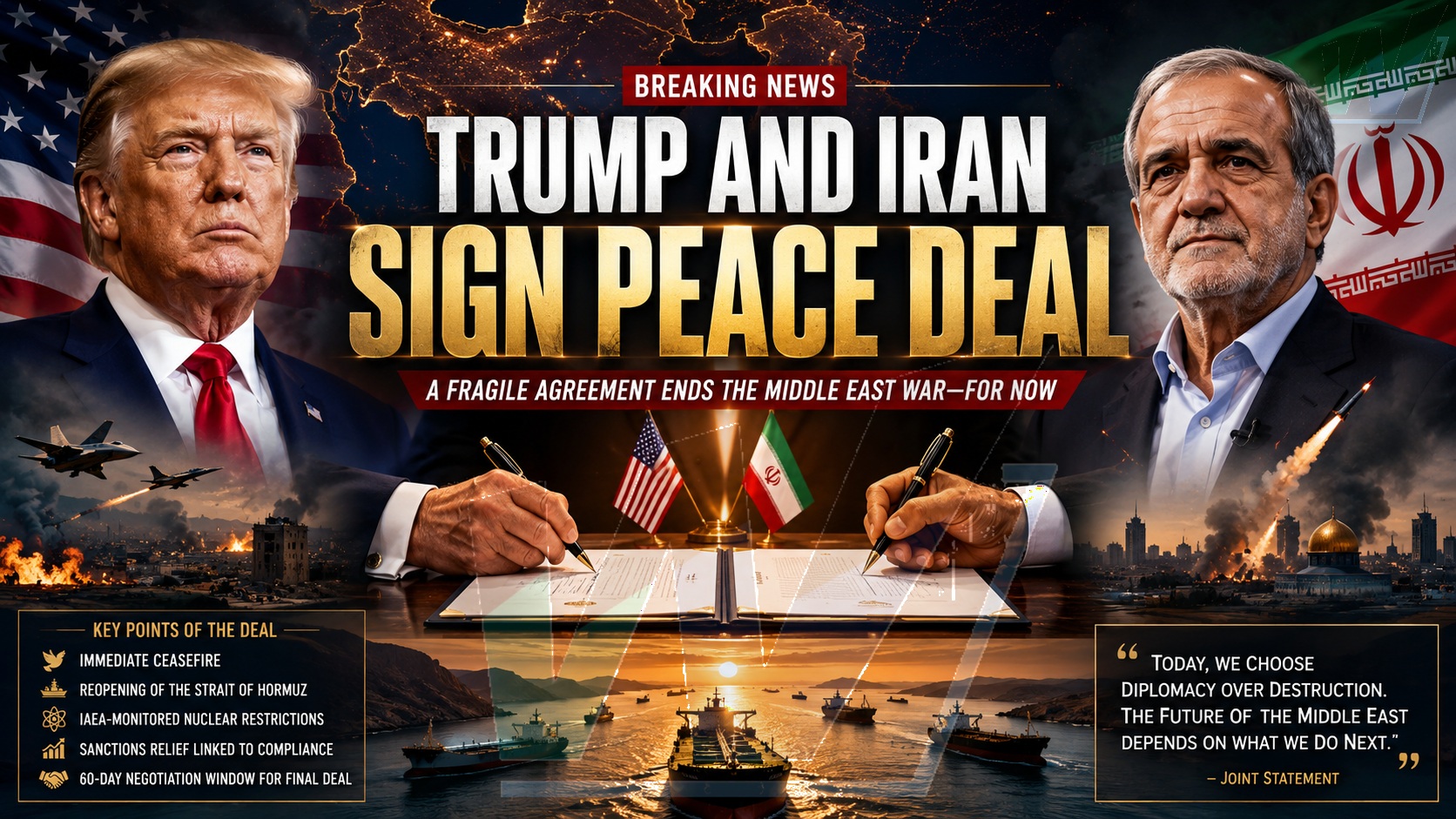
In a move few believed possible only weeks ago, U.S. President Donald Trump and Iranian President Masoud Pezeshkian signed a landmark agreement aimed at ending the war that has destabilized the Middle East and rattled the global economy.
The document—a 14-point Memorandum of Understanding—may not yet be peace.
But it may have stopped the region from plunging into something far worse.
The agreement calls for an immediate halt to direct hostilities, the gradual reopening of the Strait of Hormuz, and the beginning of intensive negotiations over Iran’s nuclear program, sanctions relief, and regional security guarantees.
For the world’s energy markets, the Strait of Hormuz was the heartbeat of the crisis.
When shipping lanes narrow under military pressure, the shockwaves were instant. Oil prices surged. Inflation fears returned. Governments from Europe to Asia scrambled for contingency plans.
Now, tankers may move again.
That alone has sent markets exhaling.
But beneath the relief lies deep uncertainty.
Trump hailed the deal as a historic triumph, declaring that it had prevented “economic catastrophe” and possibly a wider regional war. Yet he delivered the message with characteristic force, warning Tehran that any violation could trigger an immediate military response.
The message was unmistakable: peace is on the table—but so is war.
Iran, meanwhile, presented the agreement as a strategic victory of its own.
Tehran insists it preserved national sovereignty while forcing Washington to recognize the costs of prolonged confrontation. Iranian officials emphasized that sanctions relief and restored oil exports are central to the accord’s survival.
Both sides are claiming victory.
That may be exactly what made the deal possible.
Still, the real battle begins now.
The memorandum opens a 60-day window for final negotiations—arguably the most difficult phase. Diplomats must now tackle the issue that has haunted every U.S.–Iran negotiation for years: uranium enrichment.
Can Iran retain civilian nuclear capacity while convincing Washington and its allies that weaponization is impossible?
That question remains unanswered.
And looming over everything is Israel.
Israeli officials have reacted with visible unease, worried the deal grants Tehran breathing room while leaving regional proxy networks intact. Security analysts warn that even if Washington and Tehran step back, flashpoints in Lebanon, Syria, Iraq, or the Gulf could reignite violence overnight.
In other words: the war may be paused—but the powder remains dry.
International reaction has been swift.
European leaders cautiously welcomed the agreement. Energy markets responded with optimism. Shipping insurers began reassessing risk premiums for Gulf transit. Financial analysts called the deal one of the most consequential geopolitical developments of the year.
Yet skepticism remains intense.
Critics on both sides argue the agreement postpones conflict rather than resolving it.
Supporters counter that preventing immediate escalation is itself a major victory.
History offers reasons for caution.
The Middle East has seen many ceasefires collapse under the weight of mistrust, ideology, and miscalculation.
One drone strike.
One naval incident.
One missile launched by a proxy force.
That is all it could take.
Tonight, however, the missiles are quieter.
The markets are calmer.
And millions across the region are daring—carefully—to hope.
For now, the guns have fallen silent.
Whether this becomes the foundation of lasting peace or merely an intermission before another storm will depend on what happens next.
The signatures are dry.
The world waits.