
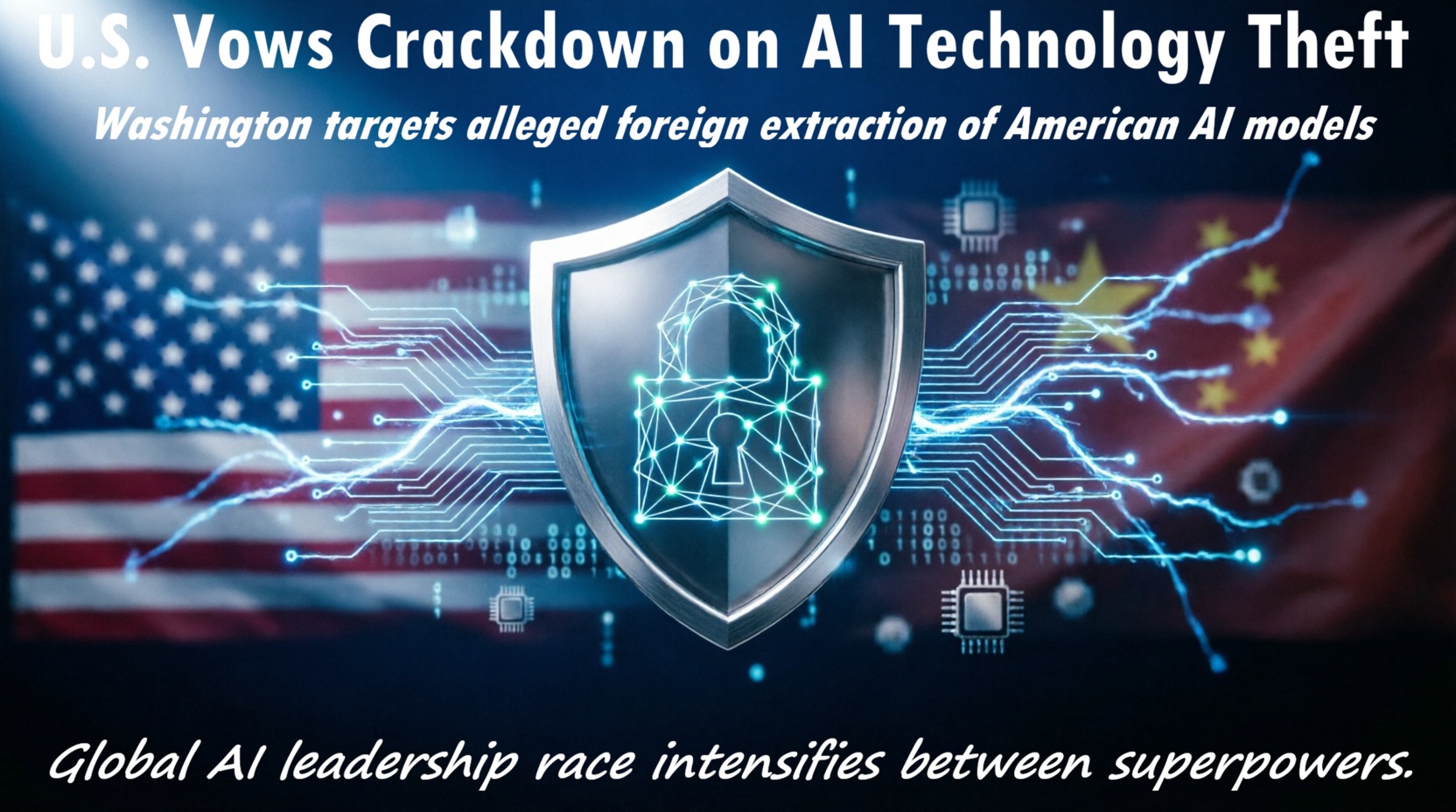
The Trump administration has pledged to intensify enforcement against foreign technology firms, particularly those in China, accused of misusing U.S.-developed artificial intelligence models.
In a memo issued Thursday, Michael Kratsios, the White House chief science and technology adviser, alleged that China-based entities are conducting large-scale, coordinated efforts to “distill” or extract capabilities from leading American AI systems. He said these activities amount to exploiting U.S. innovation and expertise.
Kratsios stated that the administration will collaborate with U.S. AI companies to detect such practices, strengthen defenses, and explore penalties against violators.
The move comes amid growing competition between the United States and China in artificial intelligence. Washington maintains that leadership in AI is essential for setting global standards and securing both economic and military advantages. However, recent analysis from Stanford University’s Institute for Human-Centered AI suggests that the performance gap between top U.S. and Chinese AI models has narrowed significantly.
China’s embassy in Washington rejected the accusations, criticizing what it called unjustified restrictions on Chinese firms. Spokesperson Liu Pengyu said China supports technological progress through cooperation and fair competition and emphasized its commitment to intellectual property protection.
The memo coincided with bipartisan support in the U.S. House Foreign Affairs Committee for legislation aimed at identifying and penalizing foreign actors that extract proprietary features from closed U.S. AI systems, including through sanctions. Rep. Bill Huizenga described such practices as a new form of economic coercion and intellectual property theft.
Concerns over model “distillation” intensified after Chinese startup DeepSeek released a cost-efficient AI model that rivaled leading U.S. systems. Former White House AI adviser David Sacks previously suggested the company may have replicated OpenAI’s models, an allegation echoed by OpenAI, which warned against the appropriation of American AI advances.
AI firm Anthropic has also accused multiple China-based labs of attempting to extract capabilities from its Claude model using distillation techniques, though it acknowledged the method can be legitimate when properly used.
At the same time, some U.S. companies have relied on open-source Chinese models, highlighting the complexity of enforcement in an interconnected AI ecosystem.
Experts say distinguishing between legitimate model training and unauthorized extraction will be extremely difficult due to the scale of global AI usage. However, improved coordination among U.S. firms and government involvement could help address the issue.
Analysts also note that political considerations, including upcoming diplomatic engagements between Washington and Beijing, may influence how aggressively new measures are pursued.