
Athens Buys a Multilayered Shield as the Missile Age Accelerates
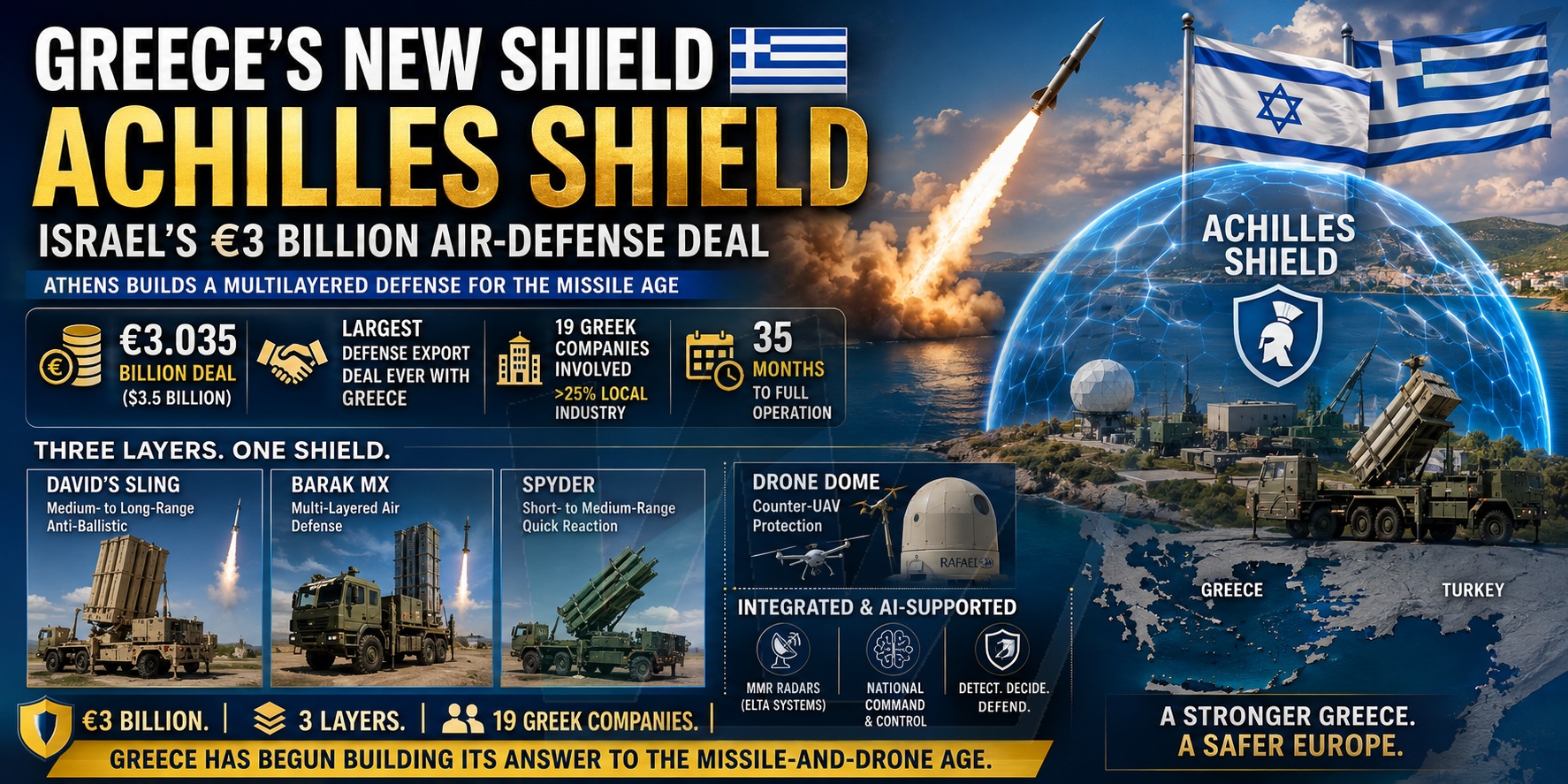
€3 billion. Three missile-defense layers. 19 Greek companies. One national shield. Greece has begun building its answer to the missile-and-drone age.
ATHENS/TEL AVIV — September 2, 2026
Greece has taken a decisive step toward transforming its air defenses, signing a landmark €3.035 billion ($3.5 billion) agreement with Israel to build the country’s new “Achilles Shield”—an integrated network designed to detect and counter ballistic missiles, aircraft, cruise missiles, drones and other aerial threats.
Signed in Tel Aviv on August 31, the agreement is the largest defense-export deal in the history of Israel-Greece relations and one of the largest defense contracts ever concluded by Israel. The system will combine Israeli missile interceptors, radars and a national command-and-control architecture into a single multilayered defensive network.
The deal moves the project from years of negotiations into implementation, and places Israel’s combat-tested air-defense technology at the heart of Greece’s military modernization.
Three Layers. One Shield.
At the core of Achilles Shield are three Israeli systems designed to cover different threat ranges.
David’s Sling, developed by Rafael with Israel’s Missile Defense Organization, provides the higher-end layer against advanced missile threats. Greece becomes only the second foreign customer for the system after Finland. Israel used David’s Sling during its recent conflict with Iran.
BARAK MX, produced by Israel Aerospace Industries, adds another flexible layer against aircraft and missile threats.
SPYDER, also produced by Rafael, provides mobile short-to-medium-range protection against aircraft and other aerial threats.
The weapons will not operate as isolated batteries.
Israel will also supply MMR multi-mission radars from IAI’s ELTA Systems and a new national command-and-control system led by Rafael, designed to integrate Greece’s air-defense assets into one operational architecture.
That integration is arguably the most important part of the deal.
The objective is not simply to buy more missiles—it is to create a national shield capable of detecting a threat, assessing it and directing the appropriate interceptor in real time.
The Drone Threat Gets Its Own Layer
Greece and Israel also signed a separate €26 million agreement for Rafael’s Drone Dome counter-UAV system.
The additional capability is intended to protect strategic installations and other vulnerable sites against increasingly sophisticated drone attacks.
The move reflects a fundamental change in modern warfare.
Ballistic missiles are no longer the only danger. Cheap drones, loitering munitions, cruise missiles, cyber operations and electronic warfare can overwhelm traditional defenses when they arrive simultaneously.
Greek Defense Minister Nikos Dendias has argued that modern conflicts have fundamentally changed military doctrine, with ballistic missiles, unmanned systems, cyber threats and hybrid warfare rendering older defense concepts increasingly inadequate.
Greece Wants More Than Israeli Weapons
There is another crucial element hidden inside the €3 billion agreement: Greek technological and industrial control.
The Greek Defense Ministry says 19 Greek companies are already participating in the program, with domestic involvement exceeding 25%, worth approximately €750 million.
The agreement also provides for the creation of a production base in Greece with potential for future exports.
Athens has also insisted on access to the source code governing key elements of command-and-control architecture.
For Greece, the logic is straightforward: buying a foreign defense system should not mean becoming permanently dependent on the foreign supplier.
Dendias has previously said Greek forces must retain the ability to intervene in the architecture and development of critical command-and-control systems rather than become dependent on an external provider.
That makes Achilles Shield more than an arms purchase.
It is also an attempt to build sovereign Greek control around imported technology.
35 Months to Build the Shield
The project will be delivered progressively, with Greek and Israeli officials putting the overall implementation timeline at approximately 35 months.
The Greek Defense Ministry says the program has a total budget of €3.035 billion, while the system forms a central part of Athens’ broader Agenda 2030 military modernization strategy.
The broader modernization effort is far larger.
Greece plans to invest roughly €28 billion through 2036, including additional fighter aircraft, naval vessels and other capabilities. Reuters reports that Athens is also pursuing up to 40 F-35 fighter jets and new frigates.
Greece already spends around 3.5% of GDP on defense, a level significantly above that of many NATO members.
Turkey Looms Over the Strategic Equation
Neither Athens nor Tel Aviv made Turkey the centerpiece of the August 31 announcement.
But the regional context is difficult to ignore.
Greece and Turkey remain locked in longstanding disputes over the Aegean Sea, maritime boundaries and Eastern Mediterranean security. Both are NATO members, yet their military relationship remains deeply competitive.
Greek officials have repeatedly linked the country’s modernization drive to changing regional threats, while Israeli officials have described Greece as a key strategic partner in the Eastern Mediterranean.
At the same time, Turkey is developing its own “Steel Dome” integrated air-defense concept.
The result is striking regional development:
Greece is building an Israeli-backed multilayered shield while Turkey is developing a domestically centered alternative.
The Eastern Mediterranean is becoming an increasingly sophisticated air-defense arena.
Why the Timing Matters
The Achilles Shield deal arrives as the security environment around Europe and the Middle East is being reshaped by the lessons of recent wars.
Israel’s air-defense systems have been repeatedly tested by missile and drone attacks, while the war in Ukraine has demonstrated how rapidly large drone and missile salvos can saturate defenses.
The lesson for Greece is clear:
A modern military cannot rely on a single interceptor, a single radar or a single line of defense.
It needs layers.
It needs sensors.
It needs command-and-control.
And it needs enough interceptors to survive the first wave—and the second.
That is precisely the architecture Greece is now attempting to build.
A New Strategic Shield for Greece, and a Signal to Europe
The significance of Achilles Shield extends beyond Greek territory.
The Greek Defense Ministry describes the project as an integrated anti-aircraft, anti-ballistic and counter-drone “dome”, and says Greece is the first EU country to adopt this model of integrated defense reform.
For Israel, the deal demonstrates the growing international market for its air-defense technology.
For Greece, it represents a major technological leap.
For the Eastern Mediterranean, it adds another powerful layer to an increasingly militarized strategic environment.
And for Europe, the message is becoming impossible to miss:
The missile-and-drone age is forcing countries to rethink how they defend their skies.
Greece has now placed €3 billion behind its answer.
The Bottom Line
Achilles Shield is not simply Greece buying David’s Sling, BARAK MX and SPYDER. It is Athens attempting to build a single national defensive brain around multiple layers of Israeli technology, with Greek industry, software control and long-term sovereignty built into the equation.
The countdown has begun.
Within roughly 35 months, Greece intends to have a new shield over its skies.
And as missiles, drones and hybrid threats redefine modern warfare, the real question is no longer whether Europe needs layered air defense.