
Fishing Revival and Maritime Reform Signal a New Strategic Era
MORONI / COMOROS –
The future of Comoros may lie where its borders end.
At sea.
This week, the island nation sent a powerful message: its maritime wealth will no longer remain underused, unprotected, or overlooked.
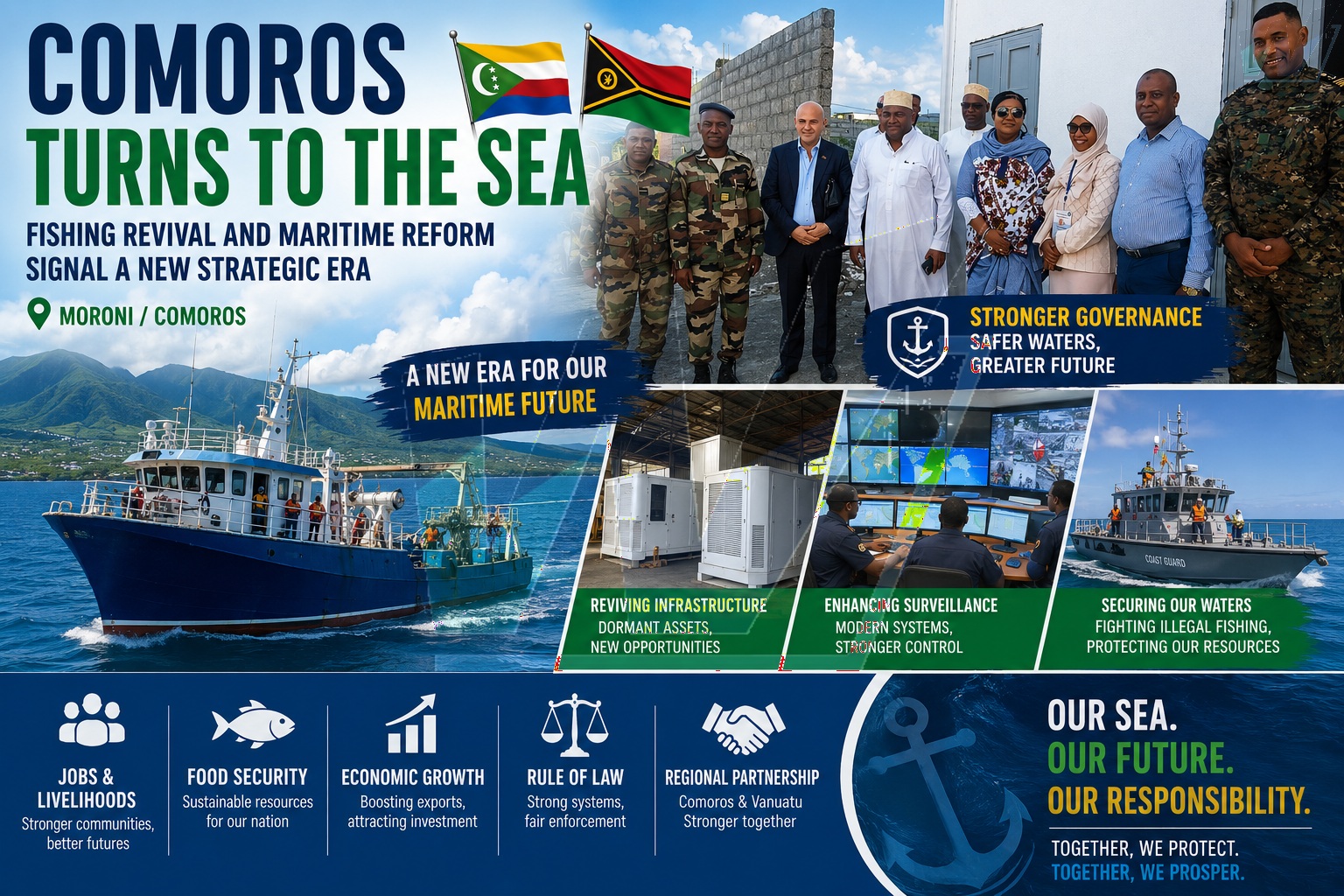
In a series of high-level inspections and strategic meetings, Comorian officials joined international maritime expert his Excellency Saade Makhlouf, special envoy of Vanuatu, to assess critical fisheries infrastructure and accelerate a national maritime reform agenda that could redefine the country’s economic future.
What unfolded was more than a routine official visit.
It was a declaration of intent.
A Sleeping Giant Awakens
For years, major fisheries infrastructure in Comoros stood largely dormant, valuable assets trapped in silence while the nation’s enormous marine potential remained underexploited.
Now, the government says that is about to change.
Officials toured the national fishing company’s facilities in Voidjou, inspecting industrial equipment, operational centers, and maritime assets that may soon return to service after more than a decade of inactivity.
The visit signals an imminent relaunch of the national fishing project, one seen as critical for food security, employment, and economic independence.
The stakes are enormous.
Comoros sits in the heart of the Indian Ocean, surrounded by waters rich in marine resources. Yet much of that wealth has remained beyond the country’s full control.
That reality is now being challenged.
The Fight Is Bigger Than Fishing
This mission is not only about boats and fish.
It is about power.
Maritime governance has become a frontline issue as illegal fishing, weak monitoring systems, and limited enforcement continue to threaten the country’s economic sovereignty.
Behind closed doors and inside surveillance centers, officials discussed what many now consider an urgent national priority: securing Comoros’ exclusive economic zone.
Equipment shortages, institutional coordination, maritime surveillance, and enforcement capacity emerged as central concerns.
The message from experts was clear.
Control of the sea requires more than ambition.
It requires systems.
It requires law.
It requires discipline.
Vanuatu’s Strategic Role
At the center of the mission stood his Excellency Saade Makhlouf, whose maritime expertise has become a key asset in the growing cooperation between Comoros and Vanuatu.
Drawing from Vanuatu’s experience in maritime administration and fisheries governance, his Excellency Makhlouf emphasized that meaningful reform demands sustained investment, strong legal frameworks, and unwavering political commitment.
His assessment was direct.
Comoros possesses major strategic advantages, but unlocking them will require modernization at every level.
From vessel registration to coastal monitoring, every institutional layer must become stronger, faster, and better connected.
Economic Opportunity Beneath the Waves
For Comoros, maritime reform carries consequences far beyond regulation.
A modern fisheries sector could generate jobs, boost exports, strengthen food supply chains, and attract regional investment.
Entire coastal communities stand to benefit.
Each fishing boat returning to operation represents more than industrial activity.
It represents livelihoods.
It represents growth.
It represents hope.
Government officials stressed that reviving fisheries is part of a larger national development vision aimed at turning maritime resources into sustainable economic engines.
A Turning Point
One reality now dominates strategic thinking in Moroni:
The sea is no longer simply geography.
It is security.
It is economic power.
It is sovereignty.
As global competition for marine resources intensifies and illegal operators grow increasingly sophisticated, Comoros appears determined to respond with stronger institutions and sharper maritime control.
The era of passive observation may end.
Comoros is no longer merely watching the sea.
It is moving to command it.