
Iranian missiles hit two communities in southern Israel late Saturday, leaving buildings destroyed and dozens injured in strikes carried out not far from Israel’s main nuclear research facility. The attacks followed earlier strikes on Iran’s Natanz nuclear enrichment site and marked a sharp escalation in the widening conflict.
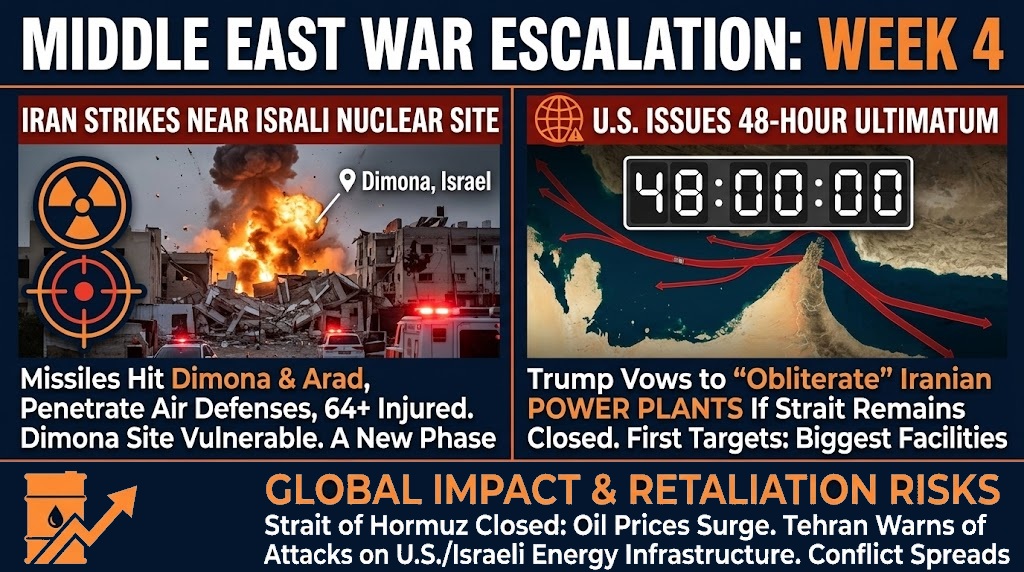
At the same time, U.S. President Donald Trump warned that Washington would “obliterate” Iranian power plants if Tehran failed to fully reopen the Strait of Hormuz within 48 hours. Posting on social media from Florida, Trump said Iran must allow free passage through the strategic waterway or face a new wave of strikes, adding that the U.S. could target “various POWER PLANTS, STARTING WITH THE BIGGEST ONE FIRST.”
The ultimatum comes amid rising domestic pressure in the U.S. as surging oil prices intensify concerns over global energy flows. The Strait of Hormuz, a critical transit route linking the Persian Gulf to global markets, has seen severe disruptions due to attacks on commercial shipping, prompting fears of broader supply chain shocks.
Iran, in turn, warned early Sunday that any strike on its energy infrastructure would trigger retaliatory attacks on U.S. and Israeli energy facilities across the region, according to statements carried by Iranian state media and semi-official outlets.
The Iranian strikes inside Israel hit Dimona and Arad, two southern cities near Israel’s Negev Desert, close to its main nuclear research center. Israeli authorities said some missiles were not intercepted, marking the first reported penetration of air defenses in the area around the facility.
Israeli emergency services reported extensive damage, particularly in Arad, where at least 10 apartment buildings were affected and several were left at risk of collapse. At least 64 people were taken to hospital. Prime Minister Benjamin Netanyahu described the situation as “a very difficult evening,” as rescue teams were deployed to the affected areas.
Iranian officials framed the strikes as a shift in the conflict’s dynamics, with Parliament Speaker Mohammad Bagher Ghalibaf warning that failure to intercept missiles in heavily protected areas signaled a “new phase” of warfare.
Elsewhere, Iran reportedly targeted the joint U.S.-U.K. Diego Garcia base in the Indian Ocean, raising questions about the range and capability of its missile arsenal. Western officials did not confirm significant damage, while analysts debated whether the strike involved extended-range systems or space-launch adaptations.
The conflict, now entering its fourth week, has increasingly impacted global energy markets. Multiple shipping disruptions in the Strait of Hormuz have reduced tanker traffic, forcing production adjustments among major oil exporters and contributing to rising prices worldwide.
Military officials on both sides have signaled further escalation. Israel’s army chief, Gen. Eyal Zamir, warned earlier that the war was “not close to ending,” while reports indicated continued Israeli operations against Iranian-linked targets.
The United Nations nuclear watchdog said it had received no reports of damage or abnormal radiation levels at Israel’s nuclear research site. Meanwhile, uncertainty persists over the broader nuclear situation in Iran, following repeated strikes on facilities including Natanz.
As tensions escalate across multiple fronts, Gulf states and international partners have increased diplomatic efforts to secure maritime routes, while the United States has expanded its military presence in the region.