

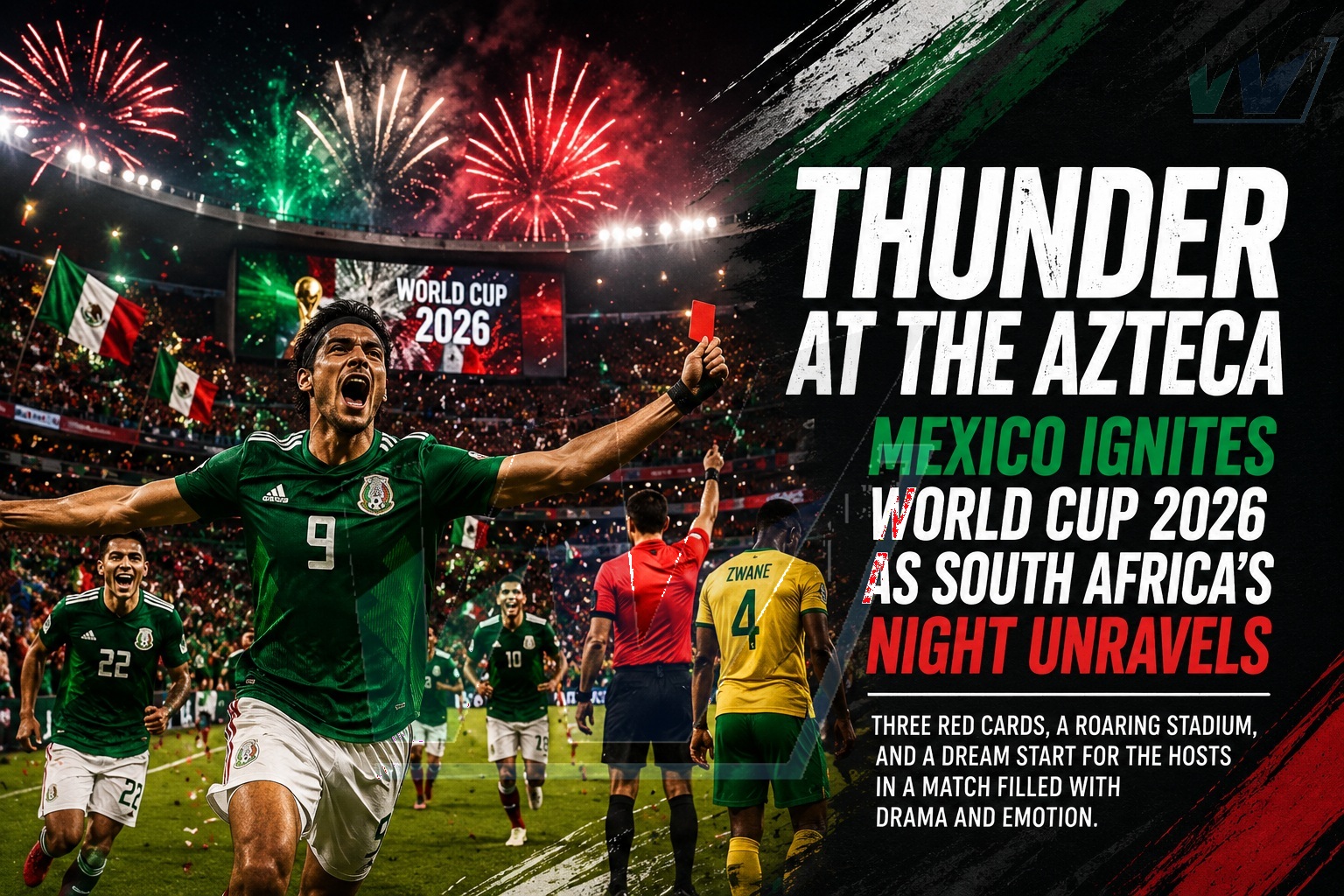
Three Red Cards, a Roaring Stadium, and a Dream Start for the Hosts in a Match Filled with Drama and Emotion
MEXICO CITY — Long before the first whistle pierced the warm evening air above the Azteca Stadium, the night already felt historic.
Fireworks exploded over the skyline of Mexico City. Red, green, and white smoke drifted across the stands. Giant screens flashed images of football legends and World Cup glory. Tens of thousands of supporters waved flags in synchronized waves, creating a living sea of color that stretched from one end of the colossal stadium to the other.
Then came the sound.
Eighty thousand voices rose as one.
A thunderous roar.
A warning.
The 2026 FIFA World Cup had begun.
And Mexico was determined to make sure the world remembered the opening night.
When the spotlight finally settled on the pitch, the co-host nation wasted no time turning anticipation into celebration, defeating South Africa 2-0 in a match that combined relentless pressure, historic moments, red cards, controversy, and enough drama to set the tone for an unforgettable tournament.
By the final whistle, South Africa had been reduced to nine men, the Azteca was shaking beneath the weight of celebration, and Mexico had announced itself as a team capable of dreaming big.
The Perfect Beginning
The opening moments felt almost surreal.
The smoke from the pre-match pyrotechnics had barely disappeared when Mexico launched forward with purpose.
Every pass was greeted by cheers.
Every challenge was met with deafening approval.
The atmosphere was not merely intimidating, it was overwhelming.
South Africa entered the match knowing exactly what awaited them. Their coaching staff had spent days warning about the intensity of the Azteca and the emotional force generated by a full house.
Nothing, however, could truly prepare them for the reality.
Nine minutes into the match, disaster struck.
Attempting to build from the back under intense pressure, South Africa hesitated for a fraction of a second.
That was all Mexico needed.
Julian Quiñones pounced.
The forward seized possession, accelerated into space, and unleashed a low drive that slipped through the legs of goalkeeper Ronwen Williams before nestling inside the net.
For a brief instant there was silence, the kind that exists only before an explosion.
Then the Azteca erupted.
The roar seemed to shake the concrete foundations of the stadium itself.
Players sprinted toward the corner flag.
Supporters embraced strangers.
Flags spun wildly through the air.
The first goal of the 2026 World Cup belonged to Mexico.
And suddenly the dream had become reality.
A Stadium Becomes a Weapon
What followed was not simply football.
It was siege warfare.
Mexico controlled possession with confidence and composure, moving the ball across the field with the certainty of a team feeding off the energy of its supporters.
Every successful pass was celebrated with chants of “Ole!”
The sound echoed around the stadium repeatedly.
“Ole!”
“Ole!”
“Ole!”
For South Africa, the noise became a constant companion.
A reminder that every touch was being judged by eighty thousand pairs of eyes.
A reminder that every mistake would be amplified.
The visitors struggled to establish rhythm.
Passes drifted astray.
Attacks dissolved before they could form.
Defenders found themselves under relentless pressure from wave after wave of Mexican advances.
Despite trailing, South Africa somehow reached halftime with only a one-goal deficit.
Yet there was a growing sense that the match was slipping beyond their control.
The second half would confirm those fears.
The Turning Point
Four minutes after the restart, the contest changed completely.
A dangerous ball released Mexico’s Brian Gutiérrez behind the South African defense.
The young attacker raced clear with only the goalkeeper standing between him and a golden opportunity.
Sphephelo Sithole knew the danger.
He also knew he had been beaten.
Desperate to stop the attack, he brought Gutiérrez down.
The referee had little choice.
Red card.
No hesitation.
No debate.
Midfielder’s evening was over.
As the card was raised high into the night sky, South African players protested briefly before accepting the inevitable.
The mountain they had been climbing suddenly became steeper.
Now they would have to survive with ten men.
Inside the stadium, Mexican supporters sensed blood.
The volume increased.
The pressure intensified.
The game tilted even further toward the hosts.
The Counterattack That Broke South Africa
For twenty minutes South Africa resisted.
They chased.
They tackled.
They fought to keep their World Cup hopes alive.
But football can be cruel.
Especially when fatigue begins to spread through tired legs.
In the 67th minute, Mexico delivered the decisive blow.
The move began deep inside their own half.
One pass became two.
Two became three.
Suddenly green shirts were flooding forward.
The counterattack gathered speed like a train racing downhill.
Roberto Alvarado surged down the right flank before lifting a perfectly weighted cross toward the far post.
Waiting there was Raúl Jiménez.
The veteran striker timed his run to perfection.
He rose above the defense.
The stadium seemed to hold its breath.
Then came the header.
Powerful.
Precise.
Unstoppable.
The ball crashed into the net.
2-0.
Game over.
Jiménez sprinted toward the crowd, arms outstretched, soaking in the deafening applause.
The celebration carried the emotion of a player who understood the significance of the moment.
Not just another goal.
Not just another victory.
A World Cup goal on home soil.
A memory destined to last forever.
From Difficult to Impossible
If South Africa’s task had been difficult before, it soon became impossible.
With six minutes remaining, another flashpoint erupted.
A challenge involving Alvarado and veteran South African playmaker Themba Zwane sent players from both teams rushing toward the referee.
The official initially allowed play to continue.
Then came the signal.
VAR review.
The stadium screens replayed the incident.
Fans watched in anticipation.
The referee approached the monitor.
Seconds felt like minutes.
When he turned back toward the pitch, the verdict was devastating for South Africa.
Red card.
Zwane had been judged to have struck Alvarado in the face with his arm.
The visitors were reduced to nine men.
Disbelief spread across their bench.
Frustration was visible on the faces of players who knew the match had slipped beyond recovery.
Mexico, meanwhile, continued to attack.
The crowd demanded more.
The players responded.
Every touch generated applause.
Every attack generated excitement.
The opening night had become a celebration.
One Final Twist
Yet football rarely allows a night to end without one final surprise.
Deep into stoppage time, Mexico’s César Montes launched into an awkward challenge near the edge of the penalty area.
The tackle was late.
The referee reached for his pocket.
Another red card.
This time against Mexico.
The decision briefly interrupted the festivities and provided South Africa with a small measure of consolation.
But it changed nothing about the outcome.
The result had already been decided.
The story had already been written.
Mexico had delivered exactly what its supporters wanted.
A victory.
A statement.
A dream beginning.
A Message to the World
As the final whistle echoed around the Azteca, players embraced beneath the bright lights while supporters celebrated long into the night.
The scoreline alone told only part of the story.
This was about more than three points.
More than Group A.
More than an opening match.
It was about belief.
Mexico entered the tournament carrying the hopes of a nation and the expectations that accompany hosting football’s greatest event.
On opening night, they did not merely win.
They were captivated.
They dominated.
They energized the entire World Cup.
The road ahead remains long. Stronger opponents will come. Greater tests await.
But for one unforgettable evening in Mexico City, none of that mattered.
The fireworks had faded.
The smoke had cleared.
The celebrations echoed into the night.
And as supporters streamed into the streets surrounding the Azteca, one message lingered above all others:
The 2026 World Cup is underway.
And Mexico has arrived.