
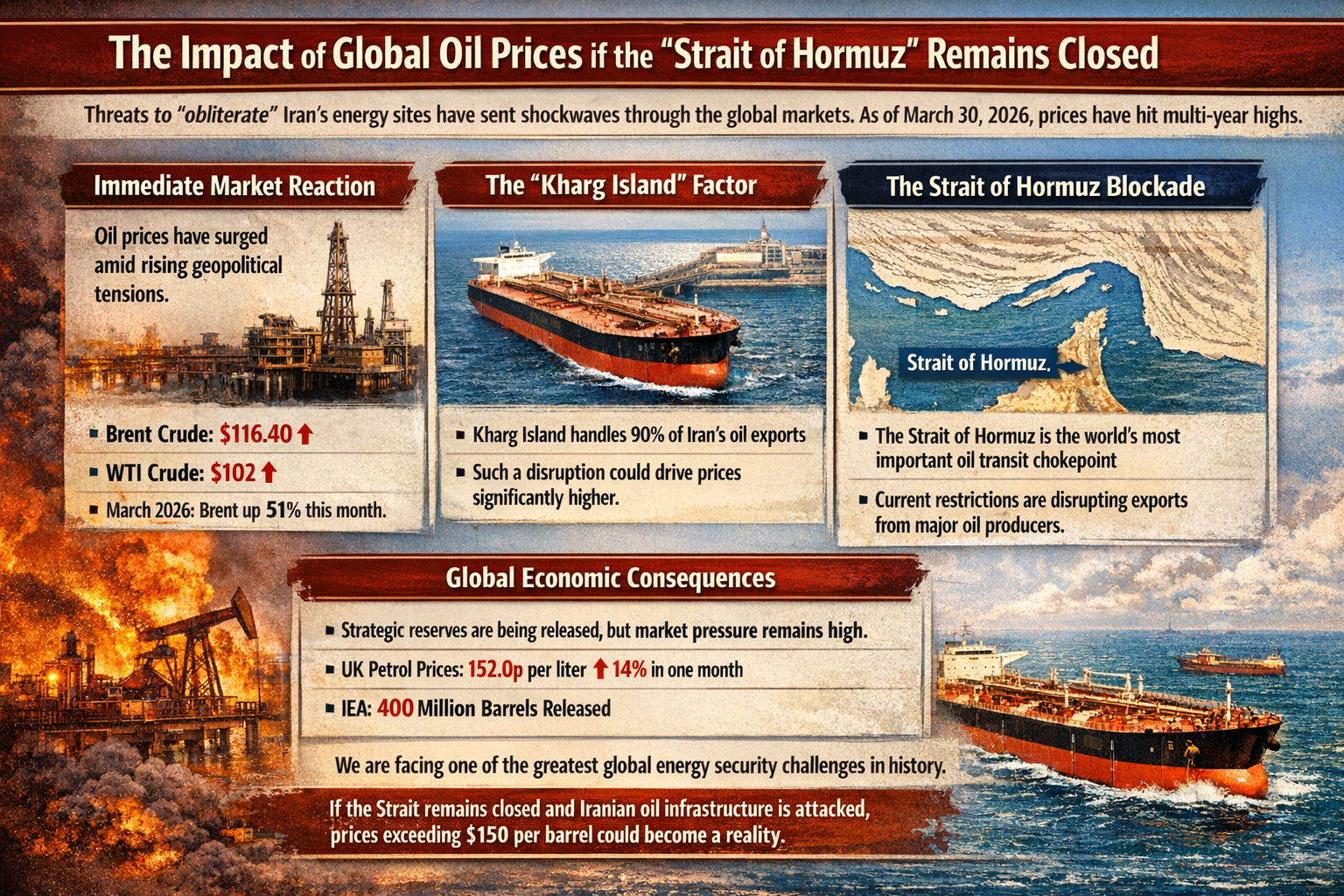
The threat to “obliterate” Iran’s energy infrastructure, specifically Kharg Island and its oil wells, has sent shockwaves through the global energy market. As of March 30, 2026, the situation has already pushed prices to multi-year highs, and a fulfillment of this threat could lead to a historic price shock.
1. Immediate Market Reaction
Oil prices have already spiked following the President’s ultimatum.
Brent Crude: Rose over 3% this morning, trading around $116.40 per barrel.
WTI Crude: Surged to over $102 per barrel.
Monthly Surge: March 2026 is on track to be the biggest monthly gain for oil on record, with Brent climbing roughly 51% since the conflict began.
2. The “Kharg Island” Factor
Kharg Island is Iran’s primary oil export terminal, handling approximately 90% of its exports.
Supply Loss: Total destruction would permanently remove nearly 1.6 to 3 million barrels per day (mb/d) from the market.
Price Forecasts: Analysts from Chatham House and JP Morgan suggest that if Kharg Island is taken offline, prices could soar past $150 per barrel, as this supply would be nearly impossible to replace quickly.
3. The Strait of Hormuz Blockade
The President’s threat is tied specifically to the reopening of the Strait of Hormuz, the world’s most important oil chokepoint.
The Chokepoint: Around 20% of global oil consumption (20 million barrels per day) typically flows through this narrow passage.
Current Status: The Strait is effectively closed to Western-allied traffic, stranding millions of barrels from Saudi Arabia, Kuwait, and the UAE.
Regional Force Majeure: Major producers like Qatar and Kuwait have already declared force majeure on contracts because they cannot ship their product, causing a global “supply emergency.”
4. Global Economic Consequences
The combination of the blockade and the threat of infrastructure destruction has created a “perfect storm”:
Inflation: In the UK, petrol prices have jumped 14% in just one month, hitting 152.0p per liter.
Emergency Reserves: The International Energy Agency (IEA) has already authorized the release of 400 million barrels from strategic reserves, but even this record-breaking move has failed to stop the price climb.
The “Tailspin” Risk: Unlike previous disruptions, the permanent destruction of refining and export infrastructure (rather than just a temporary blockade) would ensure that high prices remain for years, potentially triggering a global recession.
To summarize, we are currently seeing the “greatest global energy security challenge in history.” If the Strait remains closed and the U.S. proceeds with strikes on Iranian oil wells, $150+ per barrel becomes a very real possibility.